

How to Run a Fundraise Without Losing Three Months of Founder Focus
- A sound Fundraising Strategy protects the one asset a raise quietly consumes: the founder's attention. Run it as a defined project, not an open-ended errand.
- Most rounds sprawl to six months or more, and roughly half of that is preparation and closing mechanics that can be compressed before you ever meet an investor.
- The founders who keep growing through a raise do three things: they finish the prep before going live, they run outreach like a time-boxed sales pipeline, and they delegate everything that is not the pitch itself.
- Batching investor conversations into a tight window manufactures the urgency that shortens the process and lifts your leverage at the term sheet.
- Treat the close like the beginning of the next raise: clean diligence, disciplined investor updates, and a data room that never goes stale.
Raising capital is the most expensive thing a founder does that never shows up on the income statement. The money you spend is time, and a fundraise has an appetite for it. I have watched capable CEOs of eight-figure companies disappear into a raise for a quarter, resurface with a term sheet, and find that growth stalled while they were gone. The round closed. The business drifted. That trade is not inevitable. A deliberate Fundraising Strategy treats the raise as a bounded operating problem, and the goal of this piece is to give you the operating system that compresses it, so the raise moves fast and the business keeps moving with it.

Why a Loose Fundraising Strategy Sprawls Into a Lost Quarter
Raises sprawl because founders start them before they are ready and run them without a clock. The end-to-end venture process typically runs about six months: one to two months to prepare materials and a data room, two to three months for outreach and meetings, and two to three months to close Nikolay Anev. When none of those phases has a deadline, each one expands to fill the founder's calendar.
The environment makes drift more expensive. Global startup funding fell to $285 billion in 2023, down 38 percent from $462 billion the prior year, and a tighter market means investors are slower and more selective Crunchbase News. A slow process in a slow market is how a two-month raise becomes a lost quarter. And because the gap between rounds tends to run 12 to 18 months, a founder who runs every raise inefficiently is effectively fundraising a third of the time, forever Silicon Valley Bank.
The hidden cost is not the hours in investor meetings. It is the context-switching tax. A founder who checks out of pricing decisions, key hires, and pipeline reviews for ninety days leaves a vacuum that no one else is authorized to fill. The raise is visible. The stall is not, until the next board meeting.

The Pre-Work That Compresses the Timeline
The single highest-leverage move is to finish all preparation before you go live. Specialists advise dedicating one to two months purely to prep, cleaning financials, building the model, and assembling the data room, so the live process can be compressed to roughly four months Nikolay Anev. The mistake is doing this work while the process is already running, which forces you to negotiate with investors and build your own deck in the same week.
Pre-work means the deck, the model, and the data room are done and internally stress-tested before the first outreach email. A live process has no patience for a founder who is still reconciling last year's numbers. When an interested investor asks for cohort retention or a cap table, the answer is a link, not a three-day scramble. I go deep on what that room needs to contain in investor readiness and the data room that closes term sheets, and the discipline there is what makes everything downstream fast.
Timing is part of the pre-work too. Fundraising has clear on and off seasons: the strongest windows run mid-January to mid-May and September to November, while June through August and December tend to produce longer cycles and slower decisions Forum Ventures. Launching into a dead window is a self-inflicted delay. If you are mapping your own calendar, I walk through it in building your 2026 raise calendar around investor timing.
Running Your Fundraising Strategy Like a Sales Pipeline
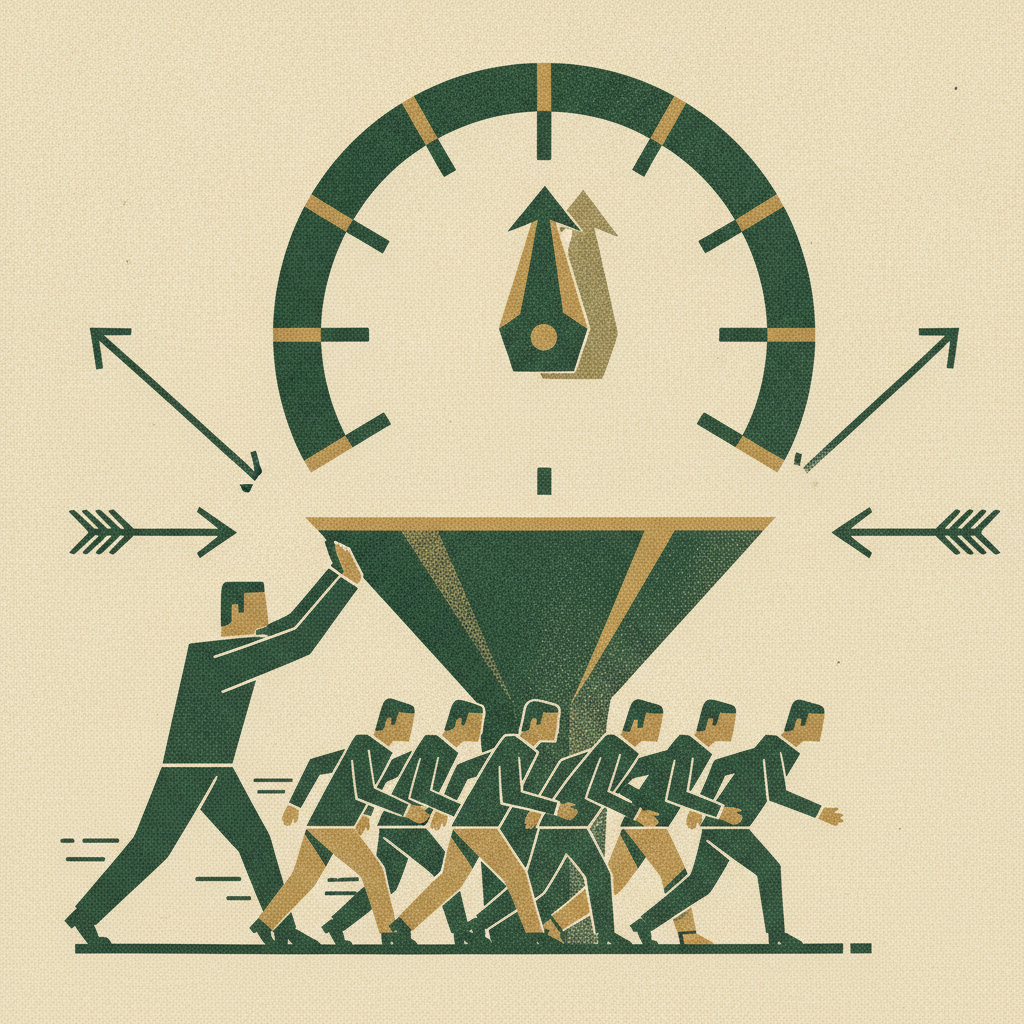
An efficient raise is a sales process with a compressed close date, and it should be managed like one. That means a real pipeline: a named list of target investors, a stage for each (contacted, met, diligence, term sheet), a weekly conversion review, and a forcing function on the calendar. Founders who run it loosely take meetings as they come and let the round drift for a year. Founders who run it tight batch their conversations.
Batching is the mechanism that manufactures urgency. Practitioners recommend concentrating 20 to 30 investor pitches into a roughly two-week sprint so that interest compounds and competitive tension is real rather than theatrical Forum Ventures. When every investor knows others are looking at the same window, the process runs on your timeline instead of theirs. Spread those same 30 meetings across four months and you get the opposite: each investor assumes they have all the time in the world, and so do you.
Expect the funnel to be wide. It is normal to hold dozens of meetings to reach a single term sheet, which means your target list has to be built for volume, not for a handful of dream funds. Treat the "no" replies as data that sharpens the pitch for the next batch, exactly as you would iterate a sales script. The pipeline is the artifact that keeps the whole thing honest and keeps you from mistaking activity for progress.

Delegating So the Business Keeps Moving
The reason a raise costs a quarter of growth is that founders treat every task in it as theirs. Most of it is not. The pitch itself, the relationships, and the final negotiation are non-transferable. Nearly everything else, the model updates, the data-room maintenance, the diligence request tracking, the scheduling, the reference coordination, can and should sit with someone else.
This is precisely where a fractional CFO earns the engagement. While the founder runs the meetings, the CFO runs the machinery: keeping the model current as investors probe it, answering diligence questions with clean support, and managing the checklist so nothing stalls the close. That division of labor is what lets the founder stay partly in the business, protecting the pricing calls, key hires, and customer relationships that would otherwise decay. Keeping the operating rhythm alive during a raise is a cash and forecasting discipline as much as a leadership one, which is why a live 13-week cash flow forecast matters most in exactly the months you are least available to build one.
Delegation also protects the raise itself. Investors read founder bandwidth as a signal. A CEO who can run a tight process and still ship product and hit numbers is demonstrating the exact operating maturity that diligence is trying to confirm.

Closing Without Losing Leverage
The close is where compressed processes quietly leak weeks. Even after a yes, the closing phase alone routinely runs two to three months of due diligence, legal, and final docs before money hits the account Nikolay Anev. That stretch is where leverage erodes, because the longer diligence drags, the more time market conditions or a competing crisis have to change the terms.
Protecting leverage at the close comes down to preparation you already did and pace you refuse to surrender. A clean, complete data room means diligence confirms rather than discovers, and confirmation is fast. Hold the timeline you set during outreach: a term sheet with a defined signing window keeps the competitive tension you built from evaporating the moment one investor leans in. Concessions made to end a slow close are the most expensive concessions in the round.
Then treat the close as the start of the next raise. Founders who keep a standing cadence of investor updates and a data room that never goes stale walk into their next round with the prep already done, which is the whole point. A disciplined Fundraising Strategy is not a sprint you survive once. It is a repeatable process that gets cheaper in founder time every cycle you run it well.

Frequently Asked Questions
How Long Does a Fundraise Take?
Plan for about six months end to end: one to two months of preparation, two to three months of outreach and meetings, and two to three months to close. In practice the live window from first investor meeting to close runs anywhere from two to six months, with the range driven mostly by how much prep was done in advance and how tightly the process is run.
How Do You Run an Efficient Fundraising Process?
Finish all preparation before going live, build a named investor pipeline with stages and a weekly review, and batch your pitches into a short sprint to create urgency. Manage it like a sales process with a compressed close date rather than an open-ended series of coffees.
How Do You Keep the Business Growing During a Raise?
Delegate everything that is not the pitch, the relationships, or the final negotiation. A fractional CFO can run the model, the data room, and diligence tracking while the founder protects pricing, hiring, and customer decisions, so the operating rhythm survives the quarter.
How Many Investors Should You Pitch?
Build the list for volume. A common benchmark is 20 to 30 targeted pitches concentrated into a roughly two-week window, since it typically takes dozens of meetings to reach a single term sheet.
How Do You Create Urgency in a Fundraise?
Compress the process in time. Batching many investor conversations into a tight window makes competitive tension real, so investors move on your timeline. A dead-season launch or a process spread thin across months does the opposite.
References
