

Pricing Changes and Cash: Modeling a Price Increase Before You Make It
- A price increase is a cash decision before it is a marketing one. The question is not "will customers be upset," it is whether the extra contribution margin per unit outweighs the volume you lose and the timing lag before the cash actually lands.
- The math is friendlier than most owners fear. On a product carrying a $22 contribution margin, a $10 increase lets you lose roughly 31 percent of your volume before total contribution dollars even start to fall, so the break-even loss is almost always larger than the real loss.
- Churn scales with the size of the move, not the fact of it. Median churn lift runs about +0.8 points for a 5 to 10 percent raise and only turns net negative above 25 percent, which means moderate, well-sequenced increases usually pay.
- Cash shows up on a delay. A higher price only "cashes up" when the next invoice or renewal bills, so on annual or lagging-collection accounts the margin gain can trail the decision by a full billing cycle.
- Model it, test it on a cohort, then roll it out with guardrails: notice periods and optional grandfathering. My team runs this on the Greenwood Engagement Model, moving from the Diagnostic to the Operating Cadence so the number is stress-tested before the notice ever goes out.
Most owners treat a price increase as a marketing event. You pick a number, you draft an email, you brace for angry replies, and you hope revenue goes up. That framing is where the money leaks out. A price change is really a cash decision wearing a marketing costume, and the reason it deserves a model is that every lever it pulls (contribution margin, volume, churn, and the timing of collections) lands on your cash flow at a different moment and a different size. Get the sequence right and a modest increase is one of the cheapest sources of enterprise value you will ever find. Get it wrong and you can hand back the entire gain to involuntary churn you never modeled. This is a walk through how I model a price increase for a company north of $5M in revenue, before anyone touches the send button.
Pricing as a Cash Decision
Treat a price increase as a cash decision, not a branding exercise, because price is the single highest-leverage input to contribution margin you control. Contribution margin is just price minus variable cost, so when you raise price and your variable cost per unit does not move, almost the entire increase drops straight through to contribution. Nothing else on the P&L converts to margin that efficiently. Cutting costs is slow and finite; winning new logos is expensive and lagging; a price change reprices your whole book at once.
That leverage is exactly why it is dangerous to run on instinct. The same efficiency that makes a raise powerful makes a botched one expensive, because you are moving the number on every customer simultaneously. The discipline I bring to it is the one we use across cash work: decide what you are optimizing (contribution dollars, not vanity revenue), then model the levers that move it. If you have read our take on margin-first pricing, this is the cash-flow companion to it. Price is not a marketing knob you turn for growth optics. It is a margin knob, and margin is what turns into cash.
For context on how common these moves have become, 79 percent of IT buyers reported a SaaS price increase at renewal in the past year, with a median year-over-year bump of 7.8 percent, according to PricePulse's 2026 pricing report. Your customers are already absorbing increases from their other vendors. The interesting question is not whether you can raise price, it is how to model the move so the cash gain survives contact with reality.
Modeling Revenue and Churn Together
Model revenue and churn as one equation, never two, because the whole decision lives in the trade between higher margin per customer and fewer customers. The clean way to frame it is a break-even volume loss: how much volume can you afford to lose before the extra contribution from the higher price is fully offset? The formula is simple and it belongs on a whiteboard in every pricing meeting.
Break-even volume loss equals the price increase divided by the sum of your old contribution margin plus that increase. EightX's elasticity walkthrough runs the canonical example: a product with a $22 contribution margin gets a $10 increase, so new unit contribution is $32, and 10 divided by 32 is 31.25 percent. You could lose almost a third of your volume and still hold total contribution dollars flat. Most businesses do not lose anything close to that on a moderate, well-communicated raise, which is the entire point. The break-even loss is your margin of safety, and it is usually enormous.
Then layer in what churn actually does at different increase sizes, because elasticity is not linear. Benchmark data from Livmo's 2026 churn analysis puts the median churn lift at about +0.8 points for a 5 to 10 percent increase, +1.4 points for 10 to 15 percent, +2.9 points for 15 to 25 percent, and +5.1 points once you cross 25 percent, where the median move finally turns net negative. Read that curve carefully. It says the danger is not raising prices, it is raising them too far in one jump. A company that takes a disciplined 8 to 12 percent increase is playing in the part of the curve where the churn cost is a rounding error against the margin gain. The model I build for clients always shows both numbers side by side: the contribution you add per retained customer and the contribution you lose per churned one. When you can see the two columns together, the decision stops being emotional. If your contribution math is shaky to begin with, fix that first; our contribution margin primer is the place to start.
The Cash Timing Effect
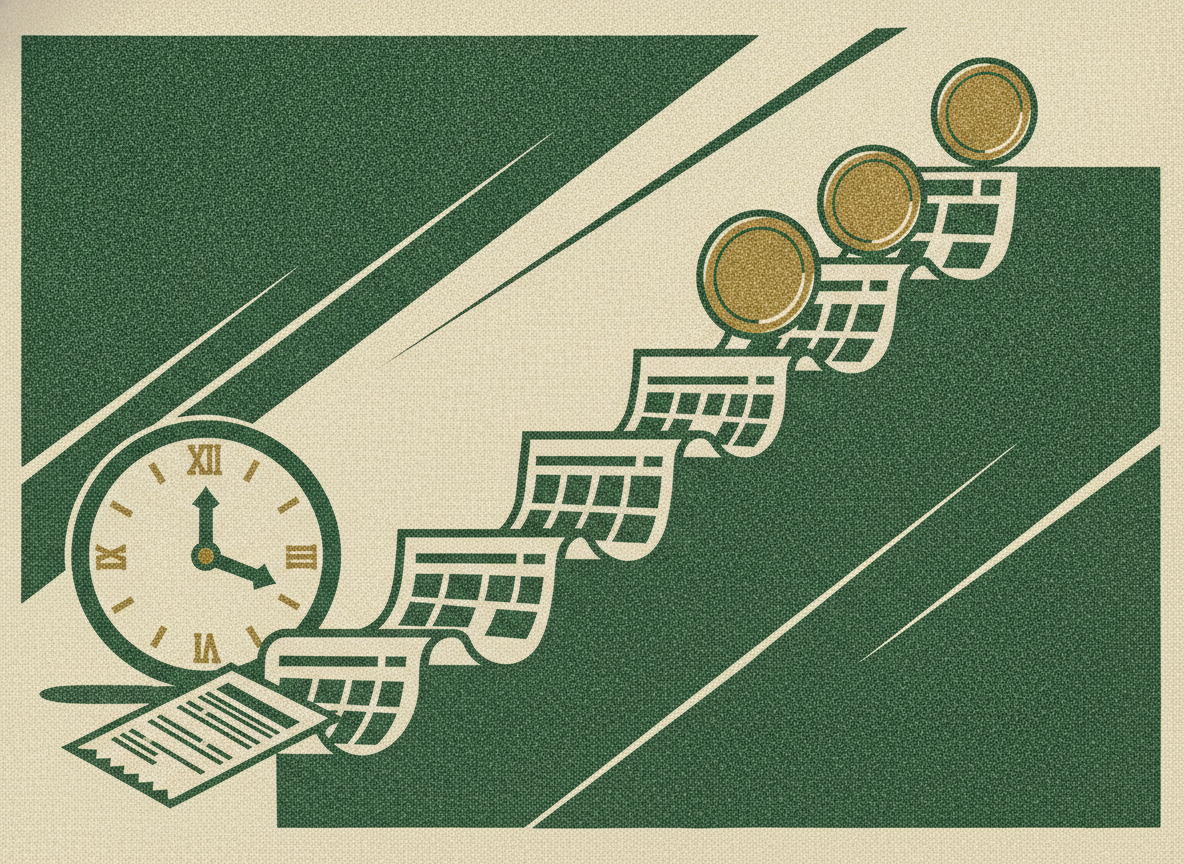
Expect the margin gain to arrive on a lag, because a price increase only turns into cash when the next invoice or renewal actually bills. This is the part almost every back-of-the-envelope model skips, and it is the part that determines whether your Q3 cash forecast is right. Higher prices improve profitability the moment they take effect on paper, but the cash does not move until billing catches up. Runway Forecaster's whitepaper on pricing and cash makes the point plainly: a price increase cashes up immediately only if you bill immediately, and on annual contracts or slow-collecting accounts the benefit can trail the decision by a full cycle.
Practically, that means you model the raise against your actual billing calendar, not a clean monthly average. If a third of your book renews in January and the rest is staggered, the cash impact of a January-effective increase is a staircase, not a step. Working capital adds another wrinkle: if a higher price slows sell-through in an inventory business, you can tie up cash in stock that sits longer, which partially offsets the margin win until volume normalizes. The timing view is where a price model connects to the 13-week cash flow forecast we build for volatile stretches. You are not just asking "is this raise accretive," you are asking "in which weeks does the accretion actually hit the bank," and those are very different questions when you are managing runway.

Testing Before You Commit
Test the increase on a slice of the book before you reprice everyone, because a live cohort beats a spreadsheet assumption every time. The elegant thing about pricing is that you rarely have to bet the whole book at once. You can raise prices for new customers first, or for one segment, or on one product line, and watch the real elasticity instead of guessing it. New-customer pricing is the lowest-risk test of all: nobody is being "taken away" anything, so you get a clean read on whether demand holds at the higher number with zero churn risk on your existing base.
When you do test on existing customers, watch the first few weeks closely, because a chunk of the early cancellations are not decisions at all. Churn Buster's 2026 analysis notes that a meaningful share of post-increase churn is front-loaded into the first two to four weeks and driven by failed payments rather than intentional cancellations. If you raise a price and a customer's card declines on the higher amount, that shows up in your data as churn, but it is really a dunning problem. Fix the involuntary layer (retry logic, card updaters, a human email) before you conclude the market rejected your price. I have watched companies abandon a perfectly good increase because they read failed-card noise as a demand signal. The test period exists precisely to separate the two, and to give you a defensible number to take into the full rollout.
Rolling Out With Guardrails
Roll out the increase with guardrails, because how you sequence the move affects churn as much as the size of the move. The two levers that matter most are notice period and grandfathering, and both have measurable effects. On notice, the 2026 SaaS price increase playbook reports that 90 or more days of warning holds churn to roughly 1.8 points above baseline, while no notice at all pushes it to 7 to 9 points. The email you send weeks ahead is not a courtesy, it is a churn-reduction instrument, and it is nearly free.
Grandfathering is the more expensive lever, and it is a genuine trade. The same playbook finds that grandfathering existing customers cuts immediate churn by about 67 percent but forfeits roughly 23 percent of the potential revenue uplift. That is not a reason to avoid it, it is a reason to model it. For a business where retention drives valuation and the base is loyal, buying a two-thirds reduction in churn for a quarter of the upside can be the right call, especially if you grandfather for a defined window rather than forever. For a business with a leaky base and low switching costs, you may take the full increase and invest the savings into fixing the leaks. This is the moment the price model stops being a math exercise and becomes a strategy decision, which is why my team runs it inside the Greenwood Engagement Model: the Diagnostic sizes the contribution and churn trade, the Operating Cadence tests it on a cohort and watches the weekly cash, and only then does the full notice go out. The point is to arrive at the send button already knowing the answer, not to find out afterward.

Frequently Asked Questions
How Do I Model a Price Increase?
Model it as one equation that combines margin and volume, not two separate guesses. Start with the break-even volume loss (the price increase divided by your old contribution margin plus that increase) to find how much volume you can afford to lose. Then overlay expected churn at that increase size, and finally map the margin gain onto your actual billing calendar so you know which weeks the cash lands. If those three layers still net positive, the raise is sound.
Will a Price Increase Hurt Cash Flow?
Usually it helps cash flow, but on a delay. The higher price improves contribution margin the moment it takes effect, yet the cash only moves when the next invoice or renewal bills, so on annual or slow-collecting accounts the benefit can trail the decision by a full cycle. In inventory businesses a raise can briefly tie up cash if it slows sell-through. Model the timing against your real billing schedule rather than a monthly average.
How Much Churn Can a Price Increase Cause?
Churn scales with the size of the increase, not the fact of it. Benchmark medians run about +0.8 points of churn for a 5 to 10 percent raise, +1.4 for 10 to 15 percent, +2.9 for 15 to 25 percent, and +5.1 once you pass 25 percent, where the move typically turns net negative. A meaningful slice of early churn is also involuntary (failed cards), so fix dunning before you judge the market's reaction.
Should I Grandfather Existing Customers?
Grandfathering is a trade you should model, not a default. It cuts immediate churn by roughly two-thirds but forfeits about a quarter of the revenue uplift, so it pays when retention drives your valuation and hurts when your base is leaky and low-commitment. A defined grandfathering window, rather than a permanent freeze, often captures most of the churn protection while still moving the base toward the new price over time.
How Much Notice Should I Give Before Raising Prices?
Give at least 90 days when you can. Longer notice periods hold churn close to baseline (around 1.8 points above it), while raising prices with no warning can push churn to 7 to 9 points above baseline. The advance notice is one of the cheapest churn-reduction tools available, so treat the announcement timeline as part of the financial model, not an afterthought.
References
