

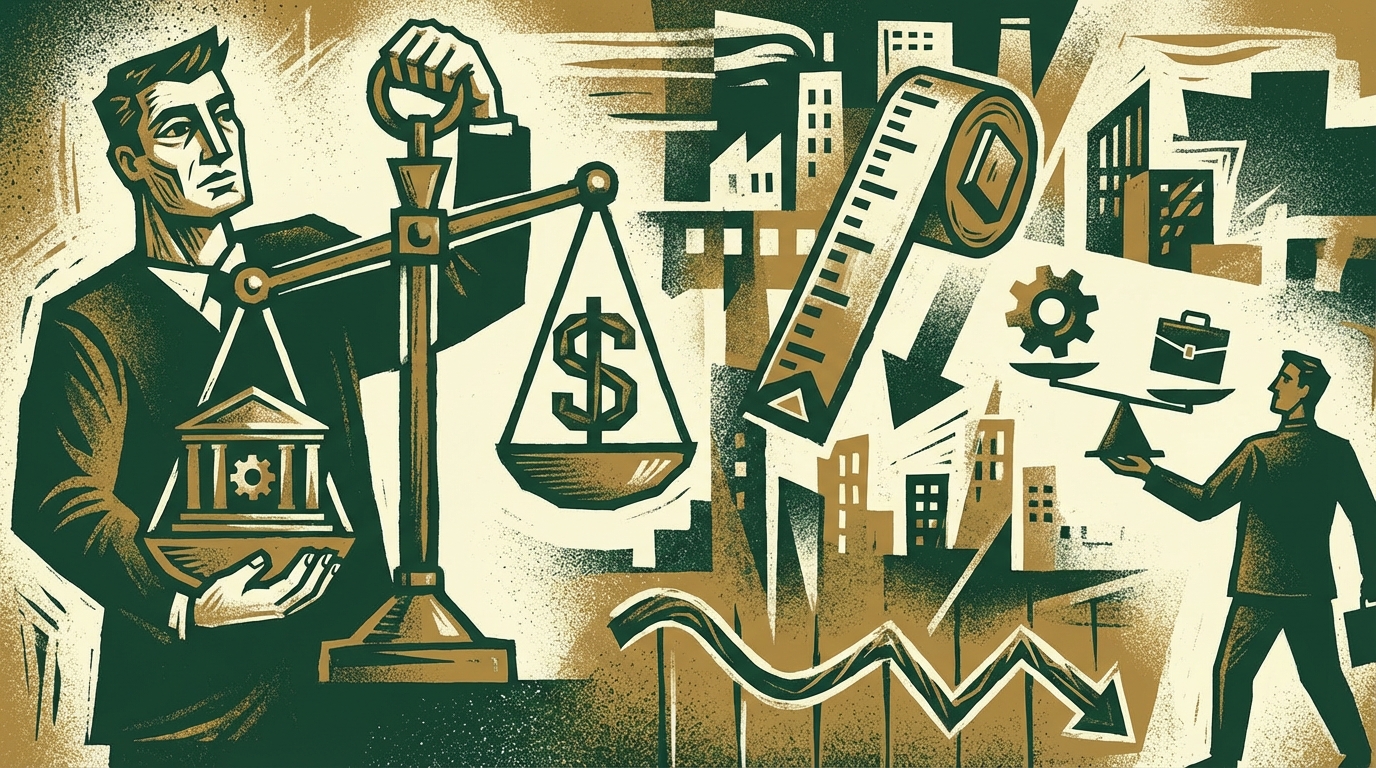
Valuation Reality Check: What Your Business Is Actually Worth
Published: 2026-02-14 • Estimated reading time: 9 min
I’ve sat across the table from hundreds of founders, brilliant people who built remarkable companies from nothing. And in nearly every first conversation about a potential sale, we hit the same wall. It’s a number. The number they’ve held in their head for years—what their business is “worth.” It’s often a beautiful, round, life-changing number. And it’s almost always wrong.
Founders dramatically overestimate their business value. It’s an epidemic of optimism born from confusing years of sweat equity with market-driven financial reality. My job isn’t to shatter dreams; it’s to inject a dose of reality so we can build a bridge from your number to the market’s number. A proper business valuation isn’t an art, and it’s not a feeling. It’s a disciplined financial exercise, determined by normalized earnings, risk, and what a specific type of buyer is willing to pay. Forget what you think it’s worth. Let’s talk about what the market will actually pay for it.
The Eye of the Beholder: Strategic vs. Financial Buyers
Strategic buyers are companies in your industry seeking synergies to grow their existing operations, while financial buyers are investors, like private equity firms, focused purely on generating a financial return. This distinction is the single most important factor in determining the ultimate price you’ll receive. Why? Because they aren’t shopping for the same thing.
A financial buyer—think a private equity group—looks at your company as a standalone asset. They model your future cash flows, stress-test your projections, and devise a plan to grow your EBITDA so they can sell the business in three to seven years for a higher multiple than they paid. They are disciplined, unemotional, and their valuation is tethered strictly to your P&L and balance sheet. According to recent PwC M&A outlooks, these buyers remain a dominant force, but their model is based on financial engineering and operational improvements.

A strategic buyer, on the other hand, is playing a different game. They’re a competitor, a supplier, or a company in an adjacent market. They look at your business and see not just what it is, but what it could be inside their ecosystem. They’re buying your customer list, your proprietary technology, your team’s talent, or your foothold in a new geographic area. These are “synergies,” and they are the magic dust of M&A. Research from McKinsey shows that strategic acquirers who consistently execute on synergies can deliver up to 12% higher total returns to shareholders. This is why they pay more. They’re not just buying your cash flow; they’re buying a puzzle piece that makes their own picture more valuable.
The EBITDA Multiple: The Industry Standard for Business Valuation
The EBITDA multiple is a common valuation metric that expresses a company’s enterprise value as a multiple of its Earnings Before Interest, Taxes, Depreciation, and Amortization. In the world of private mid-market deals, this is the lingua franca. Forget price-to-earnings or revenue multiples for a moment; buyers are acquiring your cash-generating power, and EBITDA is the industry’s favorite (if imperfect) proxy for that.
But it’s not your reported EBITDA that matters. It’s your normalized or adjusted EBITDA. My team and I spend a huge portion of our due diligence process on this. We add back the owner’s inflated salary, the family members on the payroll who don’t actually work there, the one-time legal settlement from two years ago, and the lease payments on the CEO’s Porsche. Normalizing EBITDA presents a true picture of the company’s ongoing profitability to a new owner. According to a 2026 trends report, middle-market companies are expected to see valuations in the 4-9x adjusted EBITDA range, a spread of millions of dollars driven by company-specific risk factors.

The multiple itself is determined by a cocktail of factors: industry, size, growth rate, and perceived risk. A software company with 85% recurring revenue will command a much higher multiple than a construction firm with lumpy, project-based contracts. Industry data from sources like NYU Stern provides a baseline, but the final number is negotiated based on your company’s unique story. And yes, the broader economy plays a huge role. In the current 2026 environment, higher interest rates make debt for acquisitions more expensive, which puts downward pressure on what all buyers, especially financial ones, can afford to pay. It’s a simple cost of capital reality.
The DCF: Theoretical vs. Practical Value
A Discounted Cash Flow (DCF) analysis is a business valuation method that values a company based on the present value of its projected future cash flows. On paper, it’s the purest form of valuation. You project a company’s free cash flow out for five or ten years, calculate a “terminal value” for all the years after that, and then discount all of that future money back to today’s dollars using a discount rate that reflects the investment’s risk.
It’s academically elegant. It’s also dangerously subjective. I’ve seen DCF models that can justify any valuation you want, simply by tweaking the growth rate assumption by half a percent or nudging the discount rate down. As the old saying goes, “garbage in, garbage out.”

In practice, my team and I use DCF not as a primary valuation tool, but as a sanity check. We build a DCF to understand the assumptions a buyer would have to believe to justify a certain EBITDA multiple. If a 7x EBITDA multiple requires a 20% annual growth assumption for the next decade in a mature market, we know the price is too rich. The DCF provides the theoretical framework, but the EBITDA multiple is where the rubber meets the road in actual deal negotiations.
The ‘Founder Premium’ and Why It Doesn’t Exist
The ‘founder premium’ is the misguided belief that the personal sacrifice, sleepless nights, and sweat equity invested by a founder should translate into a higher business valuation. It’s the most common and emotionally charged valuation myth I have to dismantle. A buyer is not acquiring your past; they are buying a predictable stream of future profits.
Your hard work created the asset, and for that, you should be immensely proud. But the value of that asset is determined by its ability to generate cash flow without you. In fact, the more central you are to the daily operations, customer relationships, and strategic decisions, the less valuable your company is. This is called key-person risk, and it’s a valuation killer. A buyer sees a business dependent on its founder and immediately starts discounting the price for the risk that the magic will walk out the door the day the deal closes.
In my experience, the moment a founder stops thinking about their past sacrifice and starts thinking like a future buyer is the moment they begin to build real, transferable value. - Winn Greenwood
I once worked with a founder of a $15M manufacturing business who was the lead salesperson, the primary engineer, and the only one with the key supplier relationships. He expected a premium for his indispensable role. We had to show him that a buyer would view him not as an asset, but as the single biggest liability. We spent the next two years building a management team around him, documenting processes, and transferring relationships. The work increased the final purchase price by nearly 3x. He sold a system, not a job.
Increasing Value: The Levers You Control
You can systematically increase your company’s valuation by focusing on key operational drivers like strengthening recurring revenue, diversifying your customer base, and building a strong management team. The valuation multiple isn’t just a number assigned by the market; it’s a grade on the quality and durability of your business. Improving that grade is entirely within your control.

Fortify Recurring Revenue
Recurring revenue is revenue that is predictable, stable, and likely to continue in the future. Buyers pay enormous premiums for predictability. A dollar of recurring revenue from a SaaS subscription or a long-term service contract is worth multiples of a dollar from a one-off project. If you can, shift your business model toward contracts, subscriptions, and retainers. This single act can fundamentally change your valuation narrative.
De-Risk Customer Concentration
Customer concentration risk refers to the danger of having a large portion of your revenue come from a very small number of customers. If a single client represents more than 15-20% of your sales, a buyer will see a massive red flag, according to analysis from M&A advisors like BMI Mergers. What happens if that customer leaves? Your company’s value could be cut in half overnight. Actively pursue a strategy to diversify your client base to ensure no single customer has that kind of leverage over your future.
Eliminate Founder Dependence
As discussed, a business that can’t run without you is a business that can’t be sold for its maximum value. The goal is to make yourself obsolete. You need to build a strong second-in-command and a management team that can handle day-to-day operations. Document every key process, from sales to fulfillment. The more your company looks like a well-oiled machine and less like a one-person show, the more a buyer will pay for it.
Frequently Asked Questions about Business Valuation
What are the primary valuation methods for private companies?
The three primary business valuation methods are the Market Approach (using comparable company analysis and EBITDA multiples), the Income Approach (like a Discounted Cash Flow or DCF analysis), and the Asset Approach (valuing tangible and intangible assets, typically used for liquidations).
How much is a business worth based on revenue?
While sometimes used for early-stage tech or SaaS companies, revenue multiples are less common for established, profitable businesses. Buyers are more interested in profitability (EBITDA) because revenue can be misleading. A $20M company with 5% margins is far less valuable than a $10M company with 30% margins.
What is a good EBITDA multiple for a mid-market company?
A typical EBITDA multiple for a mid-market business in 2026 is between 4x and 9x. The exact multiple depends heavily on factors like industry, growth rate, customer concentration, management depth, and the percentage of recurring revenue.
How do intangible assets like brand and IP affect business valuation?
Intangible assets significantly impact valuation, though often indirectly through their effect on profitability and competitive advantage. According to an Ocean Tomo study, intangible assets account for over 90% of the S&P 500’s value. For private companies, a strong brand, patented technology, or proprietary software translates into higher margins and a stronger competitive moat, which in turn justifies a higher EBITDA multiple.
References
https://www.pwc.com/us/en/services/consulting/deals/outlook.html
https://quistvaluation.com/resources/business-valuation-trends-2026/
https://pages.stern.nyu.edu/~adamodar/New_Home_Page/datafile/vebitda.html
https://www.bmimergers.com/concentration-can-significantly-impact-valuations/
https://oceantomo.com/insights/ocean-tomo-releases-2025-intangible-asset-market-value-study-results/
