
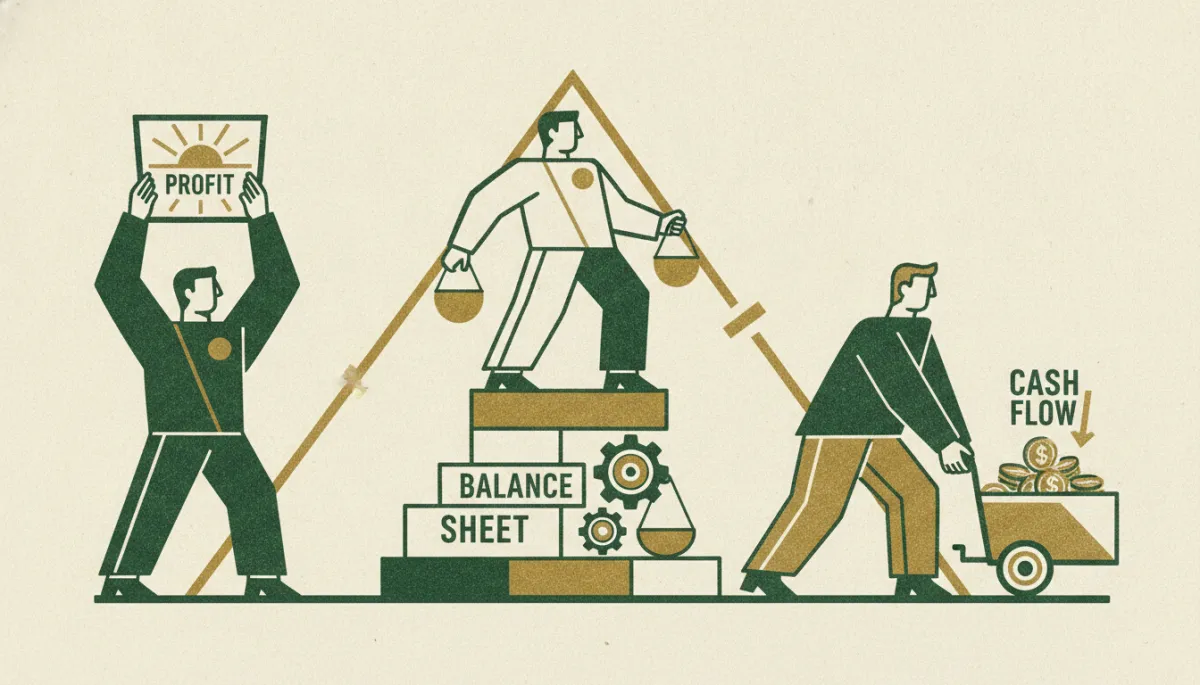
The Three-Statement Model: Linking Profit, Balance Sheet, and Cash
- The three-statement model is the backbone of serious Financial Modeling: it links the income statement, balance sheet, and cash flow statement into one connected system that moves together.
- The power is in the linkage. Change one assumption and it flows correctly through all three statements, so the model stays internally consistent.
- Net income is the central connector. It flows from the income statement into retained earnings on the balance sheet and into the top of the cash flow statement.
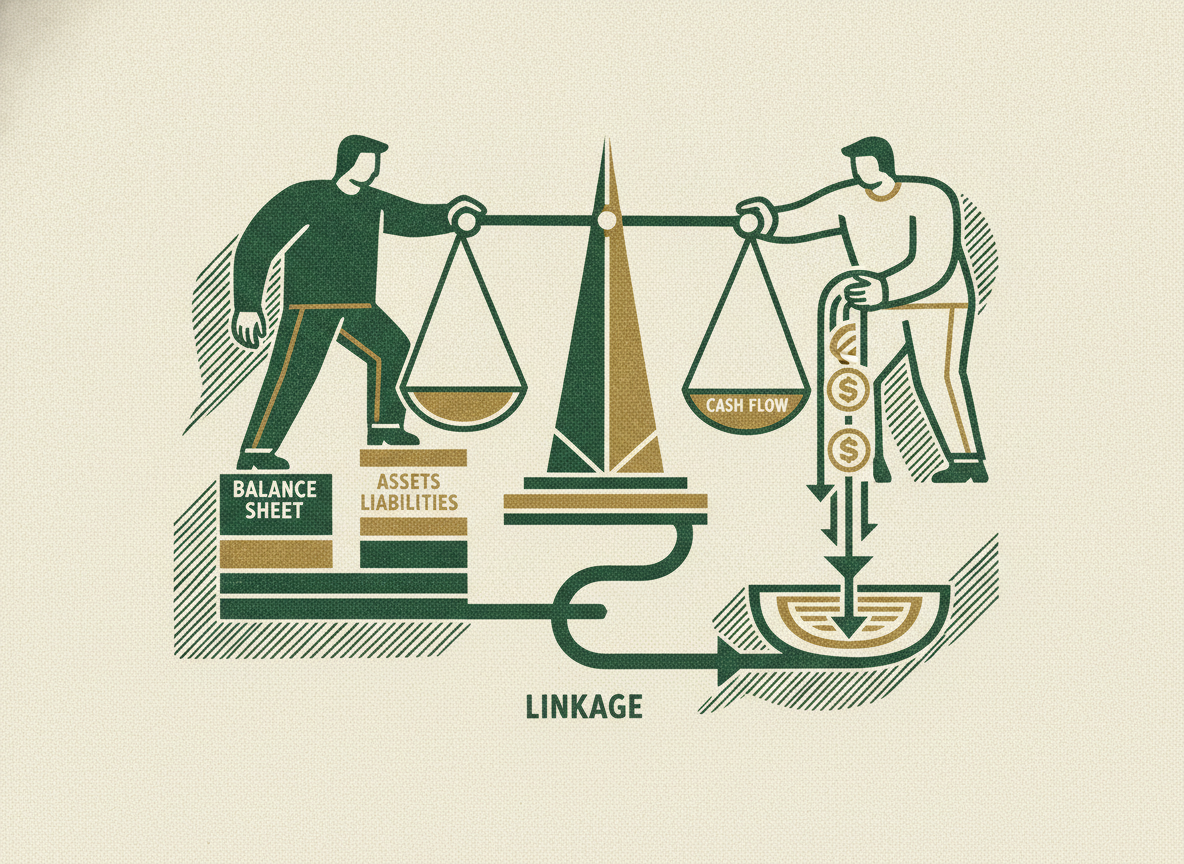
- The balance sheet and cash flow tie together through cash and working capital, so the model proves itself: ending cash on the cash flow must equal cash on the balance sheet.
- Build it in order, income statement, then balance sheet, then cash flow, and the result is a model that shows not just profit but whether you will have the cash to fund it.
Most founders model their business on a single statement, usually a projected income statement, and wonder why the numbers feel incomplete. They are incomplete, because profit alone says nothing about whether you will have the cash to operate or what your balance sheet will look like. The three-statement model solves this by linking all three financial statements into one connected system, the foundation of real Financial Modeling. It is more work to build, but it is the difference between a hopeful revenue projection and a model that actually tells you whether the plan holds together. Here is how the three statements connect and why it matters.

Why One Statement Is Never Enough
A single financial statement gives you one view of the business, and one view is never the whole picture. The income statement tells you whether you are profitable, but says nothing about whether you have cash or what you own and owe. The balance sheet shows your financial position at a moment, but not how you got there. The cash flow statement shows where cash moved, but not the profitability behind it. Each answers a different question, and the questions are connected.
The three-statement model connects them into one dynamic system, as Corporate Finance Institute describes, so you can forecast the full financial picture from a set of assumptions. The value is consistency: because the statements are linked, a change in one assumption flows correctly through all three, and the model cannot tell you a comfortable story on one statement that the others contradict. This is what separates rigorous Financial Modeling from a standalone revenue forecast. A linked model forces the numbers to agree with each other, which is exactly the discipline that catches the plans that look good on profit but fall apart on cash.

How Net Income Connects Everything
Net income is the hinge that connects the three statements, which is why it sits at the center of the model. It is the bottom line of the income statement, and from there it travels two ways. It flows into the balance sheet as a change in retained earnings, the cumulative profit the company has kept after any dividends, as Wall Street Prep explains. And it flows to the top of the cash flow statement as the starting point of the operating section, which then adjusts it for non-cash items.
Understanding this dual flow is the key to grasping the whole model. The profit you earn does not just sit on the income statement; it increases the equity on your balance sheet through retained earnings, and it begins the calculation of how much cash your operations actually generated. This is why the statements move together: a change in revenue or cost changes net income, which simultaneously changes retained earnings and operating cash flow. Once you see net income as the connector rather than just a result, the architecture of the three-statement model becomes intuitive, and the Financial Modeling that depends on it becomes far easier to build and trust.
The Balance Sheet and Cash Flow Linkage
The second critical linkage runs between the balance sheet and the cash flow statement, and it is what makes the model prove itself. The cash flow statement tracks the changes in the balance sheet's working capital accounts, receivables, payables, inventory, to calculate operating cash flow, as Financial Edge describes. When receivables rise, that is revenue you booked but have not collected, so it reduces cash; when payables rise, that is cash you are holding onto, so it adds. These changes flow from the balance sheet into the cash flow statement.
The linkage closes a loop that validates the entire model. The asset side of the balance sheet begins with cash, and that cash figure must equal the ending cash balance calculated on the cash flow statement. If the two do not match, the model is broken somewhere, which is exactly why this connection is so valuable: it is a built-in check. Other connections reinforce it, property and equipment on the balance sheet creates depreciation on the income statement and capital expenditure on the cash flow statement. These interlocking links are what make a three-statement model self-consistent. In good Financial Modeling, the cash flow statement is where the model balances and proves it holds together.

Building It in the Right Order
A three-statement model is built in a specific sequence, and following it is what makes the links come together correctly. You build the income statement first, projecting revenue and costs down to net income, because net income feeds the other two statements. You build the balance sheet second, carrying net income into retained earnings and projecting the asset and liability accounts. You build the cash flow statement last, because it draws from both the income statement and the changes in the balance sheet to arrive at the ending cash balance, per Wall Street Prep.
The order matters because each statement depends on the ones before it. The cash flow statement comes last precisely because it is the integrator, pulling net income from the income statement and working-capital changes from the balance sheet, and its ending cash flows back to the balance sheet to close the loop. This final step is where the model proves it links correctly, the ending cash must tie to the balance sheet's cash, and where it forecasts your cash and any short-term borrowing needs. Building in this order, rather than trying to construct all three at once, is what keeps the Financial Modeling tractable and ensures the connections are sound. It is also why a poorly built model so often fails to balance: the builder skipped the discipline of the sequence.
What the Linked Model Lets You See
The payoff for building a linked three-statement model is that it shows you what no single statement can: whether your plan is actually viable across profit, position, and cash at once. A profitable plan that consumes more cash than you have is something only the linked model reveals, because the income statement shows the profit while the cash flow statement shows the shortfall, and the balance sheet shows the strain. A founder modeling on the income statement alone simply cannot see this, which is how profitable-looking plans run companies out of money.
The linked model also makes scenario planning trustworthy. When you change an assumption, raise growth, add a hire, take on debt, the change flows through all three statements, so you see the complete consequence: the effect on profit, on cash, and on the balance sheet together. This is what elevates Financial Modeling from a sales forecast to a genuine decision tool. It answers the questions that actually determine survival and strategy: Will we have the cash to fund this growth? What will our balance sheet look like if we take this debt? Can we afford this plan, not just on paper but in the bank? The three-statement model is more work to build, but it is the only kind of model that can answer those questions honestly, which is why it is the foundation every serious finance function builds on.

Frequently Asked Questions
What Is a Three-Statement Model?
A three-statement model combines the income statement, balance sheet, and cash flow statement into one dynamic, linked model that forecasts a company's full financial picture from a set of assumptions. Because the statements are connected, a change in one assumption flows correctly through all three, keeping the model internally consistent. It is the foundation of serious financial modeling, used for budgeting, valuation, and decision-making.
How Are the Three Financial Statements Linked?
Net income is the central connector: it flows from the income statement into retained earnings on the balance sheet and into the top of the cash flow statement's operating section. The cash flow statement also tracks changes in the balance sheet's working capital accounts, and its ending cash balance must equal the cash on the balance sheet. These interlocking links make the model self-consistent and self-checking.
In What Order Do You Build a Three-Statement Model?
Income statement first, since net income feeds the other two; balance sheet second, carrying net income into retained earnings; and cash flow statement last, because it integrates net income and balance-sheet changes to calculate ending cash. The cash flow statement comes last as the integrator, and its ending cash must tie back to the balance sheet, which is where the model proves it links correctly.
Why Is a Three-Statement Model Better Than an Income Statement Alone?
Because profit alone says nothing about whether you have the cash to operate or what your balance sheet will look like. A linked model reveals a plan that is profitable but consumes more cash than you have, something a standalone income statement hides. It also makes scenario planning trustworthy, since a changed assumption flows through profit, cash, and position together, showing the complete consequence of a decision.
References
