

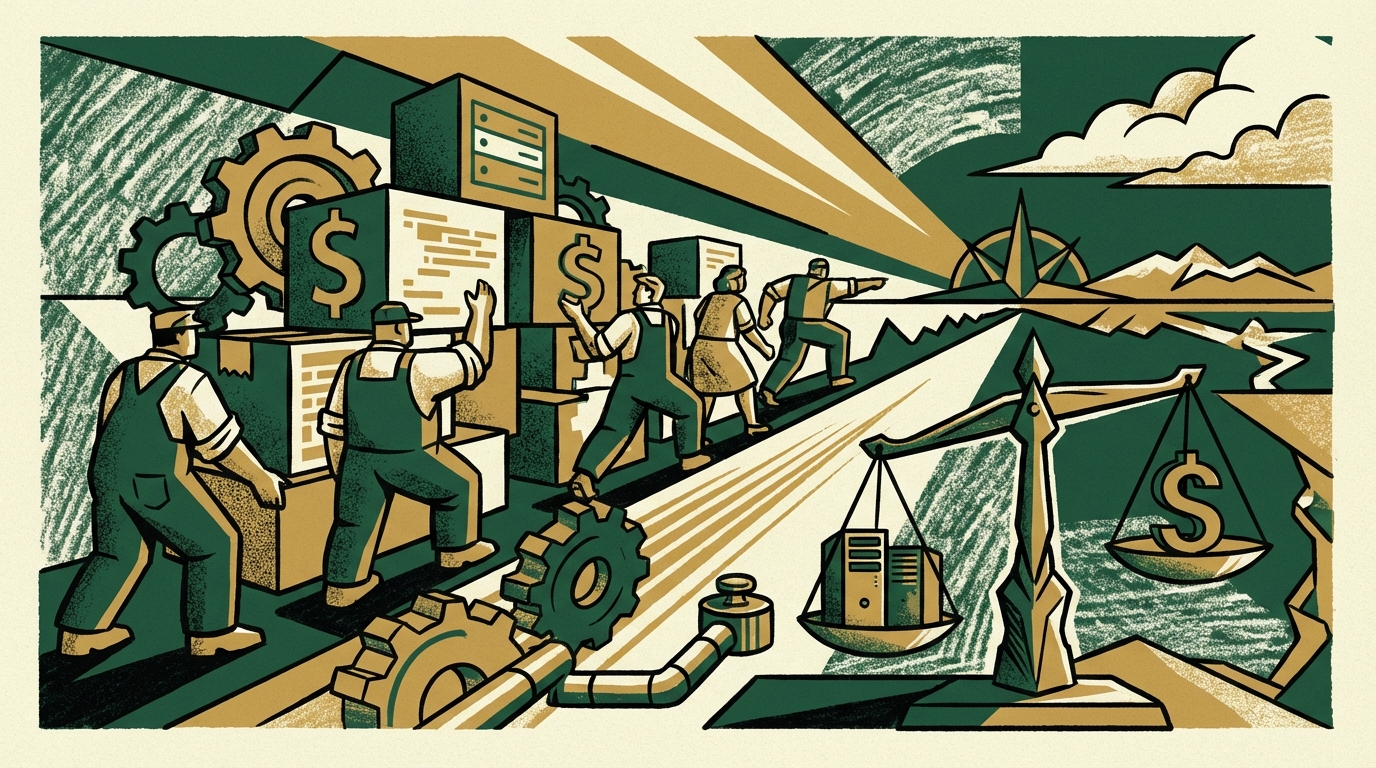
The 'Ops' in FinOps: Why Your CFO Needs to Understand Code and Cloud
Published: 2026-04-14 • Estimated reading time: 9 min
I once sat in a boardroom with the founder of a white-hot SaaS company, a startup that investors were drooling over. Their top-line growth was a hockey stick personified. But the founder looked like he’d seen a ghost. The ghost, it turned out, was his AWS bill. It had tripled in a quarter, devouring his gross margin and turning a story of explosive growth into a cautionary tale of unprofitable scaling. “We’re adding customers,” he said, “but we’re somehow getting poorer.”
His CFO, a brilliant traditional finance mind, saw the bill as a black box—a single, terrifying number from the engineering department. The CTO saw it as the necessary cost of innovation. My team at Greenwood Business Consultants was brought in to act as the bridge, the technical translator, the outsourced CFO who could speak both languages. What they needed wasn’t just cost-cutting; they needed a new operating model. They needed FinOps.
This is the new reality for any company over $5M in revenue running on the cloud. Your infrastructure spending is no longer just IT overhead. It has become the primary mechanism through which you purchase—or squander—your competitive advantage. This makes cloud governance a fundamental responsibility of the Chief Financial Officer, requiring direct engagement with technical architecture, not just a signature on a budget.
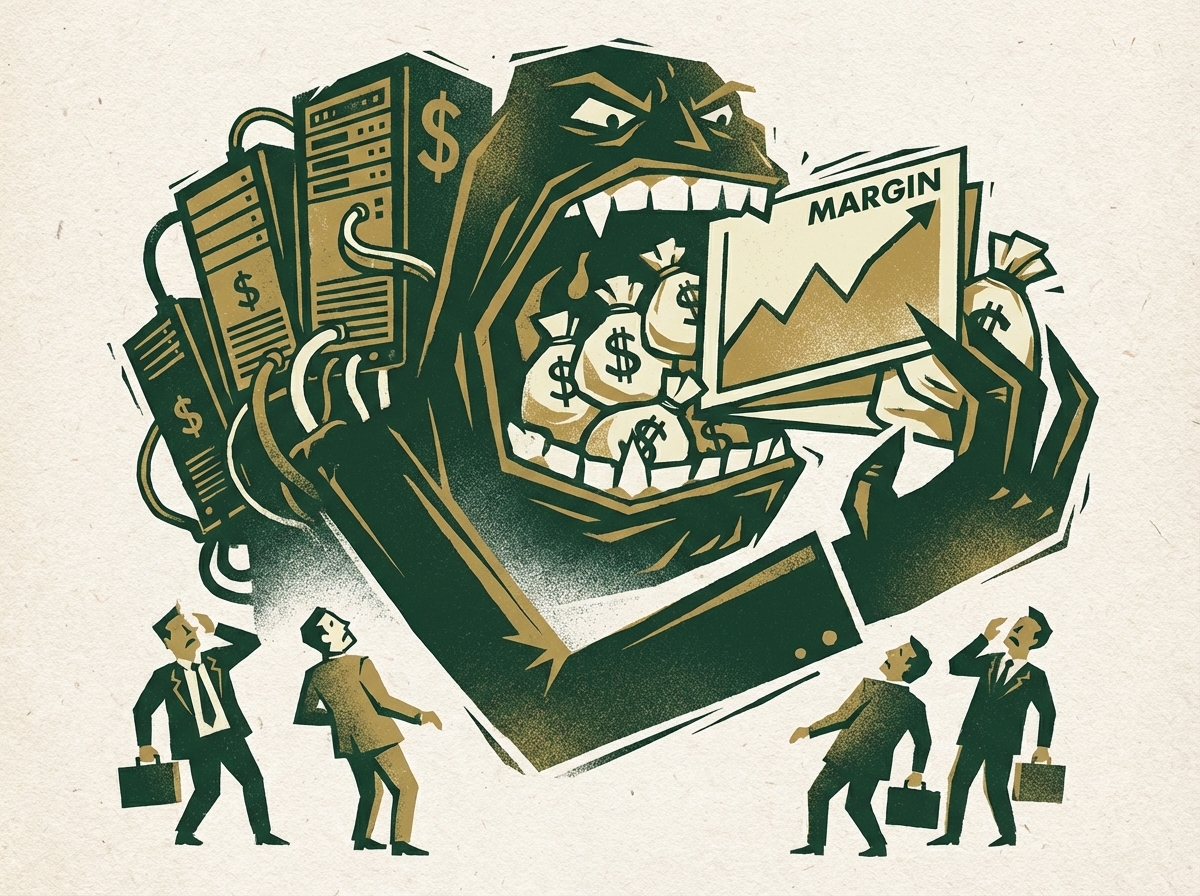
When the Server Bill Eats the Margin
Spiraling cloud costs directly erode gross margin by treating what should be a variable Cost of Goods Sold (COGS) like an unpredictable, fixed overhead. For a modern SaaS company, cloud infrastructure costs are not overhead; they are the digital equivalent of raw materials. Yet, unlike steel or silicon, their price isn't negotiated in bulk upfront. It’s a meter that’s always running, driven by millions of micro-decisions made by engineers every day. In many midsize IT companies, cloud costs have ballooned to become the second-largest expense, trailing only the cost of labor. The global public cloud spending itself is on a blistering trajectory, expected to exceed $419 billion by 2025, a testament to its value and its potential for financial chaos if left unmanaged.
This shift from a predictable, capital-expenditure model (buying servers for a data center) to a volatile, operational-expenditure model (paying for usage on AWS or Azure) is the central challenge. The danger is what I call “margin compression by a thousand cuts.” A new AI feature, an inefficient database query, an overprovisioned server cluster—each one is a small, seemingly justifiable expense that collectively sinks the ship.
Defining FinOps: Collaboration, Not Just Cutting
FinOps is a cultural practice and operational framework that brings financial accountability to the variable spending model of cloud, uniting engineering, finance, and business teams around the goal of maximizing business value. It’s not about telling engineers “no.” It’s about giving them the data and the context to make cost-aware decisions without stifling innovation. According to the FinOps Foundation, the goal is to “make money by saving money,” which perfectly captures the ethos. You’re not just trimming fat; you’re building a more efficient engine for growth.

The core of the FinOps framework is a simple, iterative lifecycle:
Inform: This is the visibility phase. You can’t manage what you can’t see. It involves implementing robust cost allocation tags, creating real-time dashboards, and making cloud spend understandable to non-technical stakeholders.
Optimize: Armed with data, teams can now take action. This can range from technical maneuvers like right-sizing instances and leveraging committed use discounts to strategic decisions like re-architecting an application for better efficiency.
Operate: This phase is about embedding cost-awareness into the DNA of the organization. Engineering teams review cost implications in their daily stand-ups. Finance teams build more accurate, usage-based forecasts. Business leaders evaluate the ROI of cloud spend per feature or customer.
This continuous loop ensures that cost governance isn't a once-a-quarter panic attack but a daily discipline.
The CFO-CTO Alliance
A successful FinOps framework requires a strategic alliance between the CFO and CTO, where financial leaders develop technical literacy and technology leaders embrace cost ownership. The old world, where the CTO hands the CFO a bill and says, “this is what it costs to keep the lights on,” is over. That model is a recipe for disaster in a cloud-native world where nearly 75% of organizations report that cloud costs are a significant source of financial volatility.
I’ve seen this breakdown firsthand. A CFO will demand a 15% cut in the AWS bill, and the engineering team, lacking business context, will achieve it by shutting down a development environment for a promising new product. The company saves a few thousand dollars in the short term and potentially loses millions in future revenue. As J.R. Storment, co-author of Cloud FinOps, states, “The goal of FinOps is not to save money but to make money. How can we align our cloud spend with our business strategy?”

The Outsourced CFO as a Technical Translator
This is often where an outsourced CFO with a deep understanding of technology finance can be invaluable. We sit at the intersection of these two worlds, translating engineering decisions into financial impact and financial goals into engineering constraints. We help CFOs understand that choosing a serverless architecture isn't just a technical preference; it's a fundamental shift in the cost structure of a product. We help CTOs understand that demonstrating a lower cost per transaction isn’t a bureaucratic exercise; it’s a vital metric for investor confidence.
The language gap is real, but it’s bridgeable when both sides understand the stakes.
Tagging Strategy: Tracking Cost per Customer
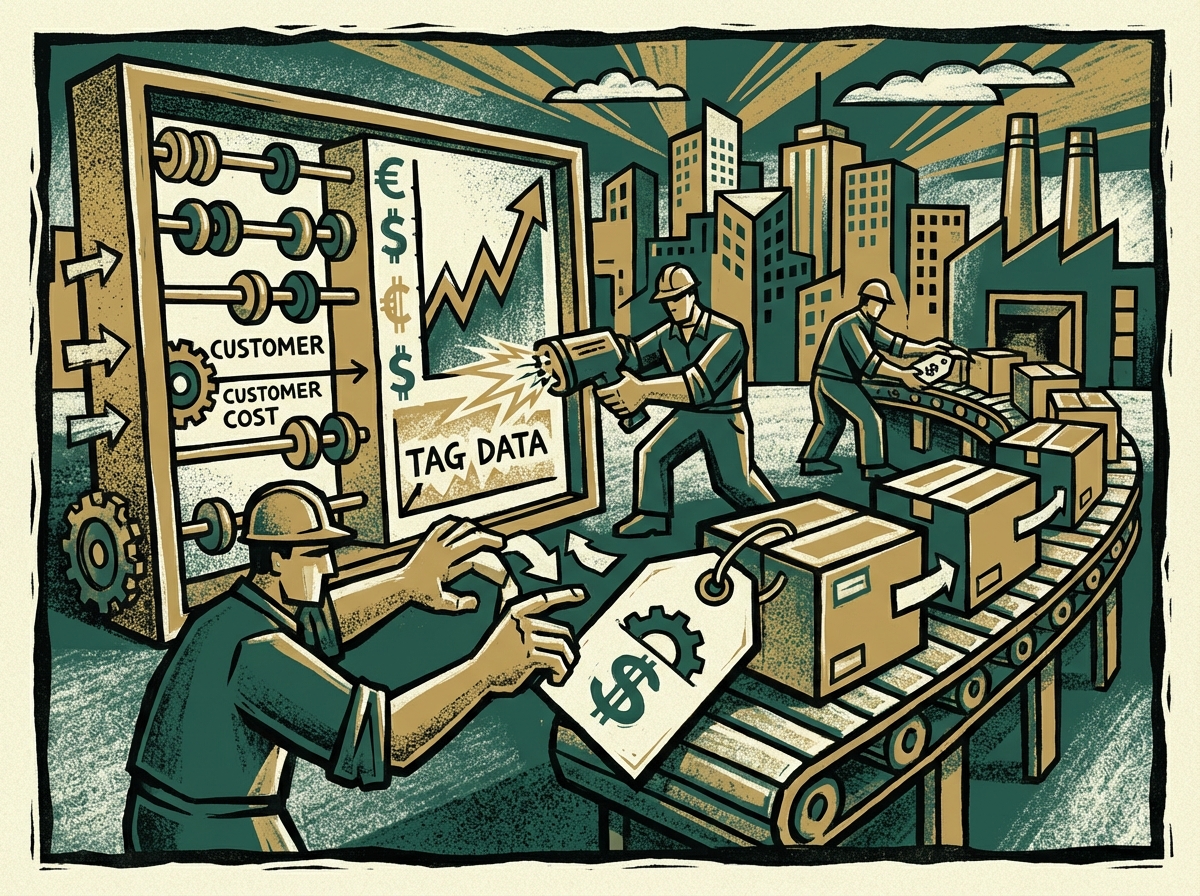
A robust cost allocation tagging strategy is the foundational mechanism for translating raw cloud spend into meaningful business metrics, such as the unit economics of your cloud or cost per customer. Without it, your cloud bill is an inscrutable monolith. With it, it’s a detailed ledger of your business operations. A well-architected tagging strategy is not an engineering task; it is a financial reporting requirement.
Imagine being able to answer these questions with certainty:
Which of our customers is the most expensive to serve?
What is the gross margin on our new AI-powered analytics feature?
Is the
Project-PhoenixR&D initiative staying on budget?
This is what a disciplined tagging policy enables. By tagging every single cloud resource with metadata—like cost-center:marketing, customer-id:acme-corp, or feature:recommendation-engine—you create the granular cost visibility needed to perform showback (reporting costs back to the responsible team) and chargeback (formally allocating those costs). This transforms the cloud bill from a problem for the CFO into actionable data for the entire company.
Forecasting the Unpredictable Cloud Bill
Forecasting variable cloud costs requires moving beyond simple historical analysis to embrace methodologies that account for seasonality, business growth drivers, and engineering roadmap changes. The old method—taking last month’s bill and adding 5%—is a recipe for a massive forecast variance. In a consumption-based architecture, your spending is directly tied to customer activity. A successful marketing campaign or a viral moment can blow through a year’s budget in a week.

Effective cloud cost forecasting in 2026 relies on a more sophisticated, multi-pronged approach:
Driver-Based Modeling: Tying cloud spend to business metrics. For example, for every 1,000 new users, we expect compute costs to increase by X and storage by Y.
Roadmap Integration: Incorporating planned product launches or new feature rollouts into the financial model. The launch of a new AI model, which can be notoriously expensive, should not be a surprise to the finance team.
Machine Learning Prediction: Utilizing platforms that analyze historical usage patterns to detect anomalies and predict future spend with far greater accuracy than a simple spreadsheet.
Achieving financial predictability in an inherently unpredictable environment is the ultimate goal. It provides the stability needed to make strategic investments, manage cash flow, and confidently report to your board and investors.
Frequently Asked Questions
What is the core principle of FinOps?
The core principle of FinOps is driving accountability for cloud spending by creating a cross-functional culture of ownership. It establishes a collaborative model where engineering and finance teams work together to make trade-offs between speed, cost, and quality to maximize the business value of the cloud.
What is the first step to controlling cloud costs?
The first and most critical step is achieving granular visibility through a comprehensive cost allocation tagging strategy. You cannot control, optimize, or forecast what you cannot see, making a consistent tagging policy the non-negotiable foundation for any successful cloud financial management practice.
Can a modern company be profitable without a FinOps strategy?
While it's possible in the short term, it is not sustainable. Without a FinOps strategy, a growing company will inevitably face margin erosion, unpredictable spending, and a cultural disconnect between engineering and finance, ultimately hindering its ability to scale profitably and respond to market opportunities effectively.
