

The Hidden Legal Risks: D&O Insurance for Fractional vs Full Time CFOs
Published: 2026-05-15 • Estimated reading time: 9 min
I was sitting across from the founder of a fast-growing SaaS company, a brilliant engineer who had just closed a $20 million Series B. He was beaming. “We just landed the best fractional CFO in the business,” he told me. “She’s got a track record a mile long and costs half of what a full-time hire would.”
My first question wasn’t about her strategy or her network. It was, “How’s she covered under your D&O policy?”
The silence was deafening. He, like so many founders I advise, had made a perfectly logical business decision without seeing the tripwire right in front of him. The conversation about a fractional CFO vs full time CFO isn't just about cost or flexibility; it’s a high-stakes discussion about liability. You’ve brought in a strategic powerhouse, but you may have also unknowingly opened a coverage gap big enough to drive a plaintiff’s lawsuit right through.
Let’s get into the weeds of where the real risk lies and how to build a fortress around your board, your company, and your new star player.
The Coverage Gap: Why Your D&O Policy Excludes External Consultants
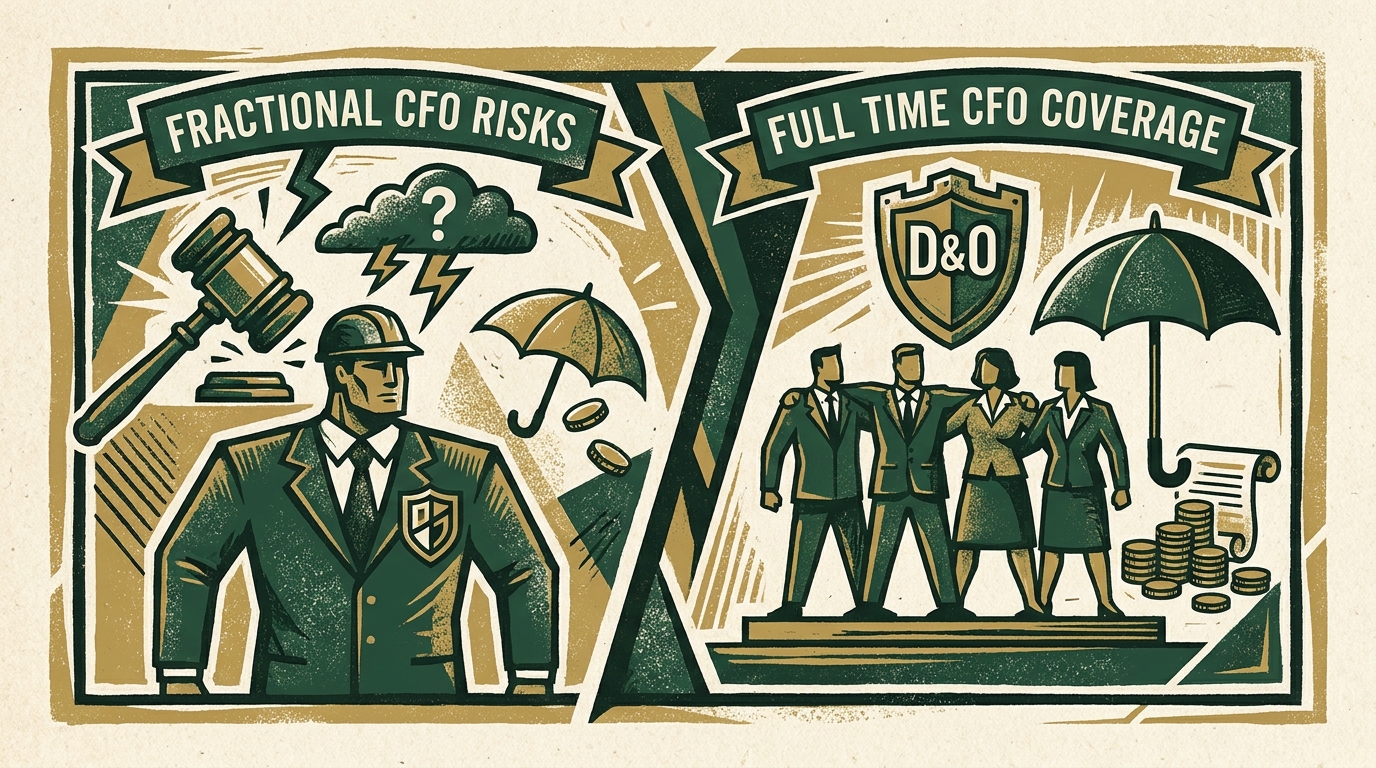
Your standard Directors & Officers (D&O) insurance policy almost certainly does not automatically cover independent contractors, including your fractional CFO. These policies are written to protect “Insured Persons,” a term typically defined as duly elected or appointed directors and officers of the company—in other words, W-2 employees with formal titles. A 1099 consultant, no matter how integral to your operations, exists outside that protective bubble.
Think of your D&O policy as a members-only club. The bouncer has a very specific list of names—your board members and official officers. Your fractional CFO, arriving with a consultant’s badge, isn’t on the list. When a lawsuit hits targeting a strategic financial decision, the policy is designed to pay the legal fees for the members inside, leaving the consultant to fend for themselves. This is a critical distinction in the fractional CFO vs full time CFO debate. According to recent market analysis from AM Best, underwriters are tightening definitions of “Insured Persons” amid emerging risks, making this gap more pronounced than ever.

This isn’t just a problem for the consultant. If a fractional CFO makes an error that leads to a shareholder suit, plaintiffs’ attorneys won’t care about employment status. They will name the consultant, the CEO, and every board member they can. If the consultant isn’t covered by your D&O, the company might be contractually obligated to pay their legal fees out of pocket, a process called indemnification, completely negating the purpose of the insurance policy for that specific incident.
Understanding Fractional CFO Errors & Omissions (E&O) Exposure
Errors & Omissions (E&O) exposure for a fractional CFO refers to the risk of lawsuits stemming from professional negligence, mistakes, or the failure to perform their duties. Unlike a W-2 employee whose mistakes are generally absorbed by the company’s D&O policy, a fractional executive is operating as a separate business entity, bringing their own distinct liability into your boardroom.
The potential for error is vast, and the stakes are incredibly high. My team and I see these scenarios play out constantly:
Flawed Financial Models: A rosy projection used for a fundraising round turns out to be based on faulty assumptions, leading investors to claim they were misled.
Poor Systems Implementation: A botched ERP or accounting software migration results in lost data, inaccurate reporting, and poor decision-making.
Capital Allocation Errors: Advising the company to take on a specific debt structure that proves to be unsustainable, leading to a liquidity crisis.
Compliance Oversights: Failure to adhere to revenue recognition standards or state-specific tax nexus rules, resulting in costly penalties and financial restatements. A startling review of 2025 filings found that accounting-related class action lawsuits continue to rise, with over 40% of all new filings involving allegations of improper accounting, according to the Cornerstone Research report.

The fractional nature of the role itself can amplify these E&O risks. An executive who is only with you 10 or 15 hours a week may not have the deep institutional knowledge to spot a historical reporting anomaly or the cultural sway to push back on a CEO’s overly optimistic forecast. Their advice is gold, but their limited time on-site can create blind spots. As one veteran underwriter at a specialty insurer told me, “We see fractional execs as a concentration of risk. They have all the authority of a C-suite officer but none of the traditional oversight or insurance coverage.”
Financial Misstatements and the Chain of Liability
Financial misstatements create a direct and perilous chain of liability that starts with the financial leader and quickly ensnares the CEO and the board of directors. In the eyes of regulators and shareholders, the distinction between a full-time employee and a fractional consultant who signs off on the numbers is legally irrelevant; responsibility flows straight to the top.
Imagine a scenario. Your fractional CFO, juggling three clients, makes a small but material error in calculating deferred revenue. The error gets baked into the quarterly reports. The board, relying on those reports, approves a major capital expenditure. Six months later, the auditors find the mistake. Now you have a full-blown financial restatement on your hands. Suddenly, the company’s valuation is questioned, lenders are reviewing debt covenants, and shareholders are furious.
The resulting lawsuit won’t just name the fractional CFO. It will name the CEO for failure to supervise and the entire board for breaching their fiduciary duty of care. The average D&O-related settlement for accounting issues can easily run into the seven figures, and that’s before legal fees. The D&O landscape is already hardening, with insurers reporting a 15% increase in the severity of claims filed against private companies in the last year, as noted by Marsh's 2026 outlook.
Here’s a simple breakdown of how liability differs in this context:

The key takeaway is that ambiguity benefits no one but the plaintiff’s lawyers. Establishing a crystal-clear legal and insurance framework is not optional.
Drafting Bulletproof Contracts: Indemnification and Scope of Authority
A meticulously drafted contract, fortified with specific indemnification clauses and a clear scope of authority, is your single most powerful tool for mitigating the risks of using a fractional executive. This document is not a formality; it is the legal architecture that separates a successful partnership from a corporate governance disaster. It’s where you define the rules of engagement before the first shot is ever fired.
The Power of Indemnification Clauses
An indemnification clause is a contractual promise by one party to cover the losses of another. In this context, you want a mutual indemnification clause. The company should agree to indemnify the fractional CFO for claims arising from their good-faith actions (protecting them from frivolous suits), and the fractional CFO’s firm must agree to indemnify the company for claims arising from their negligence or willful misconduct. This creates a two-way street of accountability. More importantly, it requires you to demand that the fractional CFO carry a substantial E&O insurance policy—a non-negotiable prerequisite. I typically advise clients to require a minimum of $2 million in E&O coverage.
Defining a Clear Scope of Authority
Ambiguity is the enemy. Your contract must explicitly detail the fractional CFO’s duties, responsibilities, and limitations. Can they sign contracts? Do they have authority to make binding financial commitments? Are they a signatory on bank accounts? Define what constitutes “advice” versus a “directive.” This written scope, as detailed by legal experts at Thomson Reuters, is crucial evidence in a dispute. It clarifies for a court what the executive was hired to do, preventing them from being held responsible for areas outside their purview, and vice versa.

Protecting the Board While Utilizing Flexible Executive Talent
Ultimately, protecting the board and the company comes down to a proactive, multi-layered risk management strategy that embraces the benefits of flexible talent without ignoring the inherent legal complexities. It’s about being smart, not scared. My team guides clients through a simple, three-step process to secure the arrangement.
Mandate and Verify Insurance. Before signing any contract, demand a certificate of insurance (COI) from your fractional CFO proving they have active E&O coverage. Do not take their word for it. Call the broker listed on the COI to verify the policy is in force and the coverage limits are adequate. The median cost for a $1 million E&O policy has risen by nearly 8% year-over-year, so serious consultants will already have this baked into their cost structure.
Amend Your D&O Policy. Work with your insurance broker to see if your fractional CFO can be explicitly named as an “agent” or “consultant” for the purposes of the D&O policy. Some modern policies are being written with endorsements to cover these roles, often for a small additional premium. This is the belt-and-suspenders approach—it provides a secondary layer of protection for your company should their personal E&O policy fail or be insufficient.
Establish Rigorous Oversight and Reporting. Treat your fractional CFO like a key executive, because they are. Integrate them into your regular board meetings. Require detailed written reports and formal presentations. Create a paper trail that demonstrates the board is actively engaged and performing its fiduciary duty of oversight. This governance rigor, as highlighted by The Corporate Governance Institute, is a board’s best defense in any shareholder dispute.
The rise of the fractional executive is a massive opportunity for growing companies to access world-class talent. But with great flexibility comes great responsibility. By addressing the insurance and liability questions head-on, you’re not just buying a policy; you’re buying peace of mind and ensuring your company’s growth is built on a foundation of solid rock, not shifting sand.

Frequently Asked Questions
Does standard D&O insurance cover a fractional CFO?
No, a standard Directors & Officers (D&O) insurance policy typically does not cover a fractional CFO because they are classified as an independent contractor (1099), not a W-2 employee who qualifies as a formally appointed “Insured Person” under the policy's definitions.
What are the E&O risks associated with outsourced financial leadership?
Key Errors & Omissions (E&O) risks with a fractional CFO include providing flawed financial models for fundraising, making capital allocation errors, overseeing botched system implementations, and failing to ensure regulatory compliance, all of which can lead to significant financial losses and lawsuits for professional negligence.
How should legal contracts be structured for fractional executives?
Legal contracts for fractional executives should be structured with a crystal-clear scope of work defining their authority and limitations, and a robust mutual indemnification clause that requires the fractional CFO to carry their own E&O insurance to cover any acts of negligence.
