


The 'Flash Close': Why You Should Close Books in 3 Days, Not 15
Published: 2026-04-04 • Estimated reading time: 8 min
I sat across from the founder of a fast-growing SaaS company, a brilliant product visionary who had just raised a solid Series B. He was showing me his month-end reports, beaming. The problem? It was April 18th, and we were looking at March’s numbers. His team had spent fifteen days meticulously compiling a perfect history lesson. His ship was sailing at full speed, but he was navigating by looking at the wake behind him.
This is a scene I’ve witnessed dozens of times. Companies celebrate a close that takes weeks, viewing it as a cost of doing business. But it’s not just a cost; it’s a strategic anchor. While your team is busy confirming what happened last month, your competitors are already acting on what’s happening this month. The solution isn't just about shaving off a few days; it’s about a complete paradigm shift. It's about implementing what my team and I call the 'Flash Close'—a system that delivers audit-ready financials in three days. As a fractional or outsourced CFO, this is often the first, most impactful change we implement.
The High Cost of a Slow Close
The most significant cost of a slow monthly close process is strategic paralysis, forcing you to make critical decisions with outdated information. By the time you get the full financial picture on the 15th or 20th of the month, you’re already halfway through the next period. The opportunity to course-correct is gone. You’re left managing the consequences of decisions you made four to six weeks prior, with no ability to influence the current month’s outcome.
It’s not just about lost opportunity. A recent survey highlighted by cfo.com revealed that 50% of finance teams still take a full week or more to close their books. Think about that. For at least one week every month, your most critical financial talent is consumed by low-value, backward-looking tasks. They're chasing down invoices, manually reconciling accounts, and wrestling with spreadsheets instead of analyzing trends, modeling scenarios, or partnering with department heads to optimize spending.

This lag creates a ripple effect of inefficiency. Budgets are based on stale data. Sales commissions can’t be paid promptly, affecting morale. And your board meetings become historical reviews rather than forward-looking strategy sessions. The traditional close isn’t just slow; it’s a competitive disadvantage.
Defining the 'Flash Close': 3 Days to Clarity
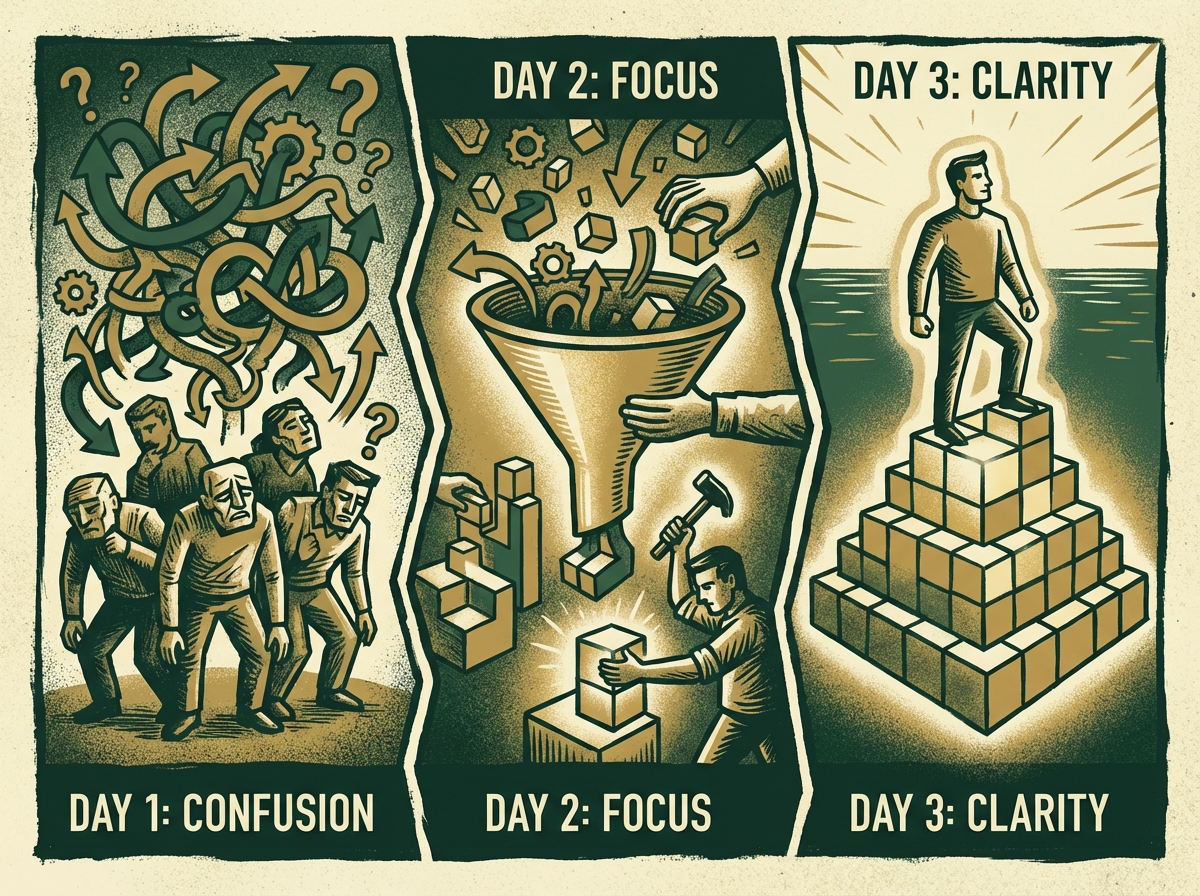
The Flash Close is a methodology that leverages automation and continuous accounting principles to produce accurate, reliable financial statements within the first three business days of the new month. It’s not about cutting corners or sacrificing accuracy for speed. It's about redesigning the entire month-end procedure, shifting tasks that are typically crammed into a chaotic first week and distributing them throughout the prior month. It’s about transforming the close from a frantic event into a smooth, predictable process.
This isn't a theoretical ideal. At Greenwood Business Consultants, we’ve guided companies from $5M ARR to over $50M through this transformation. The goal is to make “closing the books” a non-event. The data is largely reconciled and verified before the month even ends, leaving only final accruals and high-level reviews for days one, two, and three.
The Mechanics: Automation, Accruals, and an Outsourced CFO's Perspective
Achieving a three-day close relies on a disciplined system of automation, intelligent estimates, and a shift in mindset from perfection to materiality. It’s a core competency for any high-performing finance function, and it’s where an experienced outsourced CFO can provide immense value by architecting the right technology stack and processes. There are three primary pillars.
1. Ruthless Automation of Core Processes
The first step is to automate every high-volume, rules-based task you can. Modern accounting and ERP integration tools have made this more accessible than ever. According to a Forrester report, finance automation doesn't just improve efficiency; it can yield an ROI of over 170% through reduced labor costs and fewer errors. Key areas for automation include:
Accounts Payable (AP): Tools like Bill.com, Ramp, or Tipalti use OCR and AI to scan invoices, code them to the right general ledger account, and route them for approval, eliminating manual data entry. Companies using AP automation can process invoices up to 80% faster, according to a report from Bottomline.
Expense Management: Platforms like Expensify or Brex automate receipt capture and policy enforcement, directly integrating with your accounting system.
Reconciliation Automation: Software from Trintech or FloQast can perform daily or weekly cash reconciliations and account reconciliations for balance sheet items, turning a major month-end bottleneck into a continuous, background process.
2. Embrace Continuous Accounting & Intelligent Accruals
The traditional close saves all the work for the end. Continuous accounting distributes it. This means performing tasks like intercompany eliminations and bank reconciliations weekly, not monthly. Instead of a mountain of work on day one, the team faces a small hill. Furthermore, a flash close relies on well-reasoned accruals and estimates for things like variable expenses. Rather than waiting for the final utility bill, you accrue based on a historical average. The principle of materiality governs this; a small variance that will be trued up next month is acceptable in exchange for the immense strategic value of speed.
3. A Centralized, Integrated System
You cannot achieve a flash close with a patchwork of disconnected spreadsheets. A modern, cloud-based ERP like NetSuite or a robust accounting system like QuickBooks Online Advanced serves as the single source of truth. By ensuring all your subsystems—payroll, billing, AP—are properly integrated, you eliminate the need for manual data exports and imports, which are both time-consuming and a primary source of errors. As a report from PwC notes, a streamlined technology infrastructure is a prerequisite for a fast close.
Moving from 'What Happened?' to 'What Now?'
The true value of a three-day close isn't the time saved; it's what you do with that time. When financials are ready on day three, your weekly leadership meeting on day four is a strategy session, not a history report. You can analyze budget versus actuals while there are still three weeks left in the month to make a difference.
I saw this firsthand with a B2B tech client. Their 12-day close meant they didn't realize a key marketing channel was underperforming until the 15th of the following month. After we implemented a flash close, they spotted the same trend on day four. They immediately reallocated $50,000 in ad spend to a better-performing channel, a move that directly impacted that month's revenue. That is the power of real-time financial reporting. You stop just reporting the past and start shaping the future. This aligns with what one CFO noted in a Spendesk compilation, stating, “The days of the CFO as a pure controller are over. The modern CFO is a business partner to the CEO.”

This speed creates a virtuous cycle. Better data leads to better decisions, which lead to better results, which generate more data. It transforms the finance team from scorekeepers into strategic partners who can provide the forward-looking guidance every CEO needs.
Getting Your Team on Board
A shift this significant is as much about people as it is about process and technology. Your accounting team may be resistant at first. A slow, methodical close feels safe; a fast one can feel reckless. The key is to frame the change not as “doing more with less,” but as “doing more valuable work.”
I always start by mapping out the hours they spend on manual, repetitive tasks that will be automated. Then, I show them the high-value analytical work they’ll be empowered to do instead—like variance analysis, department-level profitability studies, and cash flow forecasting. The goal is to elevate their roles from bookkeepers to business analysts. Over 80% of finance leaders are already planning or implementing automation, according to Rossum.ai, so this is about staying ahead of the curve, not just catching up.

Provide the training, celebrate the small wins, and clearly communicate the strategic 'why' behind the push for speed. When your team understands that they are being freed from drudgery to become more critical to the company’s success, you’ll get buy-in. You’re not just optimizing a process; you’re investing in their careers.
Frequently Asked Questions
Why is a fast monthly close important for strategy?
A fast monthly close is crucial for strategy because it provides timely, relevant financial data that enables proactive, mid-month decision-making. Instead of analyzing historical performance six weeks after the fact, leaders can identify trends, reallocate resources, and adjust tactics in real-time, creating a significant competitive advantage through superior business agility.
How can companies reduce their close time to 3 days?
Companies can reduce their close time to three days by adopting a 'Flash Close' methodology, which involves three key steps: 1) Aggressively automating manual processes like accounts payable and reconciliations, 2) Shifting to a continuous accounting model where tasks are performed throughout the month, not just at the end, and 3) Using a modern, integrated ERP or accounting system as a single source of truth.
What role does automation play in the 'Flash Close'?
Automation is the engine of the 'Flash Close,' as it eliminates the most time-consuming manual tasks that create bottlenecks in the monthly close process. By automating data entry, journal entries, and account reconciliations, companies dramatically reduce human error, increase data accuracy, and free up their finance teams to focus on high-value strategic analysis rather than mechanical data processing.
References
https://www.forrester.com/blogs/the-roi-of-finance-automation-quantified/
https://www.bottomline.com/resources/2026-ap-automation-and-payments-technology-advisor-report
https://www.pwc.com/sk/sk/poradenstvo/assets/pwc-fast-close.pdf
https://rossum.ai/blog/automation-statistics-that-will-upset-the-finance-applecart/
