

The CEO Whisperer: The Human Side of the Fractional CFO
Published: 2026-01-31 • Estimated reading time: 9 min
They hire us for the spreadsheets, but they keep us for the sanity. In the world of executive financial leadership, the most valuable line item a Fractional CFO manages is often the one that never appears on a P&L: the CEO’s cognitive and emotional bandwidth. While founders are brilliant at building products and inspiring teams, they are often navigating a minefield of high-stakes decisions in profound isolation. The modern Fractional CFO’s true value isn't just as a financial mechanic, but as a confidential strategic partner—a CEO Whisperer who translates the cold, hard numbers into human-centric strategy and provides the unvarnished truth necessary for real growth.
My team at Greenwood Business Consultants has seen this pattern play out dozens of times. A founder brings us in to clean up the books or build a forecast, but the real work begins when the office door closes. The conversation shifts from EBITDA margins to co-founder friction, from cash flow projections to personal burnout. This is where the real value is unlocked, transforming a financial partnership into a leadership accelerant that drives both business results and executive well-being.
The Loneliness of the CEO
The CEO's role is inherently isolating, a reality often glossed over in the hustle-and-grind narrative of entrepreneurship. You're the final backstop for every decision, the person everyone looks to for answers, yet the one person who can't show vulnerability or uncertainty to the team. This structural isolation is a massive, unpriced risk to the business. It’s a breeding ground for echo chambers and bad decisions. A staggering 71% of CEOs report experiencing burnout, a condition exacerbated by this profound sense of solitude, according to research from Cerevity. The weight of the entire organization rests on your shoulders, and it’s a weight that can’t be shared with your direct reports, your board, or even your spouse in the same way.
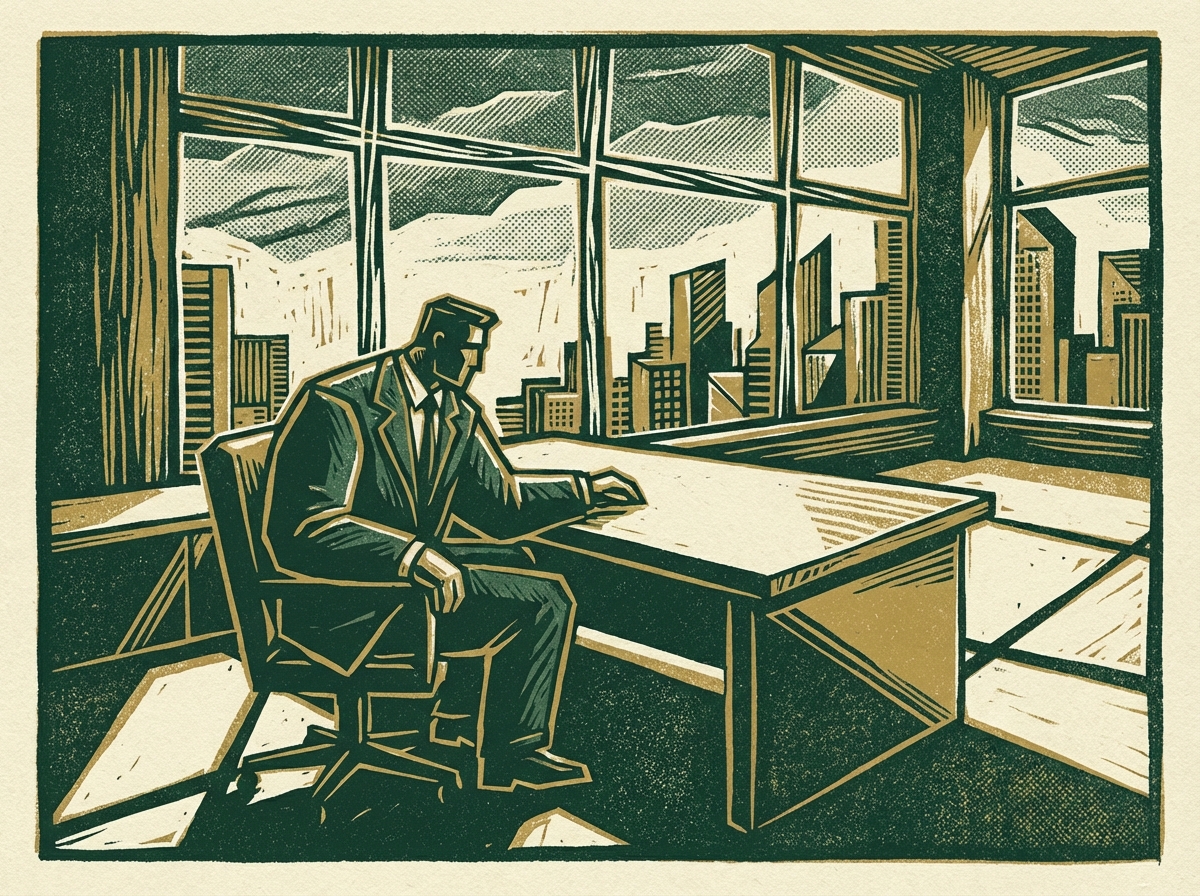
This isn't just a feeling; it's a strategic liability. When a leader feels alone, they tend to either become overly insular, trusting only their own gut, or they swing the other way, becoming paralyzed by the fear of making the wrong move. Neither is a recipe for success. A true strategic partner doesn't just provide data; they provide a confidential space to dissect that data, to challenge assumptions, and to game out scenarios without judgment. It’s a form of high-level CEO coaching grounded in the financial reality of the business.
Truth to Power: The Value of Radical Candor
A Fractional CFO’s most critical function is to speak truth to power with compassionate candor. They are uniquely positioned to be the objective voice in the room, unburdened by internal politics or historical baggage. They can say the things no one else is willing or able to say. I once had a client, a brilliant product-led founder, who was pouring money into a feature his engineers loved but customers ignored. The internal team was too invested—or too intimidated—to tell him it was a dud. The numbers, however, didn't lie. My job wasn''t just to present the negative ROI; it was to sit down with him and say, "The data shows this isn't working. Let's talk about the strategic cost of continuing down this path versus pivoting now."

This requires building a foundation of psychological safety. The monthly financial review can't feel like a trip to the principal's office. It must be a collaborative work session where bad news is just data, not an indictment. As a study highlighted by the World Economic Forum points out, leadership in 2026 demands this blend of empathy and directness. When a CEO trusts that their financial partner is motivated solely by the health of the business and their own success, they become receptive to feedback that would otherwise feel like criticism. It’s the difference between saying, "You're spending too much on R&D" and "Our R&D spend is outpacing our customer acquisition model. How can we realign these to hit our Q4 goals?" One is an accusation; the other is a shared problem to solve.
Decision Fatigue and the Financial Partner
Decision fatigue is the cognitive drain experienced from making too many choices, leading to poor judgment and procrastination. For a CEO, this is a chronic condition. Every day is a firehose of decisions—from hiring and firing to product roadmaps and pricing strategies. Research from the National Center for Biotechnology Information shows that this relentless demand on executive function can severely impair strategic thinking. A Fractional CFO acts as a powerful antidote by offloading and co-processing a significant portion of this burden.
They do this by creating frameworks that simplify complex choices. Instead of the CEO wrestling with a dozen competing budget requests, the CFO presents three viable scenarios, each with clear trade-offs tied to the strategic plan. This doesn't remove the CEO's authority; it focuses their energy where it matters most. With the recent CEO turnover rate hitting a record high in 2025, as reported by HCAmag, preserving executive bandwidth is no longer a luxury—it's a survival tactic.

Here’s a practical look at how this changes the dynamic:
Building Trust: The Currency of Leadership
The relationship between a CEO and their Fractional CFO is built on a currency more valuable than dollars: trust. This trust has two components: trust in competence (they know their stuff) and trust in character (they have my back). The first part is table stakes. The second is what enables true strategic partnership. A CEO needs to know that their CFO's advice is untainted by a personal agenda. With 78% of executives believing emotional intelligence is a must-have for leadership, as cited by Kapable Club, the ability to build this trust is a core competency for modern finance leaders.

This is earned in the trenches. It's earned by being right on a tough forecast, but also by admitting when you were wrong. It's earned by handling a sensitive board conversation with discretion. It's earned by celebrating the wins and, more importantly, by taking a proactive, non-judgmental stance when the numbers look ugly. When that level of trust exists, the CFO becomes the first call the CEO makes—not just when there's a financial fire, but when they're wrestling with any major strategic crossroad.
Case Study: From Conflict to Alignment
The most effective way to understand the impact of this approach is to see it in action, a real-world example of improving organizational health through executive financial leadership. A few years ago, we were engaged by a successful SaaS company—let's call them "AlignCo"—with around $15M in ARR. The problem wasn't their product; it was their leadership. The CEO, a visionary salesperson, and the CTO, a brilliant engineer, were the two co-founders. They had become completely misaligned. The CEO wanted to pour money into a massive sales expansion, while the CTO was adamant they needed to invest in refactoring their tech debt. Every budget meeting devolved into a heated argument, and the company was paralyzed.
The numbers were just the symptom of a broken relationship. Our first step wasn't just to build a new financial model. It was to get the founders in a room separately. We used the financial data as a neutral third party. To the CEO, we asked, "The data shows customer churn increasing by 15% over the last two quarters. What happens to your sales expansion plan if that trend continues?" To the CTO, we asked, "The model shows that if we don't hit a 40% growth target, we'll face a cash crunch in nine months. How can we sequence the tech investment to support that growth?"
By reframing the debate around a shared model of reality, we depersonalized the conflict. It was no longer about ego; it was about the math. We facilitated a series of structured conversations where they could map their priorities onto a single financial plan with clear trade-offs. The breakthrough came when they realized they could do both, but sequentially. They agreed to fund a critical piece of the tech refactor immediately to shore up the product (reducing churn) and then phase in the sales expansion three months later, funded by the improved retention.

This wasn't just a financial solution; it was an organizational one. We helped them rebuild their communication protocols and decision-making framework. Today, AlignCo is thriving, not just because they fixed their budget, but because the founders learned how to resolve conflict and get back into alignment. That is the work of a CEO Whisperer.
Frequently Asked Questions
How does a Fractional CFO act as a 'CEO Whisperer'?
A Fractional CFO acts as a 'CEO Whisperer' by moving beyond traditional financial reporting to serve as a confidential, strategic sparring partner for the CEO. They provide objective, candid feedback, help mitigate decision fatigue by framing complex choices, and serve as an experienced sounding board for the sensitive issues a CEO cannot discuss with their internal team, ultimately addressing the professional isolation inherent in the top leadership role.
Why is psychological safety important in financial reviews?
Psychological safety is crucial in financial reviews because it transforms the meeting from a judgmental audit into a collaborative, forward-looking strategy session. When a CEO and their leadership team feel safe, they are more willing to openly discuss challenges, admit to mistakes, and analyze bad news without fear of blame. This environment fosters the honesty and vulnerability required for effective problem-solving and proactive adjustments to the business strategy.
How does the Greenwood Methodology address organizational health?
The Greenwood Methodology addresses organizational health by treating financial data as a diagnostic tool for deeper, often human-centric, business issues. We believe that financial symptoms like declining margins or budget overruns are frequently rooted in strategic misalignment, co-founder conflict, or a lack of clear communication. By combining rigorous financial analysis with executive coaching and facilitation, our methodology resolves the underlying issues, not just the symptoms on the balance sheet, leading to sustainable improvements in both performance and culture.
References
https://cerevity.com/why-71-of-ceos-report-burnout-and-what-actually-helps/
https://www.weforum.org/stories/2026/01/leadership-developing-countries/
https://www.hcamag.com/ca/news/general/ceo-turnover-hit-record-high-in-2025/563528
https://kapable.club/blog/statistics/emotional-intelligence-leadership-statistics/
