

The CEO Whisperer: The Human Side of Executive Financial Leadership
Published: 2026-05-19 • Estimated reading time: 9 min
It was 2 a.m. on a Tuesday when my phone lit up. On the other end was the founder of a nine-figure tech company, and he sounded like he was at the end of his rope. A key investor was threatening to pull a term sheet, payroll was looming, and his carefully constructed financial model was starting to look like a work of fiction. He wasn’t calling for a new spreadsheet. He was calling because he was alone, staring into the financial abyss, and needed someone in the foxhole with him. This is the real work of executive financial leadership—the part that never shows up in a QuickBooks report.
For years, my team at Greenwood Business Consultants has moved beyond the traditional role of a fractional CFO. We’ve become strategic partners, confidants, and, for lack of a better term, “CEO Whisperers.” We operate at the messy intersection of numbers and psychology, where a leader’s emotional state has a direct and profound impact on the company’s balance sheet. It’s about translating the cold, hard data into a human narrative that a leader can use to navigate the immense pressure of their role. It’s about managing the fear, not just the figures.
Beyond the Spreadsheet: The Isolation of the Mid-Market CEO
The CEO role, particularly in the mid-market, is defined by a profound and often debilitating sense of professional isolation that data alone cannot solve. You’re expected to project unwavering confidence to your team, your board, and your customers, even when you’re wrestling with crippling uncertainty. You can’t vent to your direct reports about cash flow anxiety, and your board is looking for answers, not a therapy session. This creates a high-pressure echo chamber where founder burnout becomes an occupational hazard.

This isn’t just a feeling; it’s a documented phenomenon. A report I often share with new clients reveals that a staggering 76% of founders report feeling isolated in their role, according to research shared by MMO Media. An effective executive financial leader pierces that isolation. They become the one person in the organization with whom the CEO can be completely transparent—a sounding board for half-baked ideas, a safe harbor for moments of doubt, and a co-strategist for the toughest decisions. Managing founder burnout isn’t about platitudes; it’s about sharing the cognitive and emotional load of leadership.
Delivering the Hard Truths: The Art of Productive Friction
Productive friction is the practice of a trusted advisor challenging a CEO’s assumptions with objective, data-backed candor to prevent costly errors and drive better decision-making. I’ve seen more companies falter due to unchecked optimism or a culture of “yes-men” than from a single market downturn. The most valuable thing I can offer a CEO isn’t agreement; it’s rigorous, respectful, and relentless inquiry. Am I always the most popular person in the room? No. Is it essential for the health of the business? Absolutely.
This requires a deep level of what I call “vulnerability-based trust.” The CEO has to trust that my challenges come from a place of shared purpose—the long-term success of their company. We create this friction to test ideas, stress-test strategies, and ensure the financial narrative is bulletproof before it goes to the board or the market. It’s about asking, “What if we’re wrong?” and then building a plan for that possibility.
To illustrate the difference in approach, consider the two archetypes of financial leadership:
This shift from reporter to partner is the essence of modern executive financial leadership.

Managing the Psychology of Cash Flow Anxiety
Effectively managing cash flow anxiety involves translating raw financial data into a clear, actionable narrative that replaces fear and uncertainty with strategic confidence. Every founder knows the feeling—the pit in your stomach when receivables are slow and the payroll date is circled in red on the calendar. That financial anxiety can lead to panicked, short-sighted decisions that compound the problem. In fact, the American Psychological Association has consistently found money is a top cause of stress, with around 72% of adults reporting feeling stressed about it.
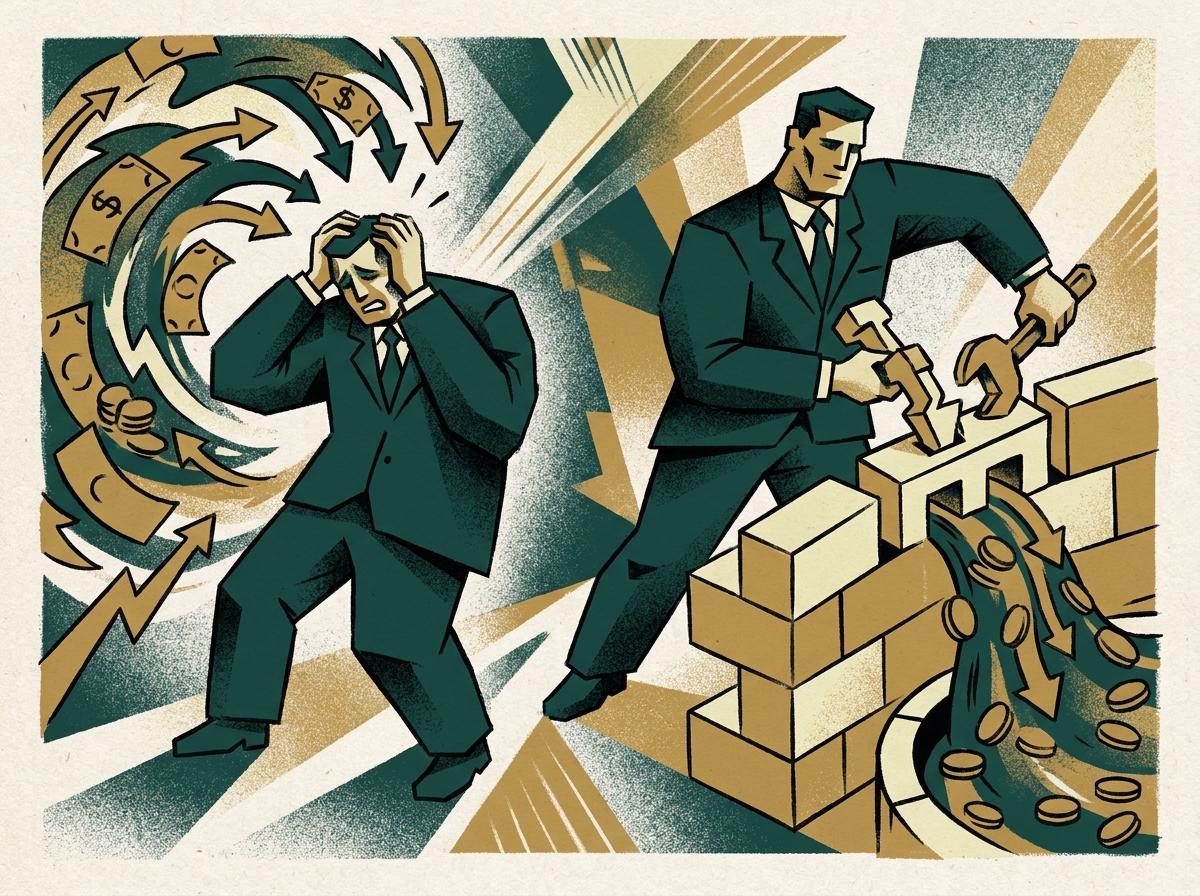
My role in these moments is to be the calm in the storm. I once worked with a CEO of a fast-growing logistics company who was on the verge of taking out a high-interest loan to cover a perceived shortfall. He was reacting to the fear. We spent three hours mapping out his cash conversion cycle on a whiteboard, identifying two specific bottlenecks in his invoicing process. We didn’t need a loan; we needed a better process and a targeted communication strategy for his biggest clients. We turned his anxiety into an operational improvement. That’s the job. It's not just finance; it's a form of crisis management rooted in emotional intelligence.
Aligning the Executive Team Behind Unpopular Financial Decisions
Securing executive team alignment on tough financial calls requires a strategic communication strategy that frames the decision around a shared mission and transparent data, not top-down authority. Whether it’s a budget cut, a departmental restructuring, or a pivot away from a founder’s pet project, these decisions can easily fracture a leadership team. Resentment builds, silos deepen, and execution grinds to a halt. A study by Leadership IQ even found that in 46% of companies, the executive team isn’t a cohesive unit but a collection of individuals.
This is where a fractional CFO’s emotional intelligence becomes a critical asset. Before the decision is announced, we work with the CEO to build the business case, anticipate objections, and craft a narrative for each stakeholder. I often act as a neutral facilitator in executive meetings, ensuring every voice is heard while steering the conversation back to the objective data. We depersonalize the conflict and focus the team on the strategic outcome. It’s about turning a moment of potential division into a moment of collective resolve.

The Ultimate ROI: Objective Counsel When It Matters Most
The true return on investment from a “CEO Whisperer” isn’t found in a spreadsheet, but in the value of having an objective, experienced partner during high-stakes moments of corporate crisis or opportunity. When you’re in the thick of it—a hostile takeover attempt, a product recall, or a global pandemic that upends your entire business model—your judgment can be clouded. Having an external strategic partner who understands your business intimately but isn’t caught up in the internal politics or emotional whirlpool is invaluable.
“The greatest value of a true advisor is the ability to tell you what you need to hear, not what you want to hear.”
Acting as a “CEO Whisperer” during a corporate crisis means serving as the designated rationalist. It’s about pressure-testing the crisis response plan, managing communication with the board and lenders, and, most importantly, keeping the CEO focused on the critical few decisions that will determine the company’s future. The ROI of this kind of partnership is immense; studies on the impact of executive coaching, a related discipline, show a median ROI of over 7 times the initial investment, according to research highlighted by American University.
Ultimately, the numbers are just the language. True executive financial leadership is about interpretation, translation, and communication. It’s about building the organizational health and business resilience to not just survive the inevitable storms, but to emerge from them stronger, smarter, and more unified than before.

References
