
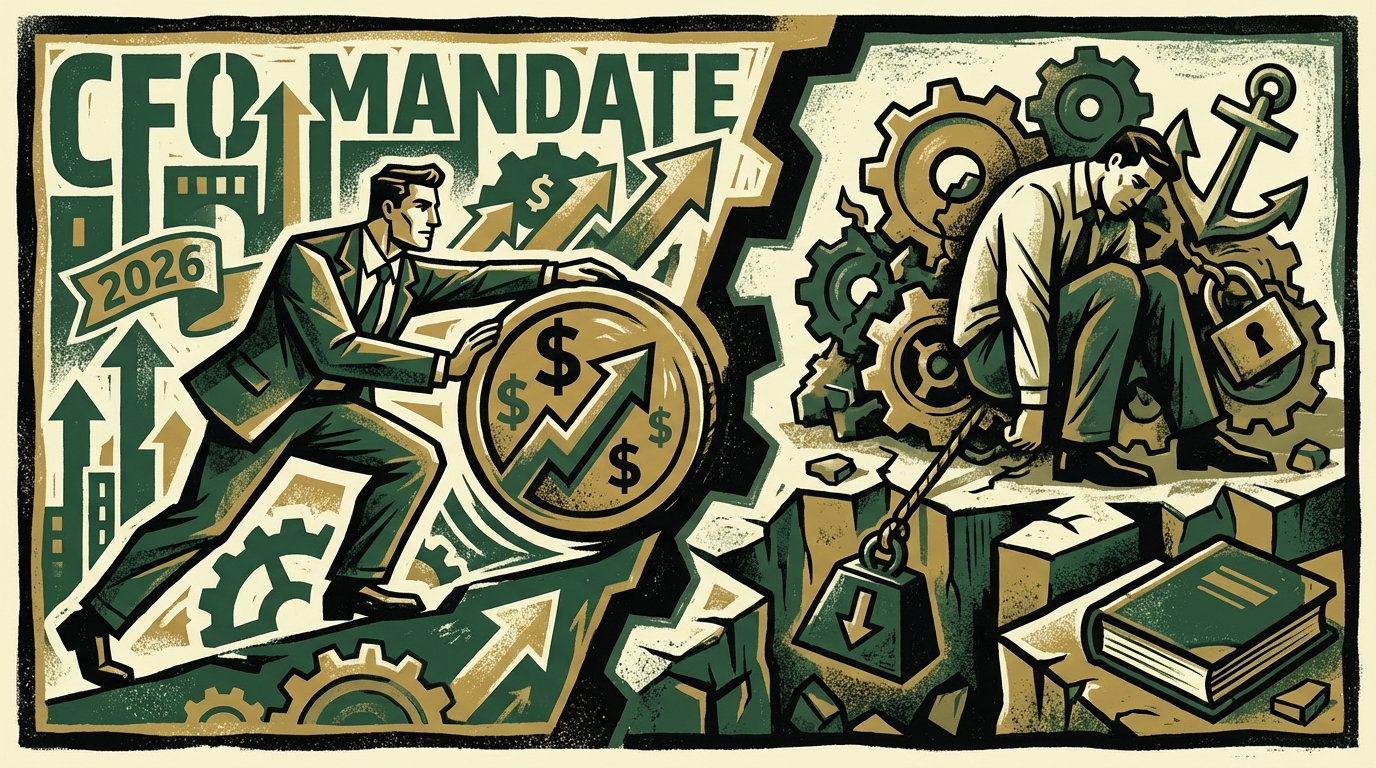
The 2026 CFO Mandate: Why 'Maintenance Mode' Is Now a Liability
Published: 2026-01-23 • Estimated reading time: 8 min
I once sat in a boardroom so sterile you could have performed surgery on the mahogany table. The CEO, a brilliant product visionary, was staring at a spreadsheet that might as well have been written in ancient Akkadian. His controller, a perfectly competent man, had just spent twenty minutes explaining, with excruciating detail, the quarterly variance in office supply expenses. The company was six months from a cash-flow cliff, and we were talking about the rising cost of paper clips.
This scene, or some variation of it, is playing out in countless mid-market companies right now. The financial leadership is stuck in 'maintenance mode'—a reactive, history-obsessed state that treats accounting as a janitorial function. In the placid economic waters of the last decade, you could get away with that. In 2026, it's a liability that will sink you. The game has changed, and what you need isn't a historian. You need a co-pilot. This is the new mandate, and it's why the demand for strategic Fractional CFO services has never been more acute.
The Era of Passive Finance is Over
The age of treating the finance function as a passive, backward-looking reporting center is definitively closed. The new mandate for financial leadership is to be a proactive, forward-looking strategic partner who actively drives growth and mitigates risk. This shift requires a fundamental change in mindset, moving from simply counting the money to making the money count.
We're staring down the barrel of an economic environment defined by what I call 'compressive volatility.' It’s not just one headwind; it's a dozen of them, all hitting at once. Supply chain disruptions are no longer black swan events; they're the Tuesday forecast. According to a recent J.P. Morgan market outlook, persistent inflation and geopolitical instability are the new constants. In this climate, a budget that's 12 months old is a historical document, not a strategic one. A staggering 74% of CFOs surveyed by Deloitte expect to face higher costs for talent and materials this year, making passive financial management a surefire way to bleed out. This isn't a temporary storm; it's a new climate. Your financial leadership needs to be built for it.

Strategic Clarity vs. Operational Noise
Strategic financial clarity is the ability to distinguish between the critical signals that drive future growth and the operational noise of day-to-day accounting. While a controller is essential for managing the noise—ensuring bills are paid and books are clean—a strategic CFO is responsible for interpreting the signals to chart the company's course. The former looks at the ledger; the latter looks at the horizon.
My team at Greenwood sees this distinction every day. A controller will tell you what you spent on marketing last month. A strategic CFO will build a model to tell you the projected lifetime value of customers acquired from that spend and advise whether to double down or cut the cord. One is reporting history; the other is shaping the future. This difference is particularly stark in a volatile economy.
The Controller vs. The Strategic CFO
A traditional controller is a master of historical accuracy and compliance, which is a non-negotiable part of the business. However, their primary function is defensive. A strategic CFO, on the other hand, plays offense. They are architects of profitability optimization, not just expense tracking. According to a study by BCG, companies that dynamically reallocate resources throughout the year—a core CFO function—grow 40% faster than their peers who stick to static annual budgets.
Here’s how my team breaks down the roles for our clients:
Thinking your controller can double as a strategic CFO is like asking an air traffic controller to fly the plane. They are both critical to a safe flight, but they are not the same job. This is the fundamental value proposition of engaging with high-level Fractional CFO services; you get the pilot without having to buy the whole airline.

The Greenwood Perspective: Integrating Strategy with Execution
The Greenwood Methodology is our proprietary framework for transforming the finance function from a cost center into a strategic growth engine. It’s built on the belief that a financial plan is useless unless it’s a living document that informs daily execution. We integrate strategic financial planning with operational reality through a three-phase process.
1. The Diagnostic: Beyond the Balance Sheet
Our initial engagement begins with a deep diagnostic that goes far beyond a typical financial audit. We analyze unit economics, customer acquisition costs, sales cycle efficiency, and working capital cycles to uncover the true drivers of your business. We don't just look at your P&L; we map the flow of every dollar from prospect to profit. This process identifies the 2-3 key metrics that actually predict future success, not the 20 vanity metrics that clutter most dashboards.
2. The Blueprint: Dynamic Cash Flow Forecasting
We replace static, useless annual budgets with a dynamic, 13-week cash flow forecasting model. This is the beating heart of your financial intelligence. Updated weekly, this blueprint allows us to model scenarios in real-time. What happens if our largest client pays 30 days late? What if a key supplier raises prices by 15%? Instead of panicking, you have a plan. This agile approach to forecasting is a critical tool for risk mitigation in an unpredictable market.
3. The Execution: Driving Profitability Optimization
Finally, we translate the blueprint into action. We work with your leadership team to tie departmental goals to financial outcomes, ensuring that every operational decision is vetted for its impact on profitability and cash flow. This isn't about slash-and-burn cost-cutting; it's about surgical investments. It's about understanding which levers to pull to generate the highest return, a sentiment echoed by experts at CFO.com who note that CFOs are increasingly focused on technology-driven efficiency to combat rising costs.

Your Next Move: Auditing Your Financial Leadership
Your next move is to conduct an honest audit of your company's financial leadership capabilities. The financial stewardship that got you to $5 or $10 million in revenue is rarely sufficient to get you to $50 million, especially in this economy. The era of the passive scorekeeper is over. The 2026 mandate demands a strategic partner in the finance chair.
Ask yourself and your team these questions:
Does your head of finance spend more time discussing last quarter's results or next quarter's strategy?
Can your finance team tell you the profitability of a single customer, product line, or sales channel within five minutes?
When was the last time your finance leader brought you an unsolicited idea that created enterprise value, rather than just a report that protected it?
Are your strategic decisions backed by a dynamic financial model, or are they based on gut feel and an outdated annual budget?
If the answers make you uneasy, it doesn't mean you have the wrong people. It means you have a gap in strategic capability. The good news is, you don't need a $400,000 full-time hire to close it. You need targeted, strategic horsepower. You need a navigator who has flown this route before.

Frequently Asked Questions
What is the primary role of a Fractional CFO?
A Fractional CFO's primary role is to provide high-level strategic financial guidance on a part-time or project basis. Unlike a controller who manages daily accounting, a Fractional CFO focuses on forward-looking activities like strategic financial planning, cash flow management, raising capital, and acting as a strategic partner to the CEO.
How does a Fractional CFO differ from a traditional Controller in a volatile economy?
In a volatile economy, a Controller's role remains focused on accurate historical reporting and maintaining compliance. A Fractional CFO's value skyrockets, as they focus on risk mitigation, scenario modeling, and identifying opportunities for profitability optimization amidst the uncertainty. They build financial resilience, while a controller simply records the impact.
What is the 'Greenwood Methodology' for financial clarity?
The Greenwood Methodology is a three-step process designed to align financial strategy with operational execution. It involves: 1) A deep Diagnostic to identify key value drivers, 2) Building a dynamic 13-week Cash Flow Forecasting Blueprint, and 3) An Execution phase focused on data-driven decision-making and continuous profitability optimization.
Is my company big enough for Fractional CFO services?
While every company is different, businesses with over $5 million in annual revenue typically reach a level of complexity where strategic financial guidance becomes critical. If your company is facing challenges like managing rapid growth, preparing for a capital raise, or navigating significant market uncertainty, it is likely ready for the expertise that Fractional CFO services provide.
References
