
Scenario Planning for 2026: Modeling the 'Soft Landing' vs. Recession
Published: 2026-04-18 • Estimated reading time: 8 min
Let’s be honest. The annual budget your team spent three months agonizing over last fall is already a work of fiction. By the time the ink dried, the underlying assumptions about interest rates, customer demand, and the geopolitical mood music were obsolete. We’re all pretending to navigate with a map of a country that no longer exists. This is why CEOs can replace static annual budgets with dynamic, real-time financial modeling that instantly shows which decisions unlock value in a “soft landing” versus which safeguard survival in a recession—transforming economic uncertainty from a threat into a competitive advantage.
My team and I have spent the last decade tearing down these fossilized rituals inside companies from $5 million startups to nine-figure enterprises. We replace them with living, breathing models that act as a co-pilot, not a rearview mirror. The goal isn’t to predict the future with perfect accuracy. It’s to build a machine that tells you the implications of different futures, instantly, so you can make the right call when it matters.
Static Budgets Are Dead
A static budget is a financial plan that, once set, remains unchanged for the duration of the period, regardless of shifts in the business environment. It’s an artifact from a bygone era of predictable, linear growth. In today’s economy, a static budget is worse than useless; it’s dangerous. It anchors your decision-making to a single, imagined future, breeding a false sense of security while reality diverges wildly. When your actuals inevitably deviate, the variance analysis becomes an exercise in archaeology, explaining what went wrong yesterday instead of informing what you should do tomorrow.
Dynamic forecasting, by contrast, is a living system. It’s a tool for continuous dialogue with the market. Here’s how they stack up:
Switching from a static to a dynamic model isn’t just an upgrade in spreadsheet technology; it’s a fundamental shift in corporate philosophy. It’s an admission that we don’t know what’s going to happen, but a declaration that we’re prepared for whatever does.
The Three Scenarios: Base, Bull, and Bear
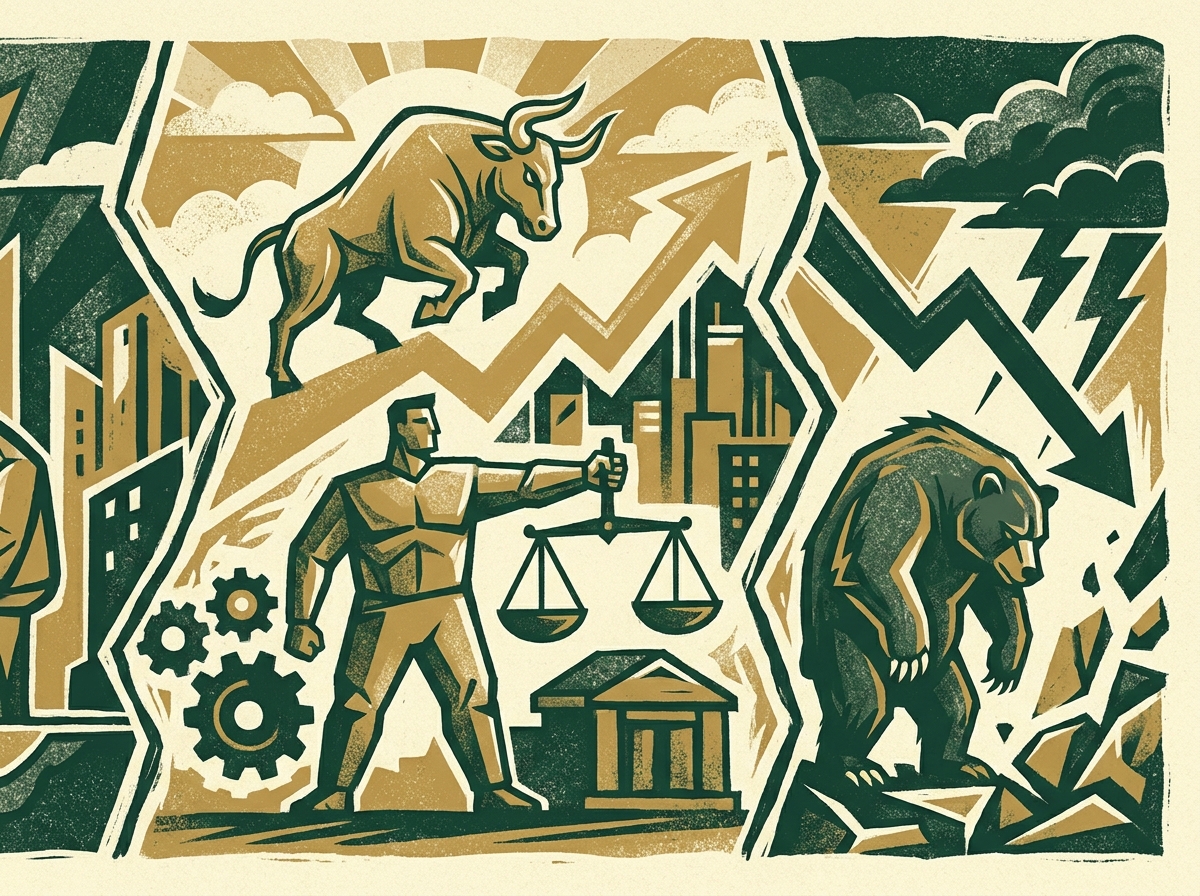
The core of effective scenario planning involves building a robust financial model for three distinct potential futures: your expected case, an optimistic case, and a pessimistic case. This isn't about guessing; it's about defining the guardrails of possibility for your business in 2026. You’re mapping the territory so you won’t be surprised when you arrive.
The Base Case (The “Soft Landing”): This is your most probable reality, the “chalk” bet. For 2026, this might look like inflation continuing its slow march down, modest GDP growth of around 2%, and a stable labor market. It’s the consensus view. It should be challenging but achievable, grounded in your current pipeline and historical conversion rates.
The Bull Case (The Breakout): This is your upside scenario. What if that big partnership closes early? What if a competitor stumbles, sending a wave of new customers your way? Maybe the Fed cuts rates more aggressively than expected, unlocking new capital for your customers. In this model, you dial up key drivers: lead velocity increases by 20%, sales cycles shorten, and pricing power improves.
The Bear Case (The Recession): This is the one nobody wants to talk about but everyone needs to plan for. This is your “what if it all goes wrong?” scenario. A global supply chain shock, a sudden spike in unemployment, or a credit crunch that freezes customer budgets. In this model, you stress test your assumptions: sales cycles double, churn spikes by 30%, and accounts receivable days stretch out. The goal here isn't to be a pessimist; it's to be a survivor. You need to know exactly what levers you’d pull, and when, if this reality begins to unfold.
Key Drivers: Identifying Your Levers
Key drivers are the handful of operational and financial variables that have a disproportionate impact on your company’s performance. The magic of dynamic financial modeling isn’t in its complexity; it's in its elegant focus on the 2-5 variables that truly matter. For a SaaS company, this isn’t the budget for office snacks; it’s Customer Acquisition Cost (CAC), Net Revenue Retention, and Sales Rep Productivity. For a manufacturing firm, it might be raw material costs, machine uptime, and cost per unit.
Identifying these levers is the most critical step. My team and I start by asking a simple question: “If you could only know five numbers to determine the health of this business, what would they be?” The answers are incredibly revealing. We then build the model around these drivers, linking them directly to the financial statements.
Changing your churn assumption from 1.5% to 2.0% shouldn’t require a week of VLOOKUPs and frantic emails. It should be a single cell change that instantly ripples through your entire P&L, balance sheet, and cash flow statement, showing you the precise impact on your year-end cash balance and debt covenants.
Stress Testing Cash Flow
Cash flow stress testing is the practice of simulating how your cash balance would hold up under adverse business scenarios. Let me be clear: Profit is an opinion, but cash is a fact. You can go years showing a paper loss while growing, but you can only run out of cash once. This is where your Bear Case model becomes your most valuable insurance policy.
We run clients through a gauntlet of “what ifs” specifically targeting cash:
The A/R Shock: What happens if your three largest customers all pay 60 days late at the same time? Do you trip a loan covenant? Do you miss payroll?
The Revenue Drop: What if a new competitor erodes your market share, causing a sudden 15% drop in new bookings next quarter? How many months of runway do you have left?
The Cost Spike: What if a key supplier raises prices by 50% overnight? What’s the immediate impact on your gross margin and cash burn?
Answering these questions in a spreadsheet is uncomfortable. Answering them in a real-life boardroom crisis is a nightmare. The goal of this financial modeling exercise is to make your crucial decisions in a state of calm preparation, not panicked reaction.
Using the Model for Real-Time Decision Making
A dynamic model is used as an interactive tool for strategic decision-making, allowing leaders to simulate the financial impact of choices before committing to them. The model’s purpose isn’t to be “right”; its purpose is to be useful. It transforms from a static report into a strategic sandbox, a flight simulator for your business where you can crash and burn without consequence.
Here’s your checklist for making the model a part of your operational rhythm:
[ ] Link to Live Data: Connect your model to real-time data sources (your CRM, ERP, accounting software) to automate the “actuals vs. forecast” process.
[ ] Weekly “What If” Meetings: Instead of a monthly budget review that looks backward, hold a weekly 30-minute meeting that looks forward. Pose one strategic question and use the model to game out the scenarios.
“What’s the ROI of hiring two more engineers now versus in six months in our Base and Bull cases?”
“If the Bear case starts to materialize, at what exact revenue number do we freeze hiring?”
[ ] Decentralize Access: Give department heads access to the model. Let them see how asking for a bigger marketing budget impacts the company’s overall cash runway. It creates a culture of ownership and financial discipline far more effectively than any top-down edict.
[ ] Tie Scenarios to Triggers: Define the specific, non-negotiable triggers that would cause you to shift from your Base Case operating plan to your Bear Case contingency plan. Is it two consecutive quarters of missed targets? A drop in pipeline below a certain threshold? Write it down. This removes emotion from future hard decisions.
By embedding dynamic financial modeling into your company's DNA, you stop reacting to the economy and start navigating through it. Uncertainty remains, but ambiguity vanishes. You’ll know your options, you’ll know your triggers, and you’ll have the confidence to act decisively while your competitors are still trying to figure out what their Q3 variance report means.
Frequently Asked Questions
How do you build a dynamic financial model?
A dynamic financial model is built by identifying the key business drivers (e.g., sales volume, pricing, churn) and creating a flexible, interconnected three-statement model (P&L, Balance Sheet, Cash Flow) in a spreadsheet. The core principle is that changing a single driver assumption in one input cell automatically and accurately updates the entire model, allowing for instant scenario analysis.
What scenarios should you plan for in 2026?
For 2026, you should plan for at least three core scenarios: a Base Case representing the consensus “soft landing” economic outlook; a Bull Case where growth accelerates due to favorable market conditions or company-specific wins; and a Bear Case that models a potential recession, accounting for constrained customer spending and tighter credit.
How often should you update your scenario analysis?
Your scenario analysis should be updated on a rolling basis, not as a static annual event. A best practice is to review the model's assumptions and compare actuals to your forecasts on a monthly rhythm, while using the model for real-time decision-making in weekly strategic discussions. The model itself is a living document.
References
