

Annual Planning Is Dead: Rolling Forecasts for Companies Past $5M
- Strategic Financial Planning built on a static annual budget breaks the moment reality moves, and in a year of shifting rates, tariffs, and demand, reality moves by February. A rolling forecast fixes this by always looking twelve to eighteen months ahead.
- A rolling forecast is a living plan that adds a new period as each one closes, so the horizon never shrinks. It answers "where are we headed from here," while the annual budget only answers "how are we doing against a number we set last fall."
- Driver-based planning is what makes a rolling forecast worth the effort. You model the two or three operational drivers that actually move your revenue and cost, then let the numbers follow, instead of nudging line items by a hopeful percentage.
- Cadence beats ambition. A monthly reforecast on a handful of drivers that your team actually keeps up will out-predict a beautiful quarterly model nobody maintains. Roughly one in five rolling-forecast rollouts fails, almost always on discipline, not math.
- You do not have to blow up budget season to get here. Freeze the current annual budget as a baseline, stand up a lightweight rolling forecast beside it, and let the forecast quietly take over decision-making over a quarter or two.
I have a client, a founder of a roughly $12M products company, who used to open every planning meeting the same way. He would slide a thick, bound annual budget across the table, tap it twice, and say "this is the plan." By March that binder described a company that no longer existed. A key supplier had repriced, one product line had taken off, another had stalled, and interest on his line of credit had climbed enough to matter. The binder did not know any of that. It could not. It was a photograph of what he believed in October, and he was running a June business off it.
This is the quiet failure at the center of a lot of Strategic Financial Planning. Companies past $5M in revenue still plan the way a corner store plans: once a year, in a spreadsheet, with a number they defend for twelve months whether or not the world cooperates. Then they wonder why the finance function feels like it is always explaining the past instead of steering the future. The problem is not the team and it is not the spreadsheet. It is the calendar. Here is how I move clients off the annual binder and onto a rolling forecast their people actually use.
Why Static Budgets Fail In A Volatile Year
Bottom line up front: a static annual budget is a bet that the next twelve months will look like the assumptions you made in the fall, and that bet has been losing badly. As one CFO put it this year, in a world of geopolitical shifts and supply-chain fragility, a plan is obsolete before the ink is dry (The CFO). That is not doom-mongering. It is arithmetic. When interest rates move, a tariff lands, or demand pivots overnight, a rigid budget does not just become inaccurate. It becomes a trap, because your team keeps steering toward a target that no longer maps to the road (VertAccount).
The failure shows up in three predictable ways. First, variance reporting turns into archaeology. Your controller spends the back half of every month explaining why actuals diverged from a number that was fictional by Q2, which is time spent looking backward at a plan nobody believes. Second, the budget calcifies decisions. A hiring freeze or a capital hold gets justified by "it is not in the budget," even when the business in front of you clearly warrants the spend. The budget stops being a tool and starts being an alibi. Third, and most expensively, you lose the early warning. A static budget only tells you that you missed. It does not tell you, in February, that the trajectory is bending, while there is still time to do something about it.
None of this means budgets are useless. You still need an annual operating plan to set targets, allocate resources, and tell your board what "good" looks like. The mistake is asking that one document, written once, to also be your steering wheel for twelve months of a moving business. That is two different jobs, and a rolling forecast is built for the second one.

Rolling Forecast Fundamentals
A rolling forecast is a financial plan that always extends a fixed number of periods into the future, so that when a month or quarter closes, you drop it off the front and add a fresh period to the back. The horizon never collapses toward year-end. In practice most companies keep a continuous twelve to eighteen month view in front of them at all times (Cube). Contrast that with an annual budget, which by definition shrinks. In December, your budget gives you one month of forward visibility. A rolling forecast in December still shows you a full year ahead.
The difference is not academic, and the numbers back it up. IBM's Institute for Business Value found that organizations using rolling forecasts delivered roughly 12% greater accuracy than those relying on traditional budgets, cut budget-preparation time by about half, and saw a measurable lift in profitability (IBM). Think about what "half the preparation time" means for a company your size. The annual budget marathon, the one that eats October and November and leaves your finance lead resentful, gets replaced by a steady monthly rhythm that never balloons into a crisis.
Two design choices define a good rolling forecast. The first is horizon: twelve months is the right starting point for most businesses, extending to eighteen if your hiring, capital, or contract decisions need longer lead time (Wall Street Prep). The second is granularity, and this is where most companies overreach. You do not forecast all 300 lines of your general ledger every month. You forecast the handful of drivers that actually move the outcome and let everything else follow. Which brings us to the part that separates a real rolling forecast from a spreadsheet you re-save with a new date.
Driver-Based Planning In Practice
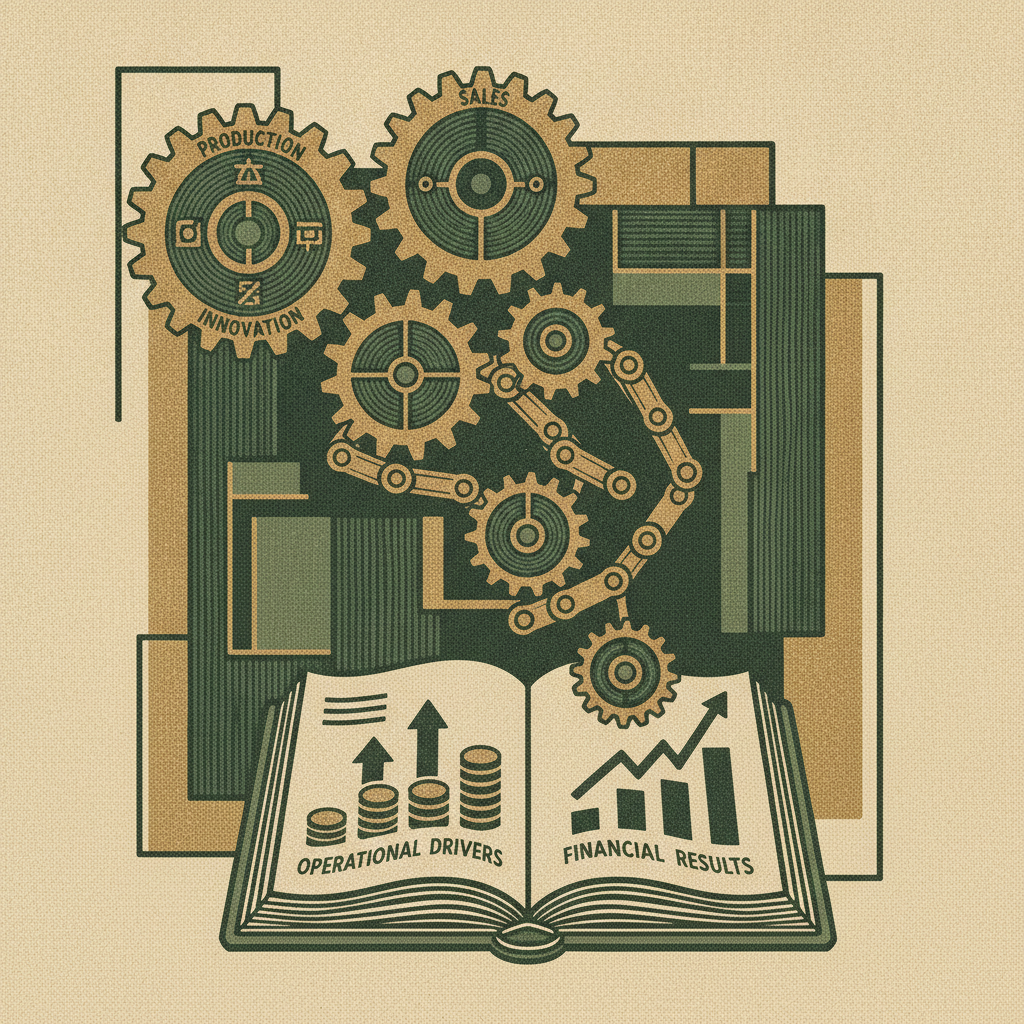
Driver-based planning means you build your forecast from the operational levers that cause your financial results, rather than from last year's numbers plus a hopeful percentage. Instead of "revenue grows 8% because it grew 8% last year," you model "revenue equals active accounts times average contract value times renewal rate," and then you forecast those three inputs. When one of them moves, the forecast moves with it, automatically and honestly.
Here is why this matters for a company past $5M. Percentage-based forecasting hides the story. If you tell me revenue will be up 8%, I cannot argue with you, because there is nothing underneath it to argue about. If you tell me revenue is up 8% because you expect to add 40 accounts at a $6,000 average while holding a 90% renewal, now we can have a real conversation. Is 40 accounts realistic given your current pipeline and close rate? Is $6,000 holding, or has discounting crept in? Every assumption becomes visible, testable, and ownable by the person who actually controls it. That is the whole game.
The discipline pays off, but only with structure around it. A 2025 Association for Financial Professionals survey found that 72% of organizations reported improved forecasting accuracy when they had strong governance protocols in place (AFP via Farseer), and among top-performing finance teams, driver-based methods are close to standard practice rather than a novelty (FP&A Trends). The practical move for most of my clients is to resist the urge to model everything. Pick the three to five drivers that explain the majority of your revenue and your largest variable costs. For a services firm that might be billable headcount, utilization, and average bill rate. For a products company, units, average selling price, and gross margin. Nail those, assign each to an owner who lives with the number, and you have a forecast that improves every month instead of one that decays.
Setting A Reforecast Cadence The Team Keeps
The best rolling forecast is not the most sophisticated one. It is the one your team actually updates, and that comes down to cadence. My rule of thumb is that your update frequency should match the speed at which your key drivers change (AccountsIQ). If you are in a fast-moving category where demand and pricing shift week to week, reforecast monthly. If your business has longer cycles, such as industrial, infrastructure, or steady professional services, a quarterly refresh may be plenty. For most mid-market companies I work with, monthly is the sweet spot, because it is frequent enough to catch trouble early but not so frequent that it becomes a treadmill.
There is a smart middle path worth knowing, sometimes called the quarterly-bias approach. You review and adjust your forecast monthly, but you only extend the horizon by a full quarter at the end of each quarter. That keeps a steady fifteen to eighteen month outlook in view while sparing your team the fatigue of rebuilding the far end of the plan every single month (NetSuite). It is the difference between a habit and a chore, and habits survive.
Whatever cadence you choose, protect it. A rolling forecast lives or dies on discipline, and the data is blunt about this: roughly one in five rolling-forecast implementations fails, and the usual causes are not analytical. They are a loss of management attention after the initial launch, difficulty getting honest forward assumptions from business-unit leaders, and underestimating how much process the thing requires (Farseer). Notice that none of those are math problems. They are leadership problems. The forecast only works if you put a standing meeting on the calendar, hold driver owners accountable for their inputs, and keep showing up after the novelty wears off.
Migrating Off The Annual Budget Without Chaos
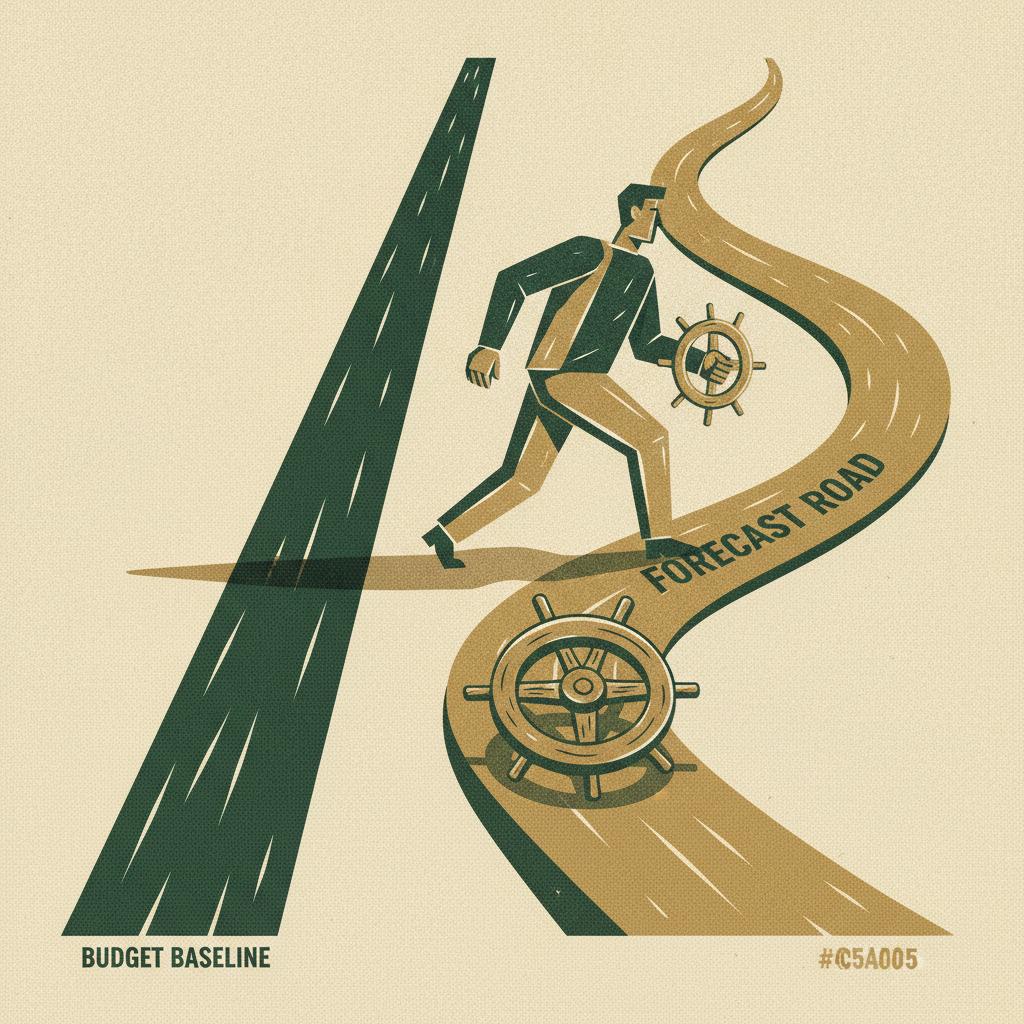
The most common objection I hear is that switching to a rolling forecast means detonating budget season and confusing everyone. It does not, and it should not. The clean way to migrate is to run both side by side for a transition period. Keep your current annual budget frozen as a baseline, the fixed yardstick you measure against and report to your board, and stand up a lightweight rolling forecast next to it. The budget stays the scorecard. The forecast becomes the steering wheel. Nobody has to give anything up on day one.
Start small on purpose. Build your first rolling forecast on only your top handful of drivers, on a twelve-month horizon, in the tool you already have. You do not need to buy planning software to begin, and buying it first is a common way to stall, because you spend three months configuring a system before you have proven the habit. Prove the habit in a spreadsheet, then let the pain of the spreadsheet tell you what to automate. Given that finance teams have been adopting analytics and AI tooling quickly, with Gartner reporting 58% of finance organizations using AI in 2024, a sharp jump over the prior year (Cube), the tools will be there when you are ready. Just do not let the tool selection become the project.
Over a quarter or two, something quiet and good happens. Your team starts quoting the forecast instead of the budget in decision meetings, because the forecast is the one that reflects the business they actually recognize. When that shift happens on its own, you are there. The annual budget recedes to what it was always meant to be, a target and a board document, and your live view of the future becomes the thing you steer by. That is Strategic Financial Planning that keeps pace with your company instead of describing a company you used to be.
If you are running a business past $5M off a binder that was already wrong by spring, this is exactly the kind of problem my team fixes. Schedule an introductory call and we will map what a rolling forecast would look like for your specific drivers.
Frequently Asked Questions
What is a rolling forecast?
A rolling forecast is a financial plan that always projects a fixed number of periods into the future. As each month or quarter closes, you drop it off and add a new period at the far end, so the horizon never shrinks toward year-end. Most companies keep a continuous twelve to eighteen month view. Unlike an annual budget, which becomes less forward-looking every month, a rolling forecast always shows you a full window ahead.
How is a rolling forecast different from an annual budget?
An annual budget is a fixed target set once and defended for twelve months. A rolling forecast is a living estimate of where the business is actually headed, updated on a regular cadence. The budget answers "how are we doing against the plan," and the forecast answers "where are we going from here." Most companies keep both: the budget as a baseline scorecard, the forecast as the steering wheel.
How do you implement rolling forecasts?
Start by freezing your current annual budget as a baseline, then build a lightweight forecast on your three to five most important operational drivers over a twelve-month horizon, in the tool you already use. Assign each driver to an owner, set a standing monthly review, and run the forecast alongside the budget until your team naturally starts making decisions from it. Automate only after the habit is proven.
How often should you reforecast?
Match your update frequency to how fast your key drivers change. Most mid-market companies do best with a monthly reforecast, which catches trouble early without becoming a treadmill. Slower-moving businesses can update quarterly. A popular middle path is to adjust monthly but only extend the horizon a full quarter at a time, keeping a steady fifteen to eighteen month outlook without forecast fatigue.
What is driver-based planning?
Driver-based planning builds your forecast from the operational levers that cause your financial results, such as active accounts, average contract value, units, or utilization, rather than from last year's numbers plus a percentage. You forecast the drivers, and the financial outcome follows. It makes every assumption visible and ownable, which is why top finance teams treat it as standard practice and governance-backed adopters report meaningfully better accuracy.
References
- IBM, "What Is a Rolling Forecast?"
- Cube, "Rolling Forecast Best Practices for FP&A."
- Farseer, "Rolling Forecasts: The Complete FP&A Guide."
- Wall Street Prep, "Rolling Forecast Best Practices Guide for FP&A Professionals."
- NetSuite, "What Is a Rolling Forecast? Pros, Cons, and Best Practices."
- AccountsIQ, "Rolling Forecasts Explained: How Mid-Market Finance Teams Reforecast Monthly."
- FP&A Trends, "Driver-Based Forecasting in FP&A: Common Pitfalls and Practical Solutions."
- VertAccount, "Your Annual Budget Is Obsolete: Why High-Growth Companies Use Rolling Forecasts."
- The CFO, "Five CFO Power Plays for 2026."
