
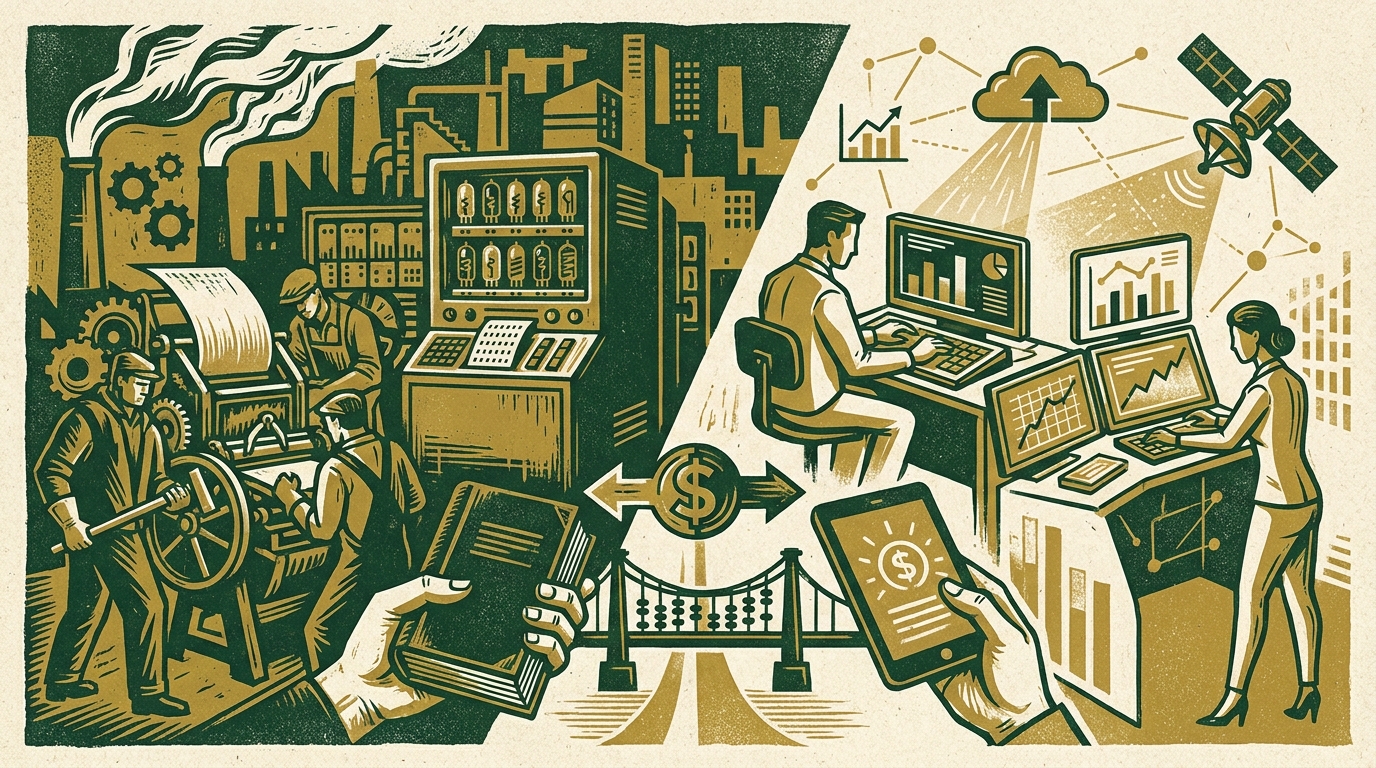
Real-Time Dashboards vs. Legacy ERPs: The Financial Modeling Cold War
Published: 2026-06-13 • Estimated reading time: 8 min
Here is a thing that happens in the lifecycle of every growing business. You are a CEO, you have crossed the five-million-dollar revenue mark, and you suddenly want to know what your money is doing. You want predictability. You want advanced financial modeling. So, you call a meeting. A consultant in a very nice suit sits across from you and delivers a grim diagnosis: to be a ‘real company,’ you must abandon your current software and embark on a massive, multi-year legacy system migration.
I sit across from founders facing this exact existential dread every single week. My team at Greenwood Business Consultants has watched the narrative unfold time and again. The consultant is pitching you a cold war—a battle of monolithic databases—when what you actually need is an agile insurgency.
The Executive Reality Check
Advanced financial modeling does not require a monolithic enterprise resource planning system; rather, it demands a lightweight integration layer connecting your existing tools to a dynamic visualization interface.
The prevailing myth in corporate finance is that “one big system” is the only path to professionalization. It is an appealing narrative. If all your data lives in one massive digital warehouse, surely it will be easier to understand, right?
Wrong. The single most important realization you can have as a mid-market executive is that investing first in an API-driven data integration layer and real-time dashboards yields exponentially greater value than a legacy overhaul. It is lower risk, higher reward, and vastly superior for actual decision-making.
The Seductive Trap of Enterprise Software
Enterprise software sells the illusion of control by promising a single, all-encompassing database for every financial transaction, which in reality creates a rigid, expensive monolith.
We call them legacy ERPs, and their sales pitch is nothing short of masterful. They promise to solve every siloed data problem you have ever experienced. But the reality is far more bruising. When you buy into a massive ecosystem, you are not just buying software; you are buying a philosophy of how your business must operate. You contort your unique business processes to fit their code.
Consider the statistics. A staggering 75% of large-scale system implementations fail to stay on schedule or budget, according to Gartner. The illusion of the all-in-one system shatters the moment you realize that to generate a customized cash flow forecast, you still have to export data into a spreadsheet. The system is too heavy, too brittle, and frankly, too slow for the modern pace of business.
Why Implementation Kills the Finance Team
The hidden costs of an ERP implementation lie primarily in the catastrophic loss of operational momentum, as your finance team spends months wrangling data instead of analyzing business performance.
Implementation costs are rarely limited to software licenses. If you are eyeing a NetSuite migration, the sticker price is just the cover charge. The true cost is extracted in human capital.
“The fastest way to burn out a brilliant CFO is to turn them into the project manager of a software deployment they never asked for,” notes a recent industry retrospective on finance tech failures. The average mid-market deployment distracts core staff for 9 to 12 months, draining over $250,000 in lost productivity and consulting fees, according to McKinsey.
While your team is mapping chart of account fields and arguing with implementation consultants over server protocols, who is watching the margins? Who is running scenario analyses? Nobody. The finance team is paralyzed.
The Agile Alternative: APIs and Intelligence
An agile finance strategy leverages API connectivity to automatically pull data from multiple existing systems into a centralized business intelligence layer, creating real-time dashboards without displacing your core accounting software.
Instead of ripping out the plumbing of your business, you simply add a smarter layer on top. We are living in the golden age of API connectivity. Modern data integration tools can silently extract your transactional data from QuickBooks, your sales data from Salesforce, and your payroll data from Gusto, funneling it all into a secure data warehouse.
Companies utilizing this API-first architecture report an 80% reduction in manual data entry. You get the unified view of the legacy monolith without the trauma of the migration. You achieve agile finance—the ability to pivot, forecast, and model scenarios without waiting for the month-end close to finalize.
Building a Tech Stack That Doesn’t Require a PhD
A modern, effective finance tech stack consists of three distinct layers: your transactional ledger, an automated data warehouse, and a visualization tool.
My team frequently helps founders construct this architecture. It is remarkably straightforward once you stop trying to buy an all-in-one magic bullet. By separating where data is recorded from where data is analyzed, you liberate your financial modeling capabilities.
Here is how the old world compares to the new world:
The Architecture of Modern Financial Modeling
Modern financial modeling relies on separating data storage from data analysis, allowing finance teams to manipulate variables in real-time without altering the underlying accounting records.
When you decouple the visualization from the ledger, magic happens. You can run Monte Carlo simulations on your real-time dashboards. You can drag a slider to see how a 10% dip in recurring revenue impacts next quarter's cash runway. Teams adopting this lightweight, layered approach achieve their targeted ROI 3x faster than those undergoing full system replacements, as highlighted by Deloitte.
Frequently Asked Questions
The following answers address the most common concerns executives have when evaluating their finance tech stack.
Do I need an ERP for advanced financial modeling?
No. Advanced financial modeling relies on the quality, structure, and accessibility of your data, not the underlying transactional system. Real-time dashboards powered by data warehouses are a far superior and more flexible option for most mid-market firms.
What are the hidden costs of an ERP implementation?
Beyond the software licensing, the true costs include external consulting fees, profound operational disruption, extensive staff retraining, and the severe opportunity cost of your finance team’s time being diverted away from strategic analysis.
How do real-time dashboards improve executive decision-making?
Real-time dashboards provide immediate, visual insights into cash flow, profitability, and operational metrics, entirely eliminating the traditional weeks-long wait for month-end close reports to make critical business pivots.
Can an API-driven finance tech stack handle multiple entities?
Yes. A properly configured data integration layer can easily pull ledgers from multiple subsidiary accounting instances into a single, consolidated business intelligence view, mimicking the primary benefit of an enterprise system at a fraction of the cost.
Is my business too small for a business intelligence layer?
If your business generates over five million dollars in revenue and relies on multiple SaaS platforms to operate, you have enough data complexity to benefit immensely from automated dashboards and centralized modeling.
References
The data and statistics cited in this article are derived from the following industry reports and analyses.
