

Measuring the Intangible: How to Calculate AI ROI in 2026
Published: 2026-04-11 • Estimated reading time: 8 min
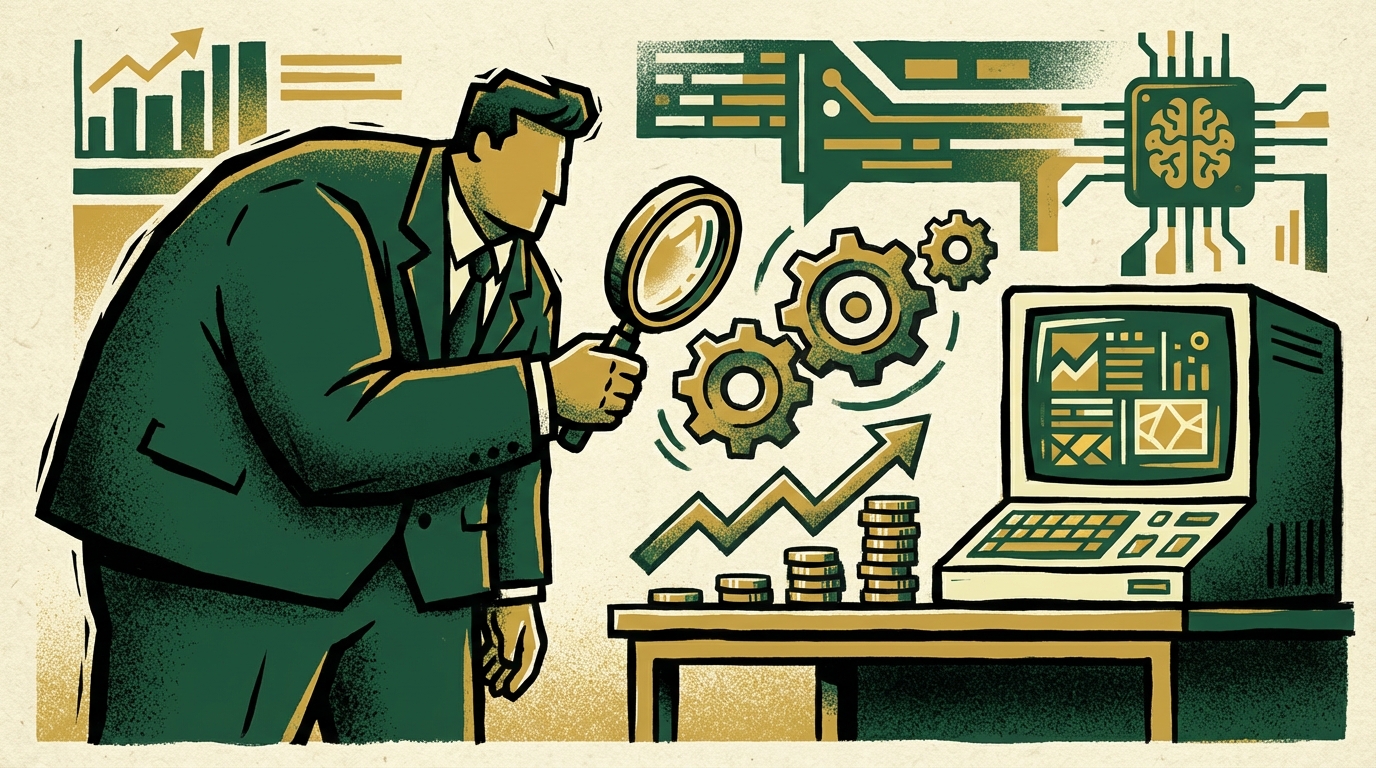
The year is 2026, and the great AI hangover is upon us. Remember 2024? The land of milk and honey, where every problem had a shiny new generative AI solution, usually paid for with a credit card and a prayer. Now, the bills are coming due. As CEOs, we’re staring at bloated expense reports, wondering how we ended up paying for seventeen different AI-powered copywriting tools that all sound suspiciously like the same Large Language Model in a different trench coat. The initial euphoria has faded, replaced by a single, nagging question from the board: “What’s the return on all this?”
Answering that question requires more than a simple expense report. It demands a new kind of Financial Modeling—one that can account for not just the obvious costs but the often-invisible, high-impact benefits. My team and I have spent the last 18 months in the trenches with leadership teams, building a framework to cut through the noise. It’s not about tracking clicks or API calls; it’s about measuring what actually matters: time, quality, and strategic advantage.
The 'Subscription Sprawl' Problem
“Subscription Sprawl” is the uncontrolled proliferation of software-as-a-service (SaaS) applications across an organization, leading to redundant functionalities, wasted spend, and significant security risks. It’s the digital equivalent of finding ten half-used bottles of ketchup in your refrigerator. Everyone on your team—from marketing to finance—signed up for the “next big thing” in AI, and now you’re left with a chaotic, expensive, and frankly, dangerous technology stack.

Let’s be honest, it happened to all of us. The promise was too great, the barrier to entry too low. But the numbers are staggering. Back in 2024, the average company was juggling 130 different SaaS apps, according to BetterCloud. My team's analysis suggests that number has easily doubled for the AI-forward enterprise. This tech spend audit isn’t just about spring cleaning; it’s a critical exercise in financial and operational hygiene. Without a firm handle on what you’re paying for and why, you’re simply lighting money on fire.
Hard ROI vs. Soft ROI: A Framework
Hard ROI represents direct, easily quantifiable financial gains like cost savings, while Soft ROI includes intangible benefits like improved decision quality, higher employee morale, and enhanced brand reputation that are harder to measure but often more impactful. Your CFO loves Hard ROI. It’s clean, it fits neatly into a spreadsheet, and it’s easy to defend. It’s the low-hanging fruit—the cost reduction analysis that shows you’ve replaced a $100k-a-year software package with an AI tool that costs $20k.
But the real magic, the true competitive advantage, lies in the murky waters of Soft ROI. This is where you find the strategic differentiation. It’s the AI that helps your legal team spot a critical risk in a contract before it blows up, or the one that gives your product team an insight that accelerates a launch by three months. Valuing these intangible assets is the central challenge—and opportunity—of the modern enterprise.

To make this concrete, here’s a simple breakdown my team uses:
Quantifying Time Saved (and Reinvested)
The financial modeling for time savings is calculated by multiplying the hours saved on a task by the fully-loaded hourly cost of the employee, then modeling the value of reinvesting that freed-up time into higher-value activities. This is where most leaders get it wrong. They see “time saved” and mentally bank it as a cost reduction. But you don’t fire a fraction of a person. The value isn’t in the time saved; it’s in how that time is reinvested.
Step 1: Baseline Your Processes
Baselining a process involves meticulously documenting the time and resources required to complete a task before AI implementation to create a benchmark for comparison. You cannot measure improvement if you don’t know your starting point. For one of our clients, we found their finance team was spending a collective 80 hours per month manually reconciling invoices. That was our baseline.
Step 2: Calculate the Raw Time Savings
Raw time savings are calculated with a simple formula: (Time per Task Pre-AI - Time per Task Post-AI) x Task Frequency x Number of Employees. In our client’s case, an AI-powered accounts payable platform reduced the reconciliation time to just 10 hours per month. That’s a raw savings of 70 hours—a significant boost in labor productivity.
Step 3: Model the Reinvestment Value
Modeling reinvestment value means assessing the strategic or financial impact of reallocating saved employee hours from low-value, automatable tasks to high-value work like strategy, innovation, or client engagement. The 70 hours our client’s finance team got back weren’t spent on longer coffee breaks. They were reallocated to proactive cash flow analysis and identifying working capital optimization opportunities. Within six months, that reinvested effort directly contributed to a 2% improvement in their cash conversion cycle. That’s real, measurable, strategic value.
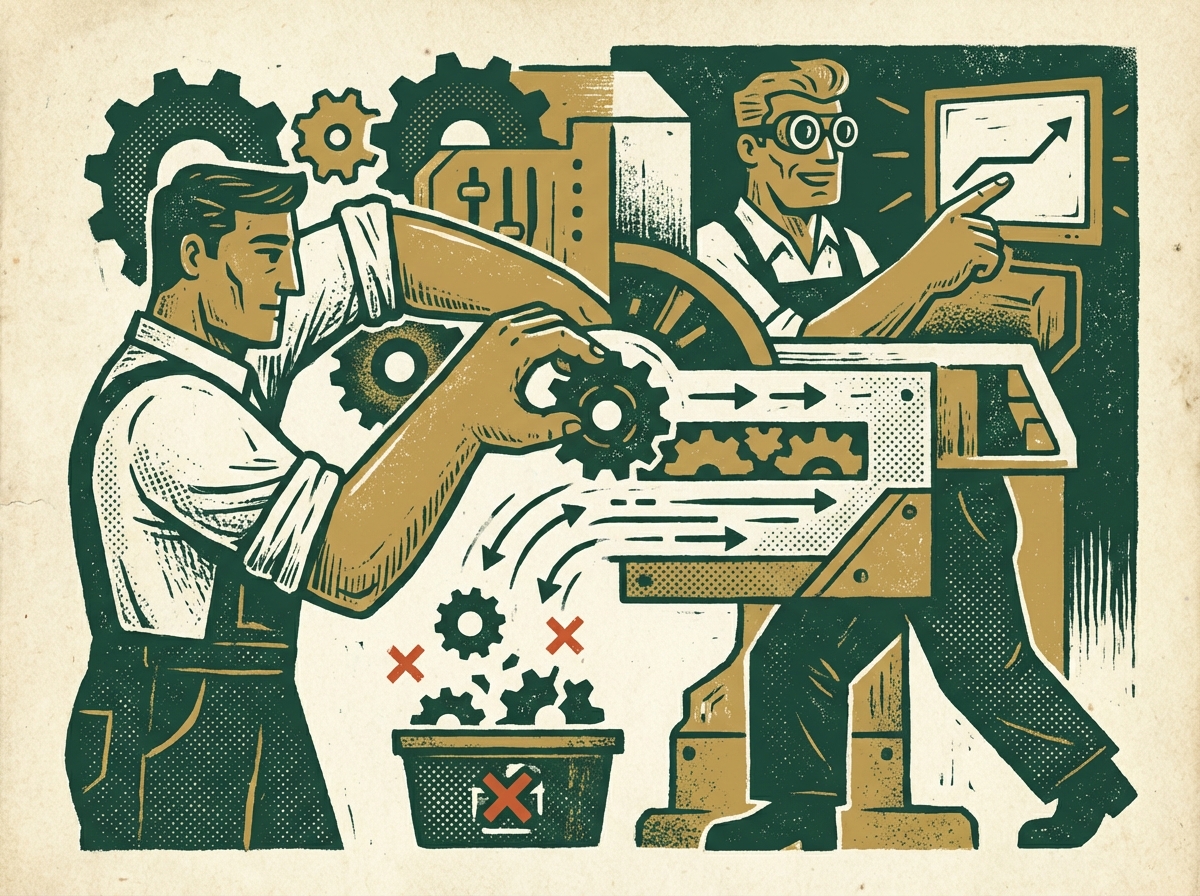
A recent Harvard Business Review survey highlighted that top-performing companies focus intensely on re-skilling employees whose tasks are automated, directly linking time savings to innovation enablement.
The 'Quality' Metric: Fewer Errors, Faster Decisions
The “Quality” metric quantifies the financial impact of AI-driven improvements in accuracy and speed, specifically by measuring the reduction in costly errors and the value of accelerated strategic decisions. This is often the most profound, yet most poorly measured, component of AI ROI. An AI that prevents one catastrophic human error—a faulty financial projection, a missed compliance deadline, a flawed engineering spec—can deliver a return that dwarfs its cost for a decade.
Think about it. What’s the value of making a go/no-go decision on a major capital expenditure a month faster, with 15% higher confidence in the data? What’s the cost of a single flawed internal control that an AI auditor would have flagged instantly? A McKinsey report found that high-performing organizations see AI not just as a cost-cutter but as a revenue generator, with 52% attributing at least 5% of their EBIT to AI. This revenue often comes from better, faster decisions that create new business opportunities.

Measuring this requires a shift in mindset. You need to attach a value to risk mitigation and opportunity cost. We work with leadership teams to run pre-mortems, asking, “What is the cost of getting this decision wrong?” When you frame it that way, the value of an AI tool that improves decision quality becomes crystal clear.
A Simple Scorecard for Your Tech Stack
An AI ROI scorecard is a simple framework used to evaluate and compare the business value of different AI tools by assigning scores to both quantitative and qualitative metrics. A recent Grant Thornton CFO survey revealed that while 78% of CFOs are increasing tech spend, their primary concern is a lack of clear frameworks for investment justification. This scorecard is the starting point.
Give this to your department heads. For every AI tool they want to keep, they need to fill this out. It forces a conversation grounded in business impact, not just cool features.
The AI Tool ROI Scorecard: [Tool Name]
Hard Cost Savings Score (1-5): What direct costs does this tool eliminate? (e.g., replaced software, reduced contractor spend). Score 5 for >200% of its own cost.
Time Savings & Reinvestment Score (1-5): How many hours does it save, and how are those hours being reinvested into higher-value work? Score 5 for significant time savings clearly linked to a strategic initiative.
Quality & Error Reduction Score (1-5): Does it measurably reduce errors in a critical business process? Does it improve accuracy and relevance? Score 5 for eliminating a known, costly source of errors.
Decision Velocity Score (1-5): Does it allow us to make important decisions faster and with more confidence? Score 5 for accelerating a core strategic decision loop (e.g., product development, M&A analysis).
Strategic Enablement Score (1-5): Does this tool unlock a new capability or business model that was previously impossible? Score 5 for enabling genuine competitive advantage.
Integration & Maintenance Drag (1-5, inverted): How much time, effort, and risk are involved in keeping this tool running? (e.g., vendor lock-in risk, data quality issues). Score 1 for high maintenance and friction.
Total Score: ___ / 30
Tools with a low score get cut. It’s that simple. This process transforms your tech spend audit from a subjective debate into a data-driven exercise in portfolio management.
Frequently Asked Questions
How do you measure the ROI of AI tools?
You measure AI ROI by creating a comprehensive financial model that captures both “Hard ROI” (direct cost savings, headcount efficiencies) and “Soft ROI” (quantified time savings, quality improvements, and accelerated decision-making). The key is to move beyond direct costs and model the business impact of reinvested time and reduced errors.
What are the 'soft' benefits that should be quantified?
The most critical soft benefits to quantify are time savings, decision quality, and error rate reduction. Time savings should be valued based on the employee's fully-loaded cost and the strategic value of the work their freed-up time is reallocated to. Decision quality and error reduction can be valued by modeling the cost of a negative outcome (e.g., a bad strategic bet, a compliance failure) that the AI helps prevent.
When should you cut an AI subscription?
You should cut an AI subscription when it fails to demonstrate a clear and justifiable return on investment through a structured evaluation. Using a scorecard that assesses its impact on hard costs, time savings, quality, and strategic value provides a data-driven basis for the decision. If a tool scores poorly and cannot be clearly linked to a core operational KPI or strategic objective, it should be cut to reduce tech bloat and reallocate funds to higher-performing investments.
