

Margin Expansion: The 2026 Mandate for Growth-Stage Founders
- Investors have stopped paying for growth at any price. Strategic financial planning in 2026 has to treat margin expansion as the headline metric, not a footnote to the growth story.
- The market is pricing the difference. McKinsey finds top-quartile software companies trade at a median 24x revenue versus 5x for the bottom quartile, and the split tracks efficient growth, not raw speed.
- Margin expansion starts at the top of the P&L. The 2025 subscription gross-margin median sits near 77%, and anything under 70% reads to investors as a cost-structure problem.
- Operating leverage is the real engine: when revenue grows faster than the fixed cost base, the gap between gross and operating margin widens on its own. That gap is the number to watch.
- Fewer than 20% of software companies consistently clear the Rule of 40, so the founders who plan margin expansion deliberately are competing against a field that mostly does not.
For a decade, the fastest way to raise the next round was to show a steeper growth curve and apologize for the burn later. That trade is over. Strategic financial planning in 2026 has to start from a harder premise: investors are rewarding efficient growth, and margin expansion has quietly become the headline metric that growth-stage founders are judged on. Growth still matters. It just no longer excuses the losses underneath it. My argument here is that margin expansion is not an austerity project you run when the market turns. It is a discipline you build into the plan, and the founders who treat it that way are the ones getting repriced upward.
The shift is visible in the multiples. According to McKinsey's work on efficient growth in software, the top quartile of B2B software companies trades at a median enterprise value of roughly 24 times revenue, against about 5 times for the bottom quartile. The line separating the two is not who grew fastest. It is who grew efficiently. That is the whole game now, and it is why I keep telling founders that revenue growth became the CFO's job again.

Why Efficient Growth Is Being Repriced
The repricing is not a mood. It is the market applying a rule it always believed and briefly forgot. When capital was free, boards funded growth on faith. When capital got expensive, they started asking what each dollar of growth actually cost. Strategic financial planning is now mostly the work of answering that question before the board asks it.
The bar is famously the Rule of 40, where your growth rate plus your profit margin should clear 40. The interesting part is how few companies actually reach it. Bain's software research finds that fewer than 20% of software companies consistently deliver Rule of 40 performance, even though nearly all of them aspire to it. That gap is the opportunity. Margin expansion is one of only two levers in the equation, and it is the one most founders have been trained to ignore.
McKinsey's classic "grow fast or die slow" analysis made the underlying point years ago: growth predicts value, but only growth the business can sustain. The 2026 version of that lesson is that the sustaining part now shows up in the margin line, in real time, in the multiple you are offered. Growth buys you attention. Margin expansion is what converts the attention into a valuation.

Gross Margin Is Where Margin Expansion Starts
Margin expansion has a natural starting point, and it sits at the very top of the income statement. Gross margin sets the ceiling on everything below it, because it decides how much of each new dollar of revenue is even available to cover the cost of running the company. Expand the gross line and every operating decision underneath it gets easier. Ignore it and no amount of expense discipline will save the operating margin.
The benchmarks are unforgiving. In the 2025 SaaS performance metrics, the overall gross-margin median lands near 77%, with healthy subscription businesses clearing 75 to 80 percent. Drop below 70% and sophisticated investors read it as a structural cost problem rather than a rounding error, because it usually is. A soft gross margin is where hosting waste, over-serviced accounts, and mispriced contracts all quietly accumulate.
The three real drivers are pricing, cost of goods, and mix. Raising price on the customers who are underpaying, pulling infrastructure and support cost out of delivery, and shifting the revenue base toward the higher-margin products each move the gross line without touching the growth rate. This is unglamorous work, and it is exactly the kind of margin expansion that compounds. It is also the point where a finance partner who owns the questions earns their keep, because the fix is almost never a single lever.
Operating Leverage Is the Real Engine
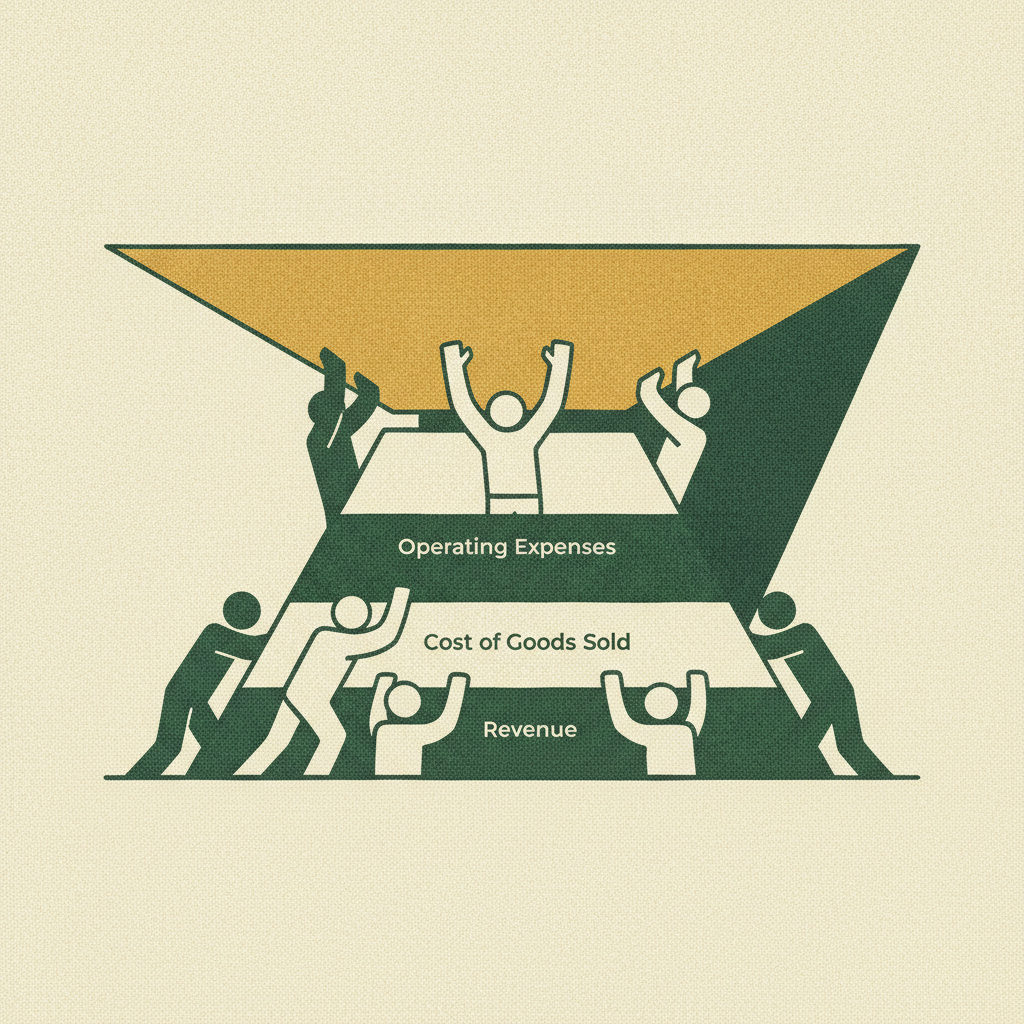
Gross margin sets the ceiling, but operating leverage is what actually carries margin expansion as you scale. Operating leverage is the simple, powerful idea that when a business has a largely fixed cost base, revenue growth flows to the bottom line faster than it flows in. Each new dollar of revenue meets a cost base that grew more slowly, so operating margin widens on its own, provided you hold the discipline.
The number to watch is the gap between gross margin and operating margin. As The SaaS CFO explains on operating leverage, that spread tells you how much of your gross profit the operating base is consuming in R&D, sales, and administration. Watch the gap narrow over several quarters and you are watching operating leverage arrive. Watch it stay flat while revenue climbs and you have a headcount and spend problem masquerading as a growth story.
This is where strategic financial planning does its most valuable work, because operating leverage does not happen by accident. It happens when you let revenue outrun a deliberately paced cost base. The trap is hiring ahead of the leverage on the theory that the growth will catch up. Sometimes it does. More often the fixed base ratchets up, the gap never closes, and the company has quietly bought itself a lower multiple. The same governance that disciplines where your next dollar goes is what protects the operating line.

A Strategic Financial Planning Playbook for Margin Expansion
Margin expansion becomes real when it lives in an operating rhythm instead of a spreadsheet. The founders who get it right do not run a one-time cost-cutting sprint. They install a cadence where the plan is revisited on a schedule and every quarter has an explicit margin target that sits right next to the growth target. When the two goals share the same page, the tradeoffs stop being theoretical.
The sequence matters. Start by fixing the gross line, because it is the highest-leverage and the least painful: reprice the underpriced, retire the unprofitable, and pull cost out of delivery. Then pace the operating base so revenue can outrun it, funding the roles that create leverage and starving the ones that only add fixed cost. The discipline is not spending less on everything. It is spending deliberately on the few things that widen the gap between what you sell and what it costs to run the company.
None of this requires a full-time finance chief. Plenty of growth-stage companies get this executive discipline on a fractional basis long before they can justify the seven-figure hire, which is the logic behind the fractional versus full-time CFO decision. What matters is that someone senior owns the margin target with the same seriousness they owned the growth target, and that the founder can read the tradeoff themselves. I spend real time coaching founders to read their own financials precisely so the margin conversation is not outsourced to the person building the model.

What Strategic Financial Planning Looks Like From the Founder's Seat
From the founder's seat, margin expansion should not feel like retreat. It should feel like the growth story getting more credible. A plan built for 2026 has a growth number and a margin number on the same slide, and it can explain how the second improves while the first holds. If your plan can only defend the growth line, you are bringing last decade's story to this decade's market.
Expect three habits from a strong plan. First, a stated margin trajectory, not just a growth trajectory, so the board sees where operating leverage is supposed to show up and when. Second, an honest read on the gross line, because a soft gross margin will undo any operating discipline beneath it. Third, a bias toward the tradeoff, where every growth investment is weighed against what it does to the margin path rather than assumed to pay for itself later.
The reframe I want every founder to keep is this. Growth gets you into the conversation. Margin expansion is what the market is actually buying in 2026, and it is a choice you make in the plan long before it shows up in the multiple. Build it in on purpose, or explain later why the valuation did not follow the growth.

Frequently Asked Questions
What Is Margin Expansion?
Margin expansion is the deliberate widening of a company's profit margins over time, usually gross margin and operating margin, without sacrificing the growth rate. It comes from pricing power, lower cost of delivery, favorable product mix, and operating leverage as revenue outgrows a mostly fixed cost base.
Why Is Margin Expansion the 2026 Mandate for Founders?
Because investors have shifted from rewarding growth at any cost to rewarding efficient growth. Top-quartile software companies trade at several times the revenue multiple of the bottom quartile, and that split tracks efficiency, so a credible margin path now drives valuation as much as the growth rate does.
What Is the Difference Between Gross Margin and Operating Margin?
Gross margin is revenue minus the direct cost of delivering the product, and it sets the ceiling on profitability. Operating margin subtracts the operating expenses of running the business, such as R&D, sales, and administration. The gap between the two shows how much operating leverage the company is generating as it scales.
How Does Operating Leverage Drive Margin Expansion?
Operating leverage means a largely fixed cost base lets revenue grow faster than costs, so each new dollar of revenue adds more to operating profit. When revenue outruns the fixed base, operating margin widens on its own. The signal is the gap between gross and operating margin closing over several quarters.
Do I Need a Full-Time CFO to Plan Margin Expansion?
No. Many growth-stage companies get this executive-level financial planning on a fractional basis well before a full-time CFO is justified. What matters is that someone senior owns a margin target alongside the growth target and installs the operating rhythm that keeps both in view.
References
