

Convertible Notes: Caps, Discounts, and the Math
- The convertible note is a common early-stage instrument, and understanding its mechanics, caps, discounts, interest, and maturity, is essential to a sound Fundraising Strategy.
- A convertible note is short-term debt that converts to equity at your next priced round. Unlike a SAFE, it is a loan with a maturity date, interest, and a repayment obligation if it does not convert.
- The valuation cap sets the maximum valuation at which the note converts, rewarding early investors when the next round prices higher.
- The discount, typically 20%, gives noteholders a further price break, and when both apply, the investor takes whichever is better.
- Interest of 4 to 8% accrues and converts into equity, and maturities of 18 to 24 months create a deadline you must plan around.
The convertible note is one of the most widely used and least understood instruments in early-stage fundraising. Founders sign them to raise quickly and defer the valuation conversation, often without fully grasping how the cap, discount, interest, and maturity interact to determine what the note actually costs them at conversion. That gap is dangerous, because the terms you agree to now decide how much of your company those early dollars buy when the note converts. Understanding the math is a core part of Fundraising Strategy. Here is how a convertible note works, term by term, and how to do the conversion math that reveals its true cost.
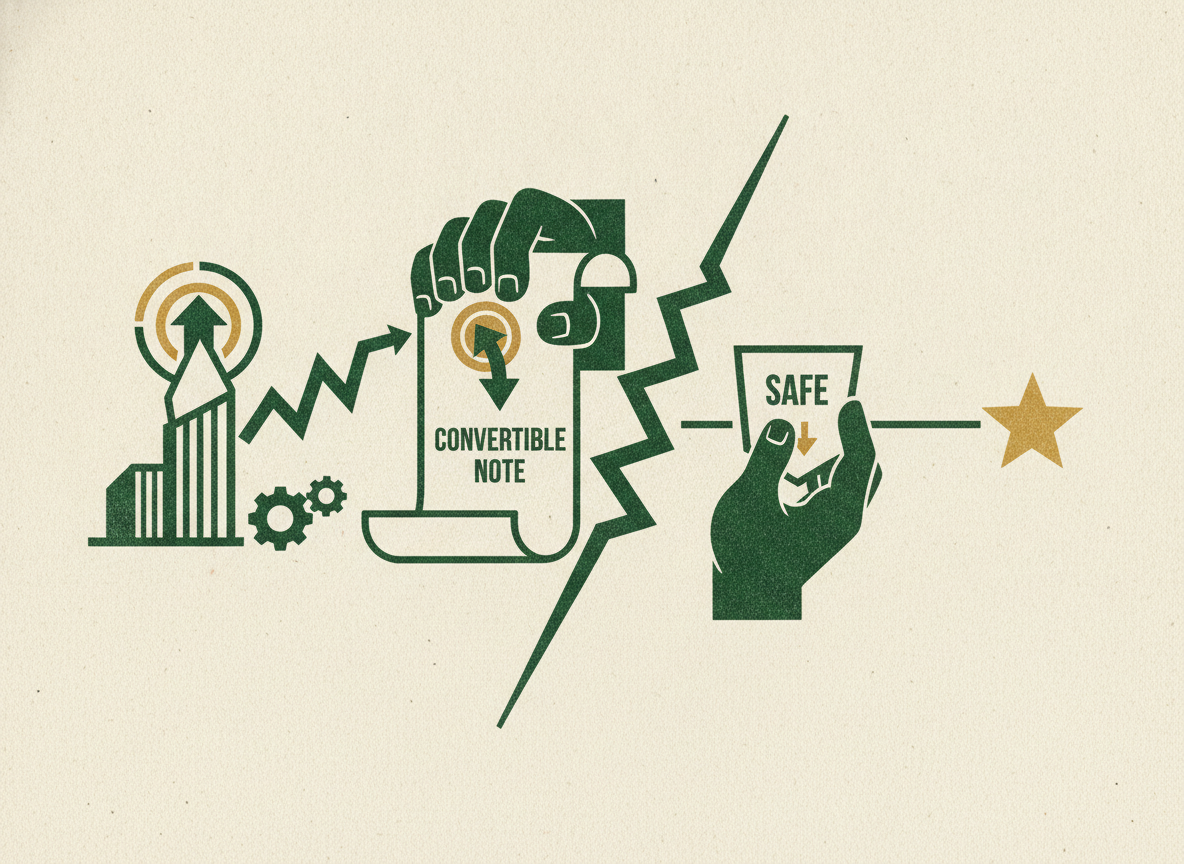
What a Convertible Note Is (and How It Differs From a SAFE)
A convertible note is a short-term debt instrument that converts into equity at a later financing event, usually your next priced round. You raise money now as a loan, and instead of repaying it in cash, the balance converts into shares when you raise a qualifying equity round, as Avisen Legal explains. This lets you raise capital quickly and defer the valuation negotiation to the priced round, which is the main appeal for founders.
The crucial distinction from a SAFE is that a convertible note is genuinely a loan, with the features that implies. It has a maturity date, it accrues interest, and if it does not convert by maturity, the noteholders technically have the right to demand repayment. A SAFE, by contrast, is not debt and has no maturity or interest. This makes a convertible note somewhat more lender-friendly and somewhat more demanding on the founder, because the debt features, the interest accruing and the maturity deadline, create obligations a SAFE does not. For Fundraising Strategy, the choice between the two and the terms within a note both matter, and understanding that a convertible note carries real debt characteristics, not just a future equity conversion, is the starting point for using it well. The note's terms, which follow, are where its actual cost to the founder is determined.

The Valuation Cap: Rewarding Early Risk
The valuation cap is usually the most important term in a convertible note, because it sets the maximum valuation at which the note converts, protecting the early investor's upside. The cap is the ceiling: if your next round prices the company above the cap, the noteholder converts as if the round had priced at the cap instead, which gives them more shares for their money than the later investors who paid the full round price, as DLA Piper describes.
A concrete example shows the cap's power. A note with a $5 million cap that converts into a $20 million round converts as if the company were valued at $5 million, so the early investor receives shares as though they had invested at a quarter of the later valuation, a substantial reward for backing the company early. This is the cap doing its job: compensating early investors for the higher risk they took by ensuring they benefit from the value created between their investment and the priced round. For the founder, the cap is the term that most determines dilution, because a low cap means early investors convert into a large number of shares. Negotiating the cap is therefore a central Fundraising Strategy decision, balancing the need to attract early investors with the desire to limit how much of the company their notes will claim at conversion. A founder who does not model the cap's effect can be surprised by how much ownership the notes consume when they convert.

The Discount: A Second Reward
The discount is the second mechanism rewarding early investors, giving them a percentage off the price per share in the priced round. A discount of 20%, the most common figure, means the noteholder converts at 80% of the round's price per share, so they get more shares than the new investors paying full price, as Avisen Legal notes. The discount rewards the early investor for their earlier commitment, separate from the cap.
In most convertible notes, the cap and the discount both apply, and the investor receives whichever produces the better outcome for them at conversion. This dual-mechanism structure is important to understand, because it means the investor always gets the more favorable of the two: if the round prices below the cap, the discount governs; if it prices well above the cap, the cap governs and produces an even better result for the investor. As a founder, you should model both to see which will control and what dilution results, rather than assuming only one matters. The discount alone is a modest, predictable cost, but combined with the cap it can produce significant dilution in a strong up-round. Understanding that the investor benefits from the better of cap and discount, not just one, is essential to accurately assessing what a convertible note will cost you, and it is a detail founders frequently overlook in their Fundraising Strategy until the conversion math surprises them.

Interest and Maturity: The Debt Features
Because a convertible note is debt, it carries two features a SAFE lacks: accruing interest and a maturity date, both of which affect the founder. Convertible notes typically accrue simple interest of 4 to 8% annually, and this interest is added to the principal and converted into equity along with it, so the investor ends up with shares for both their original investment and the accumulated interest, as Kruze Consulting describes. The interest modestly increases the investor's ownership at conversion, though it is usually a small effect relative to the cap and discount.
The maturity date is the more consequential debt feature. Common maturities are 18 to 24 months, and if the company has not raised a priced round before the note matures, the noteholders technically have the right to demand repayment, as the New York Venture Hub emphasizes. In practice, investors usually extend the note, renegotiate terms, or accept conversion at a default valuation rather than forcing repayment from a company that likely cannot pay, but the maturity still creates real risk and a deadline. A founder must plan to raise a priced round, or otherwise address the notes, before maturity, rather than letting the deadline arrive unmanaged. The maturity is the term that most distinguishes the founder's obligations under a note versus a SAFE, and ignoring it is a Fundraising Strategy mistake, because it can put the company in a weak negotiating position if it arrives without a priced round in sight.

Doing the Conversion Math
The terms come together at conversion, and doing the actual math is what reveals the note's true cost, which every founder should do before signing. The mechanics are straightforward: at a qualifying round, the outstanding balance, the original principal plus accrued interest, is divided by the conversion price per share, which is calculated using the lesser of the cap-implied price or the discounted price, whichever benefits the investor more. The result is the number of shares the noteholder receives, as Avisen Legal lays out.
A worked example clarifies it. If your priced round sells shares at $2.00 each and the note carries a 20% discount, the note converts at $1.60 per share, so the investor's principal plus interest buys shares at $1.60 rather than $2.00, giving them more shares than the new investors. If the cap produces an even lower effective price, the cap governs instead and the investor does even better. Running this calculation, with your actual cap, discount, interest, and expected round price, tells you exactly how many shares your convertible notes will convert into and therefore how much they dilute you. This is the conversion math, and doing it before you sign is the single most important Fundraising Strategy discipline with convertible notes, because it turns the abstract terms into the concrete reality of how much of your company those early dollars will own. Founders who skip this math are the ones surprised at the priced round by how much ownership the notes consumed.

Frequently Asked Questions
What Is a Convertible Note?
A convertible note is a short-term debt instrument that converts into equity at your next priced round. You raise money now as a loan, and instead of repaying it in cash, the balance converts into shares when you raise a qualifying round. Unlike a SAFE, it is genuinely debt, with a maturity date, accruing interest, and a contractual repayment obligation if it does not convert, which makes it more demanding on the founder.
What Is a Valuation Cap on a Convertible Note?
The cap is the maximum valuation at which the note converts. If your next round prices the company above the cap, the noteholder converts as if the round had priced at the cap, giving them more shares than later investors. A $5 million cap converting into a $20 million round lets the early investor convert as though the company were valued at $5 million, a large reward for early risk and the term that most determines dilution.
How Do the Cap and Discount Work Together?
In most notes both apply, and the investor receives whichever produces the better outcome for them. If the round prices below the cap, the discount, typically 20 percent off the round price, governs; if it prices well above the cap, the cap governs and produces an even better result for the investor. Founders should model both to see which will control and what dilution results, since the investor always gets the more favorable of the two.
What Happens When a Convertible Note Matures?
Common maturities are 18 to 24 months. If the company has not raised a priced round by then, noteholders technically have the right to demand repayment. In practice, investors usually extend the note, renegotiate, or accept conversion at a default valuation rather than force repayment, but the maturity creates real risk and a deadline. A founder should plan to raise a priced round or address the notes before maturity arrives.
References
