

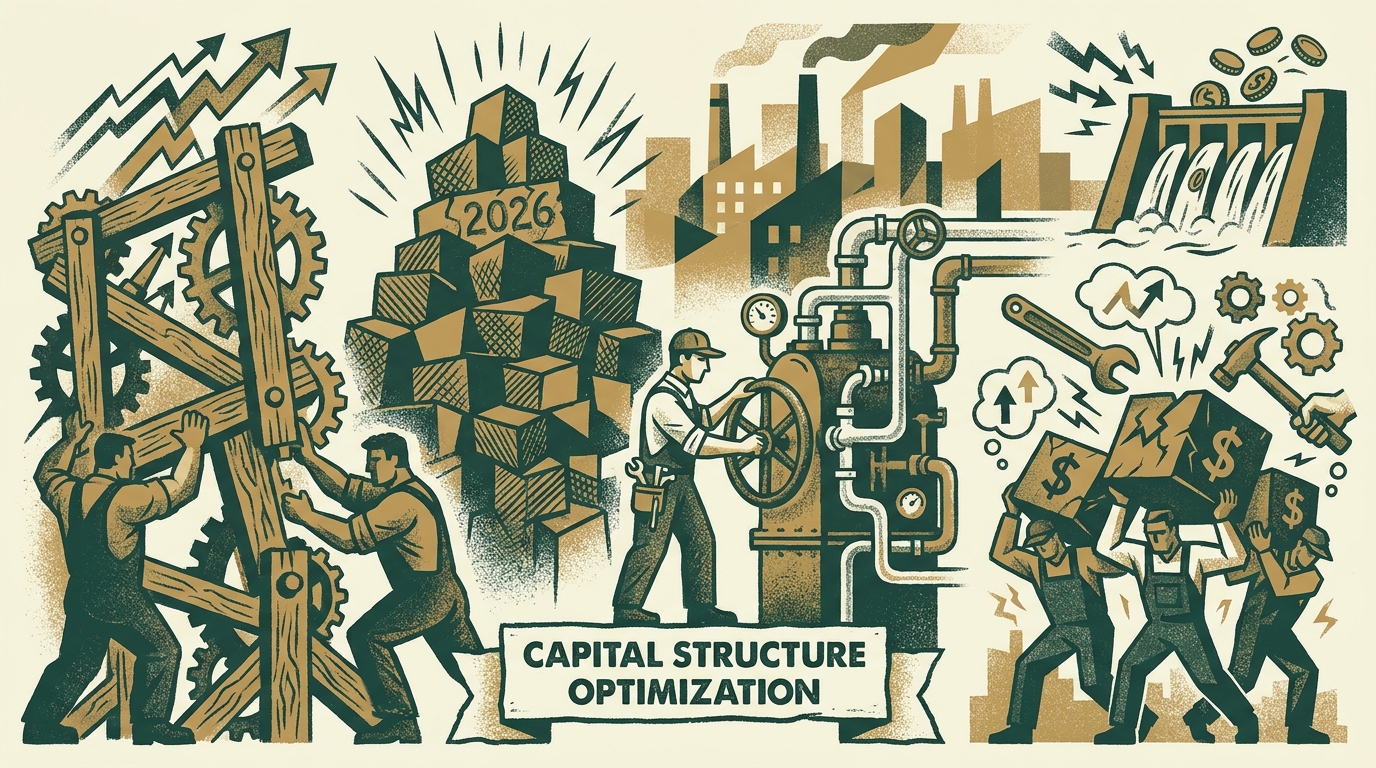
Capital Structure Optimization in 2026: Surviving High Interest Rates and Wage Pressures
Published: 2026-05-06 • Estimated reading time: 8 min
I sat across from the CEO of a fast-growing manufacturing firm last week, and she said something that’s been echoing in my head ever since: “It feels like the financial playbook I’ve used for a decade was written in a different language.” She’s not wrong. The era of cheap money is definitively over, and we’re now navigating a landscape where the two biggest line items for most companies—capital and labor—are both getting prohibitively expensive. This isn’t a temporary storm; it’s a climate change event for corporate finance. That’s why a forensic approach to capital structure optimization is no longer a “nice to have” for the CFO’s office; it’s the central strategic challenge for the CEO.
The confluence of stubbornly high interest rates and persistent wage pressures is creating a macro-level vise grip on mid-market companies. The cheap debt that fueled a decade of growth now comes with punishing terms, while a tight labor market continues to drive payroll costs skyward. My team and I are seeing this across our entire portfolio. Companies that once leveraged up to accelerate are now finding that same debt is a millstone, threatening to drown them as their margins get compressed from both sides.
The Macro Squeeze: Expensive Debt Meets an Expensive Workforce
The fundamental challenge is that companies are being squeezed by two powerful, opposing forces: the rising cost of borrowing and the escalating cost of retaining talent. For years, the Federal Reserve’s accommodative stance made debt financing the default tool for growth. But with the Fed signaling a “higher for longer” approach to combat inflation, that spigot has been tightened. Projections from institutions like J.P. Morgan suggest we shouldn’t expect a return to the near-zero rates of the past. This means that as debt from the early 2020s comes due, companies face a brutal refinancing shock, with interest expenses potentially doubling or tripling.
Simultaneously, the labor market remains one of the most significant headwinds. The U.S. is facing a structural workforce shortage, a trend expected to continue through 2026, according to analysis by the U.S. Institute of Quality. This isn’t just about finding people; it’s about affording them. While wage growth has shown some signs of moderation, real average hourly earnings still increased 1.1% over the last year, as reported by the Bureau of Labor Statistics. This puts direct pressure on profit margins, making it harder to service the very debt taken on to grow the business in the first place.
De-leveraging vs. Restructuring: Evaluating Your Debt Burden
Your first step in this new environment is to conduct an honest, unsentimental assessment of your company’s debt. De-leveraging involves actively paying down debt to reduce leverage ratios, while restructuring modifies the terms of existing debt without necessarily reducing the principal. The choice between them depends entirely on whether your debt is productive or simply a liability. Is it financing assets that generate returns well above the cost of interest, or is it a relic of a bygone era, slowly strangling your cash flow?
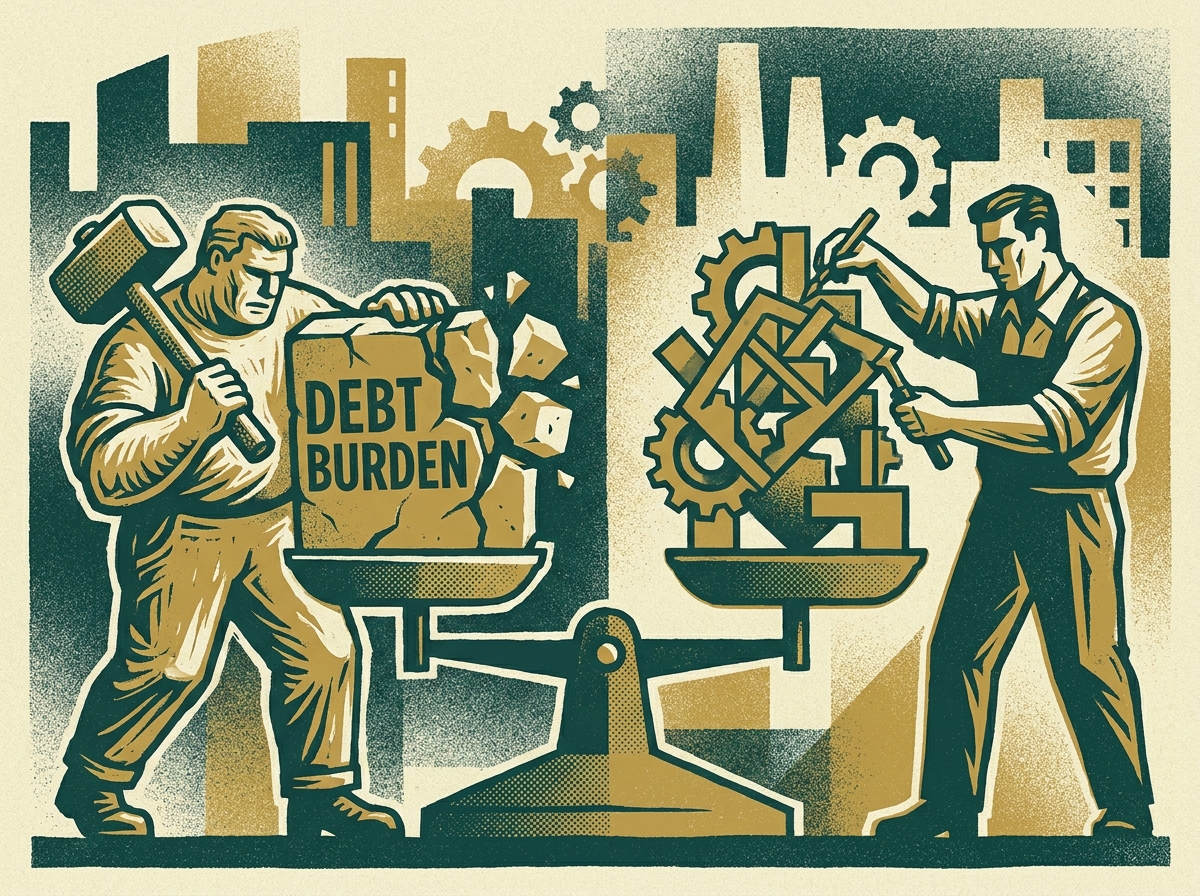
Many CFOs are staring down what TheCFO.io calls the “great refinancing shock,” a wall of maturities that must be rolled over at much higher rates. Global corporate bond maturities are projected to be substantial, with S&P Global noting that steep maturities lie ahead despite recent record issuance. For a mid-market company, this isn’t an abstract market trend; it’s a five-alarm fire. You have to decide whether to aggressively pay down that debt now (de-leverage) or negotiate for more favorable terms, like extending the maturity date or altering covenants (restructure). The latter often requires giving up something else—a higher coupon, more stringent reporting, or even equity warrants.
Here’s a simple framework my team uses to guide this decision:
The Cost of Equity: When Selling a Stake is Cheaper Than the Bank
Selling a stake in your company is often a cheaper financing option when the cost of debt exceeds the expected long-term cost of equity dilution. For founders, bringing on new equity partners can feel like a defeat—a dilution of control and future upside. But in 2026, it’s often the most rational, strategic move you can make. The math is simple: a 7-9% interest rate on a term loan is a fixed, near-term cash drain. The “cost” of equity, on the other hand, is a long-term, contingent cost that’s only realized upon a future exit or dividend distribution.

When I discuss this with founders, I frame it as trading a fixed expense for a variable one. Debt demands its pound of flesh every month, regardless of your performance. Equity partners, however, are in the boat with you; they only win if you win. In a volatile environment, that alignment is incredibly valuable. Furthermore, the right partner brings more than just capital—they bring expertise, networks, and strategic guidance that can accelerate growth, partially offsetting the dilution. Instruments like mezzanine debt, a hybrid that sits between traditional debt and equity, are also gaining traction as they offer lenders an equity “kicker” in exchange for more flexible terms, as outlined by experts at Ellty.
Working Capital Optimization as a Funding Source
One of the most powerful, yet overlooked, strategies for navigating this environment is treating your own working capital as a primary funding source. Optimizing working capital means unlocking the cash trapped on your own balance sheet by tightening the cash conversion cycle. It’s the cheapest money you’ll ever find because it’s already yours. Before you even think about calling a banker or a private equity firm, you should be forensically examining your accounts receivable, accounts payable, and inventory.
My team often finds that simple process improvements can free up millions in cash. Are you offering 60-day payment terms when your competitors demand 30? Are you holding six months of inventory when three would suffice with better forecasting? According to research from J.P. Morgan Asset Management, even minor improvements in Days Sales Outstanding (DSO) or Days Inventory Outstanding (DIO) can have a dramatic impact on liquidity. For example, a company with $50 million in revenue can unlock nearly $1.4 million in cash flow by reducing its cash conversion cycle by just 10 days. These operational wins strengthen your balance sheet, reduce your reliance on expensive external capital, and provide a buffer against rising labor and interest costs.
Stress-Testing Your Balance Sheet Against 2026 Labor Projections
Stress-testing your balance sheet is the process of modeling how your company’s financials would perform under various adverse scenarios, particularly those involving labor costs. It’s no longer enough to have a static budget; you need a dynamic financial model that simulates the future. The projections for the labor market are a perfect input for this kind of analysis. With the U.S. labor force participation rate projected to decline through 2034, as noted by Indeed Hiring Lab, the upward pressure on wages for skilled workers is unlikely to abate.
What does this mean for your capital structure optimization? It means you should be running scenarios now:
Scenario A: What happens to our debt service coverage ratio if wages increase by 5% next year with no corresponding price increase?
Scenario B: If a key supplier fails, how many days of cash do we have on hand to manage the disruption without drawing on our revolver?
Scenario C: If interest rates on our variable-rate debt jump another 150 basis points, where is our breakeven point?
This isn’t about predicting the future with perfect accuracy. It’s about building financial resilience. The insights from these stress tests, as guided by frameworks from organizations like GARP, should directly inform your capital structure decisions. If your model breaks under moderate wage pressure, it’s a clear signal that you’re over-leveraged and need to prioritize de-leveraging or raising equity before the crisis hits. A resilient balance sheet in 2026 isn’t just about having a low debt-to-equity ratio; it’s about having a structure that can absorb the shocks of an expensive and unpredictable world.
Frequently Asked Questions
How do high interest rates impact optimal capital structure?
High interest rates directly increase the cost of debt, making it a less attractive financing option. This fundamentally shifts the optimal capital structure away from high leverage and toward a greater reliance on equity financing and internally generated cash flow to fund operations and growth.
What strategies mitigate the financial impact of labor wage inflation?
To mitigate rising labor costs, companies should focus on aggressive working capital optimization to unlock internal cash, implement operational efficiencies to protect profit margins, and use financial stress-testing to model the impact of future wage hikes and ensure the balance sheet can withstand the pressure.
How should mid-market companies balance debt and equity in 2026?
In 2026, mid-market companies should prioritize balance sheet strength by de-leveraging expensive, variable-rate debt. They should view equity dilution not as a failure but as a strategic, and often cheaper, alternative to bank financing. The goal is to build a resilient capital structure that relies more on equity and internal funding to navigate the high-cost environment.
References
https://www.jpmorgan.com/insights/global-research/economy/fed-rate-cuts
https://www.usiq.org/blog/prediction-of-workforce-shortage-in-2026-key-trends-and-solutions/
https://the-cfo.io/2026/03/11/cfos-face-the-great-refinancing-shock/
https://www.jpmorgan.com/insights/treasury/trade-working-capital/optimizing-working-capital
https://www.garp.org/risk-intelligence/credit/stress-testing-a-practical-guide
