
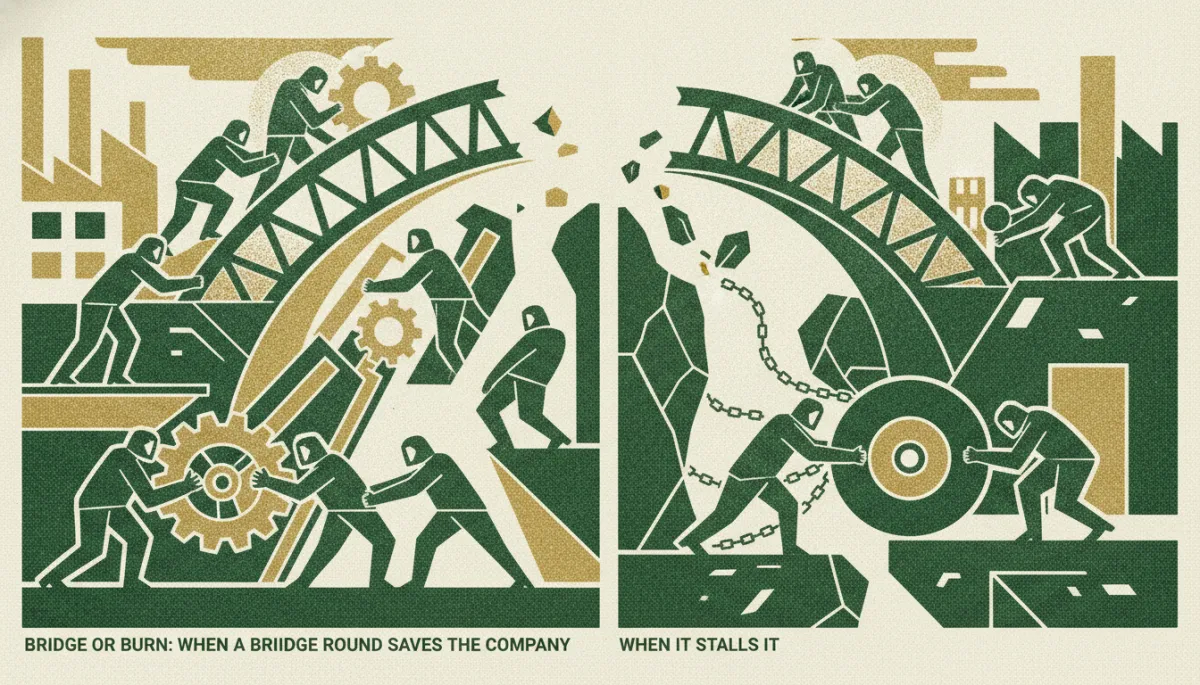
Bridge or Burn: When a Bridge Round Saves the Company and When It Stalls It
- A bridge round is a tool of Capital Structure Optimization, not a sign of failure. Used well it buys time to hit a catalyst; used poorly it just delays a hard truth at the cost of dilution.
- Bridges are now mainstream. In Q2 2025 about 16.6% of all startup cash came via bridge rounds, up from 11.8% a year earlier, and 46% of Q1 2025 seed deals were bridges.
- The deciding question is whether you have a clear, near-term catalyst the bridge funds you to reach: a signed contract, a product launch, a milestone that resets your valuation.
- Without a catalyst, a bridge is burn with extra steps. It postpones the reckoning and dilutes you on the way.
- Raise the bridge from strength, before you are desperate, and structure the discount and terms so you are not mortgaging the next round.
The word bridge makes founders flinch, because it used to whisper trouble. That stigma has faded, and for good reason: a well-timed bridge round is now a normal, even smart, piece of Capital Structure Optimization. The danger is not the bridge itself but using one to avoid a decision you should be making. A bridge that funds you to a real catalyst saves the company. A bridge that funds more of the same just burns money slowly. Here is how to tell which one you are about to raise.

What a Bridge Round Really Is
A bridge round is interim financing raised between priced rounds to extend runway, usually structured as convertible debt or a SAFE that converts into the next equity round. It is meant to carry you across a specific gap, hence the name, not to serve as a standalone round. The structure matters: because it converts later, a bridge defers the valuation question to your next priced round, which is exactly why timing and catalyst are everything.
Bridges have shed their old stigma and become a standard instrument. In the second quarter of 2025, roughly 16.6% of all cash raised by startups came through bridge rounds, up from 11.8% a year earlier, according to Carta. As Seedblink notes, investors no longer assume a bridge means trouble; what they look at is whether the company has traction and a reason for the bridge. Treated as a deliberate Capital Structure Optimization move, a bridge is just another financing tool with its own right uses.

The Catalyst Test: When a Bridge Makes Sense
A bridge makes sense when it funds you to reach a specific, near-term catalyst that improves your position before the next round. Investors back bridges when there is a clear event waiting on the other side: a signed customer contract about to activate, a product release that unlocks revenue, a regulatory approval that expands your market. The bridge exists to get you to that moment, after which you raise the next round on stronger terms.
The catalyst test is simple and unforgiving. Can you name the event, the date, and exactly how it changes your metrics or valuation? If yes, a bridge is a rational way to avoid raising a full round from a weak position today when a few months will materially strengthen your story. If you cannot name the catalyst, you do not have a bridge; you have a hope. The discipline of Capital Structure Optimization is refusing to raise interim capital unless there is a concrete reason the next dollar will be worth more than this one.

When a Bridge Is Just Delaying the Inevitable
A bridge becomes a trap when it funds more of the same instead of a change in trajectory. If the business is not working, money that buys six more months of the current plan does not fix anything; it just spends investor goodwill and your equity on a delay. The hard version of this conversation is the one founders avoid: sometimes the right move is not a bridge but a decisive cut to burn, a pivot, or an honest assessment that the path is not there.
The tell is the absence of a catalyst plus a story that depends on things outside your control improving. Hoping the fundraising market warms up is not a catalyst. Assuming churn will fix itself is not a catalyst. As re:cap frames it, a poorly managed bridge leads to excessive dilution and uncertainty rather than clarity. A bridge should change where you are going, not just how long you take to get there. When it only does the latter, it is burn with extra paperwork, and the kinder choice is usually to face the underlying problem now.

Structuring the Bridge Without Wrecking Your Cap Table
The terms of a bridge decide whether it strengthens or weakens your next round, so structure is where Capital Structure Optimization earns its name. Most bridges convert at a discount to the next round's price, and those discounts currently run 20 to 30 percent depending on the company's risk, per Seedblink. A steep discount or a low valuation cap can hand a large slice of your next round to bridge investors before new money even arrives, which is how founders wake up over-diluted.
Negotiate the discount, cap, and amount against the round you actually expect to raise, not just the cash you need today. Raising more bridge than necessary feels safe but compounds dilution at conversion. The cleanest bridges are sized to reach the catalyst with a modest buffer, carry terms that a future lead investor will accept without renegotiating, and avoid stacking complex provisions that scare off the next round. Model the conversion before you sign, so you know exactly what the bridge costs you when the priced round closes.

Raising the Bridge From Strength
Raise the bridge while you still have leverage, not when you are nearly out of cash. The best time to raise interim financing is before you urgently need it, when you still have runway, a clear story, and the ability to walk away from bad terms. Wait until the account is almost empty and you negotiate from weakness, which shows up as a worse discount, a lower cap, and rushed decisions you regret at conversion.
This is the same runway discipline that governs any raise, applied to the bridge. Open the conversation with several months of cash left and a sharp articulation of the catalyst, and investors engage with you as a company making a deliberate move. Show up desperate and they price the desperation. A bridge raised from strength reinforces investor confidence and can even preserve your valuation into the next round; a bridge raised in panic erodes both. The instrument is neutral. Whether it saves the company or stalls it comes down to having a real catalyst and the discipline to raise before you are forced to.

Frequently Asked Questions
What Is a Bridge Round?
A bridge round is interim financing raised between priced rounds to extend runway, usually as convertible debt or a SAFE that converts into the next equity round at a discount. It is designed to carry a company across a specific gap to a near-term milestone, not to act as a full standalone round. Bridges now make up a significant share of startup financing.
When Does a Bridge Round Make Sense?
When it funds you to reach a specific, near-term catalyst that strengthens your next raise, such as a signed contract activating, a product launch unlocking revenue, or a regulatory approval expanding your market. If you can name the event, the date, and how it changes your metrics, a bridge is rational. If you cannot, you do not have a bridge, you have a hope.
Do Bridge Rounds Look Bad to Investors?
Not anymore. The old stigma has faded, and bridges are now mainstream: about 16.6 percent of startup cash in Q2 2025 came via bridges. Investors care about traction and the reason for the bridge, not the label. If you have strong metrics and a clear catalyst, raising a bridge to get there does not hurt your ability to raise the next round.
How Much Do Bridge Rounds Dilute You?
It depends on the discount and cap. Convertible bridges typically convert at a 20 to 30 percent discount to the next round, so a large or steeply discounted bridge can hand a meaningful slice of your next round to bridge investors. Size the bridge to reach your catalyst with a modest buffer and model the conversion before signing, so you know the true dilution at the priced round.
References
