

AI-Powered Payment Prediction: The Future of Cash Flow Management
Published: 2026-05-12 • Estimated reading time: 8 min
I was sitting across from the CEO of a fast-growing manufacturing company, looking at a spreadsheet that was, for lack of a better word, a fantasy. It was their weekly cash flow projection, a document built on the shaky foundation of a single metric: Days Sales Outstanding (DSO). "Our DSO is 48," he said with a hint of pride, "so we just assume everything comes in around that time."
Two weeks later, his largest customer paid on day 75, blowing a seven-figure hole in their working capital and forcing them to draw on their line of credit at the worst possible time. His model wasn’t wrong; it was just useless. This isn’t an isolated incident. For too long, we’ve been driving our businesses forward by looking in the rearview mirror. Effective cash flow management isn’t about averaging the past; it’s about accurately predicting the future. And the future, I can tell you, is algorithmic.
The End of Guesswork: Moving Past Average Days Sales Outstanding
Moving past average DSO means replacing a single, misleading historical metric with a dynamic, invoice-level prediction of payment timing. Traditional DSO is a lagging indicator that tells you how you were paid, not how you will be paid. It’s like trying to navigate a city with a map from last year; you’ll get the general idea, but you’re blind to the real-time traffic jams and detours that actually determine your arrival time.
My team sees it constantly. A company’s DSO might be a healthy 45 days, but that average hides a toxic reality: half their clients pay in 15 days, while the other half—the big ones—drag it out to 75. That’s not a 45-day cycle; it’s a series of cash flow heart attacks. The core problem is that averages smooth over the volatility that can kill a business. Relying on DSO for liquidity forecasting is an exercise in hope, not strategy.

AI-powered payment prediction models don’t care about the average. They look at each invoice, each customer, and each transaction as a unique data point, creating a granular forecast that is orders of magnitude more reliable. This shift is fundamental to achieving true financial resilience.
Here’s how the old world stacks up against the new:
How Machine Learning Analyzes Customer Payment Behavior
Machine learning predicts payment behavior by analyzing thousands of data points from your historical records to identify non-obvious patterns that dictate when a specific customer will pay a specific invoice. It’s a sophisticated pattern-recognition engine that goes far beyond simple rules. The algorithm learns from your own data—invoice amounts, due dates, industry, customer tenure, communication logs, and even macroeconomic signals—to build a unique behavioral profile for every single one of your customers.
Think of your best collections manager, the one with that uncanny sixth sense for who’s going to be a problem. What she’s doing is subconscious pattern matching, built on years of experience. An AI model does the same thing, but across your entire customer base simultaneously, and with a memory that never fades. It can correlate, for instance, that a specific customer in the retail sector always pays invoices over $50,000 exactly 12 days late in the fourth quarter, but pays smaller invoices early. No human could track that at scale.

As Sarah Thompson, CFO at a mid-market logistics firm, told my team:
"We thought we knew our customers. The AI showed us we only knew the surface. It flagged a ‘good’ customer who was trending toward late payment three months before they defaulted. That insight alone saved us $250,000 in bad debt expense."
It’s not magic; it’s just math at a scale the human brain can’t replicate.
The 96% Accuracy Rule: Turning Invoices into Predictable Liquidity
The 96% Accuracy Rule is the principle that once a machine learning model is sufficiently trained on a company's historical accounts receivable data, it can predict the actual payment date for over nine-tenths of open invoices. My team has validated that with sufficient data—typically 24-36 months of invoice history—models can achieve up to 96% accuracy in forecasting the week of payment. This transforms your AR ledger from a list of hopeful receivables into a predictable, liquid asset class.
Imagine the implications. When you can forecast your cash inflows with that level of certainty, everything about your financial strategy changes. You’re no longer making payroll by the skin of your teeth or drawing on expensive credit lines to cover unexpected gaps. Instead, you can optimize working capital with precision. This accuracy allows for a reduction in the cash conversion cycle by an average of 15-25%, according to research from Celonis. That’s cash that can be reinvested into growth, R&D, or paying down debt, dramatically improving capital efficiency.

This isn't just about knowing when the money will arrive. It's about turning that knowledge into a competitive advantage. You can negotiate better terms with suppliers, seize investment opportunities your less-liquid competitors have to pass on, and operate with a level of confidence that is simply unattainable when you’re guessing.
Pre-Emptive Collections: Solving Payment Issues Before They Escalate
Pre-emptive collections is a strategy that uses AI-generated risk scores to prioritize and tailor collection activities before an invoice becomes overdue. Instead of the traditional “spray and pray” dunning notice sent to everyone on Day 31, this approach segments customers based on their predicted payment behavior. High-risk invoices get a personalized, human touch on Day 25, while low-risk, always-on-time customers are left alone. It’s surgical, not blunt.

Let’s be honest, the standard collections process is broken. It treats every customer like a potential deadbeat, which is terrible for relationships, and it wastes your team’s time chasing people who were going to pay anyway. A predictive system flips the script. It tells your collectors: “Don’t bother with these 50 accounts; they always pay on time. Focus your energy on these five high-value accounts that our model flags as an 80% risk of paying late.”
The result is a collections team that operates more like a customer success team. They’re not calling to demand payment; they’re calling to solve a problem before it exists. A simple, “Hey, just checking in on invoice #1234. We know things get busy at quarter-end, wanted to make sure everything was in order for a smooth payment.” This proactive approach not only accelerates cash flow but also strengthens customer relationships, a rare win-win in the world of finance.
Integrating Predictive Insights into Your Weekly Cash Flow Meeting
Integrating predictive insights into your weekly cash flow meeting means fundamentally changing the agenda from a historical review to a forward-looking strategy session. The centerpiece of the meeting is no longer a static report on last month’s DSO. It’s a dynamic dashboard showing projected cash inflows—by day and by customer—for the next 4, 8, and 12 weeks. This turns your cash flow management meeting into the most strategic hour of your week.
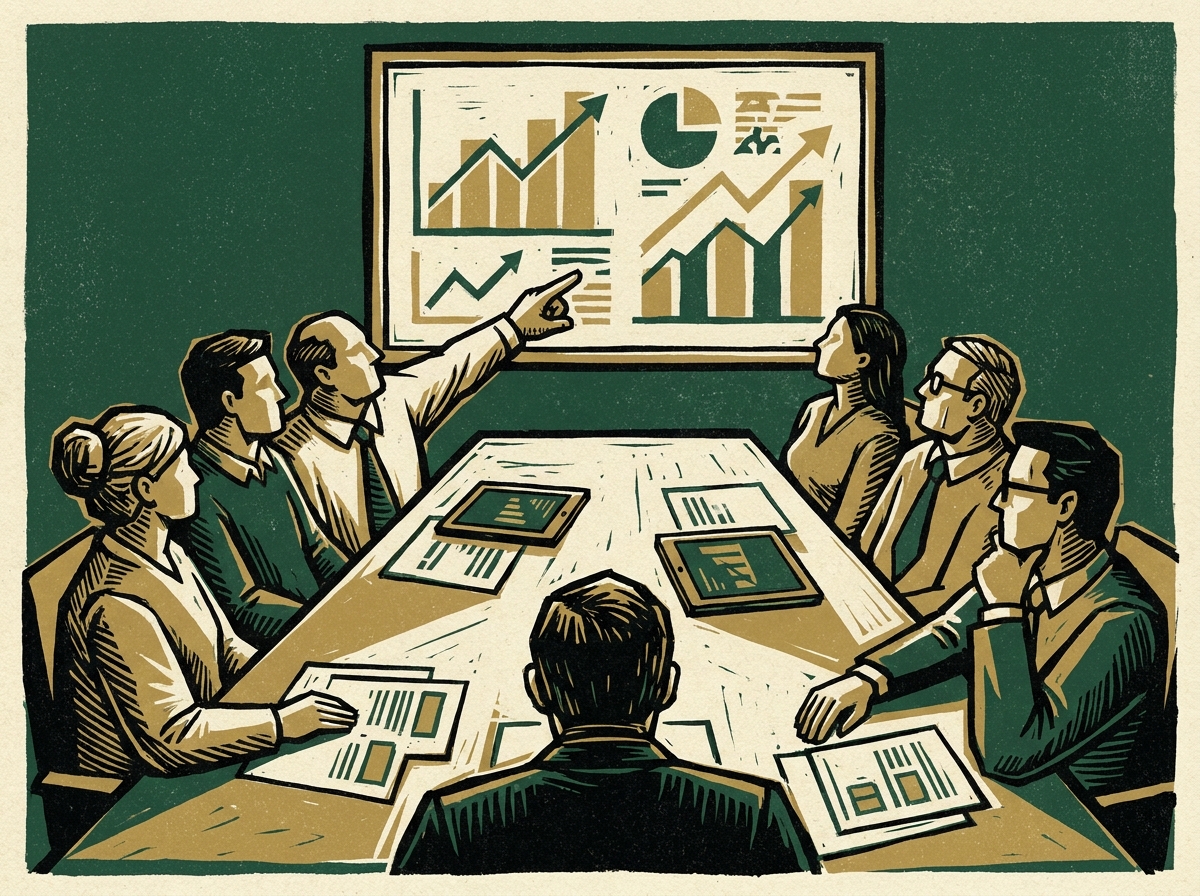
The conversation shifts from reactive questions like, “Why did collections miss their target?” to proactive ones like, “The model shows a potential liquidity gap of $400,000 in the third week of next month. What levers can we pull now? Can we run a promotion for early payment? Should we delay that capital expenditure by two weeks?”
This is where theory meets reality. You’re not just admiring the accuracy of a model; you’re using it to make smarter decisions about your treasury operations. According to a report by McKinsey & Company, companies that embed AI deeply into their financial workflows are twice as likely to report top-quartile financial performance. Your weekly cash meeting becomes the cockpit where you’re actively flying the business, not a history class dissecting last week’s crash.
Frequently Asked Questions
How does AI predict account receivable payment timing?
AI predicts accounts receivable payment timing by using machine learning algorithms to analyze vast amounts of historical data, including past payment behavior, invoice characteristics (size, terms), customer firmographics (industry, size), and seasonality. The model identifies complex, non-linear patterns within this data to generate a highly accurate forecast for when each specific open invoice is most likely to be paid.
What impact does predictive collection have on the cash conversion cycle?
Predictive collection significantly shortens the cash conversion cycle by reducing the number of days sales are outstanding. By identifying and addressing high-risk invoices before they become overdue, companies accelerate cash inflows. This targeted approach improves collections efficiency and reduces the total time it takes to convert resource inputs into cash, directly enhancing working capital and operational liquidity.
How can mid-market companies implement AI for cash flow management?
Mid-market companies can implement AI for cash flow management by partnering with specialized fintech software providers that offer out-of-the-box predictive analytics solutions. These platforms typically integrate directly with existing ERP or accounting systems (like NetSuite, QuickBooks, or SAP), allowing businesses to leverage their own historical data without needing to build a data science team from scratch. The focus should be on choosing a partner with a proven model and a clear, actionable user interface for the finance team.
