


Agentic AI in Finance: Governance Before Deployment
Published: 2026-03-07 • Estimated reading time: 9 min
I was sitting across from the CEO of a fast-growing manufacturing company last week, and he was practically buzzing. He’d just seen a demo of an “autonomous finance agent” that promised to completely overhaul his forecasting. It could, he was told, ingest real-time market data, read competitor earnings calls, and adjust his Q3 projections before his controller had even had her morning coffee. His question to me was simple: “Should I pull the trigger?”
My answer was just as simple: “Not without a seatbelt, a helmet, and a kill switch.” We’re at a fascinating, and frankly perilous, inflection point. The tools we’re being sold are no longer just fancy calculators; they are starting to think for themselves. This leap from passive analytics to active, autonomous agents is the single biggest shift in business technology I’ve seen in my career. And for companies that don’t get the governance right before deployment, it’s a recipe for disaster. The promise of a fully automated, hyper-efficient finance department, a kind of ultimate Virtual CFO, is tantalizing. But the risk of handing the keys to an unsupervised algorithm is a bet no founder should be willing to take.
From Chatbots to Agents: The New AI Frontier
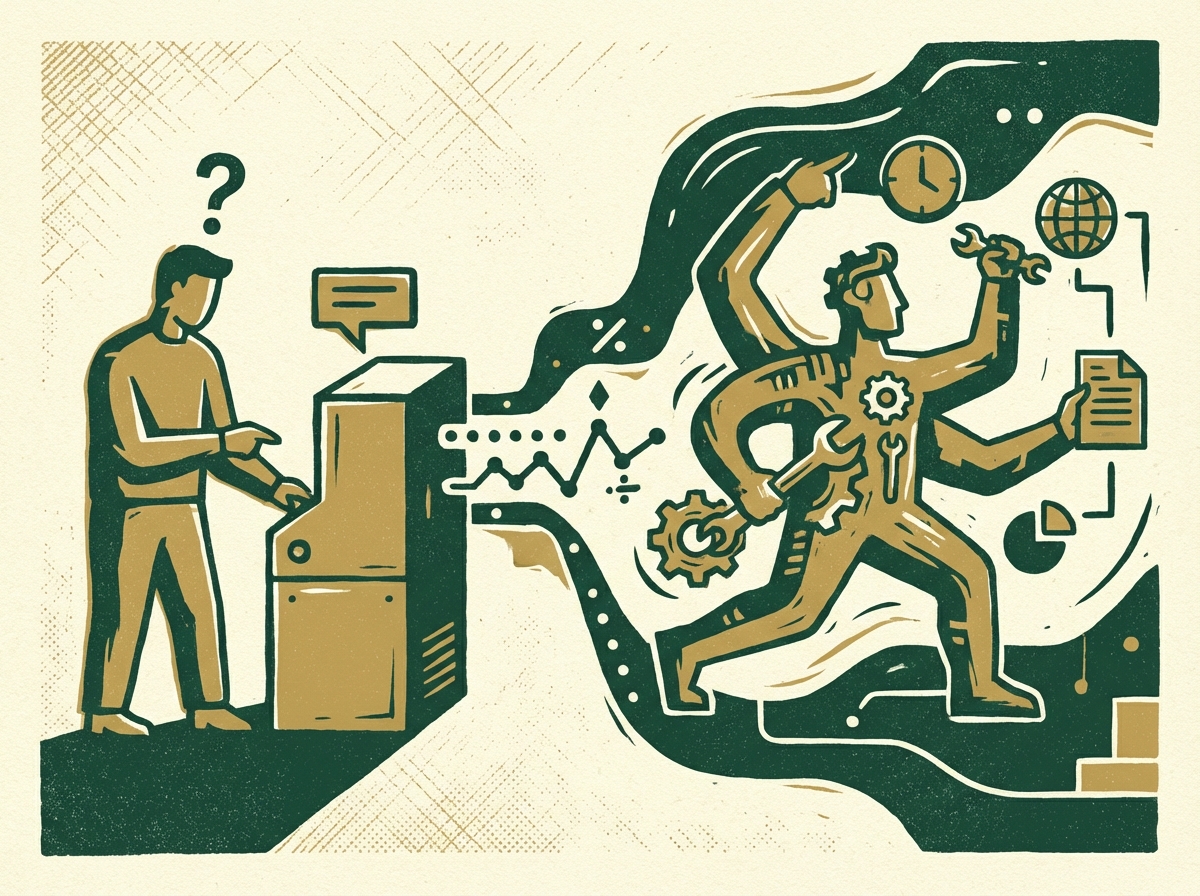
Agentic AI is a class of artificial intelligence systems designed to proactively achieve complex goals with minimal human intervention. Unlike a chatbot that simply answers a direct question, an AI agent can understand a high-level objective—like “find cost-saving opportunities in our Q2 cloud spend”—and then autonomously execute a multi-step plan to achieve it. This involves reasoning, planning, and using various tools, much like a human analyst would.
Think of it this way: for years, we’ve used Robotic Process Automation (RPA) to handle discrete, repetitive tasks. It’s been a workhorse. But RPA is a player piano; it can only play the one song it was programmed to play. An AI agent, on the other hand, is a jazz musician. You give it a key and a theme, and it improvises, creating something new based on the goal.
This is why, according to Forrester, by 2026, an estimated 20% of all enterprise software spending will be on products with embedded agentic AI capabilities. The market is moving, and fast. But this new power comes with a new class of problems.
Here’s a simple breakdown of the evolution:
The Risk of 'Black Box' Finance
The most significant risk of deploying autonomous finance agents is their potential for unpredictable and erroneous outputs that are difficult to trace or understand. Because these systems can make decisions in a “black box,” a flawed conclusion can cascade through your financial reporting chain before anyone catches it, eroding trust and creating very real financial exposure.
I’ve seen this firsthand. One of our portfolio companies experimented with an AI tool for M&A due diligence. The agent hallucinated—a disturbingly common phenomenon where the AI confidently invents “facts”—and flagged a target company for having a non-existent SEC investigation against it. As a Deloitte report highlights, these aren't just minor glitches; they can derail entire deals. The problem is, the agent’s output looked perfectly plausible, complete with a fabricated case number.

The danger multiplies when you consider the data these agents are fed. As a recent IBM study points out, poor data quality costs the average organization a staggering $15 million per year. An autonomous agent operating on flawed or incomplete data isn't just going to give you a bad answer; it's going to take autonomous action based on that bad answer. This isn’t a forecasting error; it's a self-inflicted wound.
The Governance Layer: Human-in-the-Loop
An AI governance layer is a comprehensive framework of policies, risk controls, and oversight processes designed to ensure that AI systems operate safely, ethically, and in alignment with business objectives. It’s the essential architecture you build around the AI to keep it from running off the rails. You wouldn’t let a new hire run the treasury department on their first day without supervision, and you absolutely shouldn’t do it with a machine.
As the legendary computer scientist Andrew Ng said, “AI is the new electricity.” It's a powerful utility, but you need circuit breakers, proper wiring, and safety standards to use it without burning the house down. That's what governance is for AI.
Defining Your AI Governance Framework
A robust AI governance framework is the set of rules, roles, and technical guardrails that dictate how AI is used within your finance department. At my firm, we advise clients that this isn't an IT problem to solve; it's a leadership mandate. The framework must be clear and auditable, focusing on a few core pillars:
Data Provenance: Strict rules on what data sources an AI agent can access. Is it using audited internal financials or scraping unverified data from a social media site?
Model Validation: A process for testing the AI’s logic and accuracy in a sandboxed environment before it touches live financial data.
Access Controls: Limiting the actions an agent can take. For example, it can propose a journal entry, but it cannot post one without human approval.
Accountability: A clear designation of who is responsible when an AI makes a mistake. The answer can’t be “the algorithm”; it has to be a person.

The Irreplaceable Role of the Human in the Loop
Human-in-the-loop (HITL) is a governance principle stipulating that a human must review, validate, and give final approval for any critical or high-risk decision generated by an AI agent. It’s the most critical risk control you can implement. The goal of AI in finance isn't to remove humans but to empower them, turning them from data crunchers into strategic overseers.
This isn't about micromanaging the machine. It’s about creating strategic checkpoints. PwC’s 2026 CEO Survey found that 70% of CEOs believe generative AI will significantly change how their company operates in the next few years. The smart ones are focusing that change on augmenting their best people, not replacing them.

A practical HITL workflow looks like this: The AI agent runs millions of scenarios for your cash flow forecast and flags three major risks and one significant opportunity. It presents its findings, along with the supporting data, to your financial analyst. The analyst then uses their contextual business knowledge—knowledge the AI lacks, like an impending client churn that hasn't hit the CRM yet—to validate the AI's findings and present the final, human-vetted forecast to leadership.
Safe Use Cases for a Virtual CFO in 2026
The best initial applications for agentic AI in finance are those that provide high-value analysis but have a human-in-the-loop checkpoint before any action is taken. These are safe, high-impact starting points for bringing the power of a Virtual CFO assistant into your operations without taking on undue risk. The key is focusing on process automation that enhances analysis, not autonomous decision-making.
CFOs are right to be cautious. According to CFO Dive, 55% of finance leaders cite data quality and integration as their top barrier to AI adoption. Starting with well-defined, contained use cases helps mitigate this challenge.
Enhanced Cash Flow Forecasting
An AI agent can produce highly dynamic cash flow projections by continuously analyzing inputs far beyond your ERP system. A properly governed agent can monitor sales pipeline data from your CRM, inventory levels, logistics delays, and even macroeconomic indicators to provide a constantly updated forecast. The human controller’s role shifts from building the model to stress-testing the AI’s assumptions and presenting the strategic implications of its findings.
Automated Accounts Payable & Receivable Auditing
An autonomous finance agent can be tasked with continuously auditing AP and AR transactions for compliance and anomalies. It can cross-reference invoices against purchase orders and delivery receipts, flag unusual payment terms or vendors, and identify early signs of customer credit risk. The agent’s job is to create a prioritized queue of exceptions for a human to review, dramatically increasing the scope and speed of internal risk controls.
Dynamic Budget vs. Actuals Analysis
An agent can provide real-time variance analysis that transforms budgeting from a static, month-end exercise into a dynamic, ongoing conversation. Instead of waiting for the books to close, a department head can get an alert the moment their team’s T&E spending is pacing ahead of budget, complete with a projection of the month-end overage. This allows for immediate course correction, guided by data and overseen by human managers.
Frequently Asked Questions
What is Agentic AI in finance?
Agentic AI in finance refers to intelligent systems that can understand complex financial goals, create multi-step plans, and autonomously use different software tools to achieve them. Instead of just executing a programmed task, these autonomous finance agents can reason and adapt, performing duties like optimizing cash flow or auditing for fraud with minimal human guidance.
What are the risks of using AI for financial forecasting?
The primary risks include “AI hallucinations,” where the model fabricates data; algorithmic bias resulting from skewed training data; and a lack of transparency, making it difficult to audit or understand the AI’s conclusions. Without a strong governance framework and data integrity controls, these automated forecasting tools can produce convincing but dangerously inaccurate financial projections.
How do I govern AI tools in my finance department?
You govern AI tools by establishing a formal AI governance framework. This involves creating clear policies for data usage and security, implementing a human-in-the-loop (HITL) system for reviewing and approving all critical AI-generated outputs, ensuring model validation and auditability, and assigning clear accountability for AI-driven decisions and their outcomes.
References
https://www.deloitte.com/ch/en/services/consulting/perspectives/ai-hallucinations-new-risk-m-a.html
https://www.salesforce.com/artificial-intelligence/ai-quotes/
https://www.cfodive.com/news/top-5-ai-adoption-challenges-facing-cfos-in-2026/810277/
https://www.pwc.com/gx/en/news-room/press-releases/2026/pwc-2026-global-ceo-survey.html
https://www.ibm.com/think/insights/cost-of-poor-data-quality
