
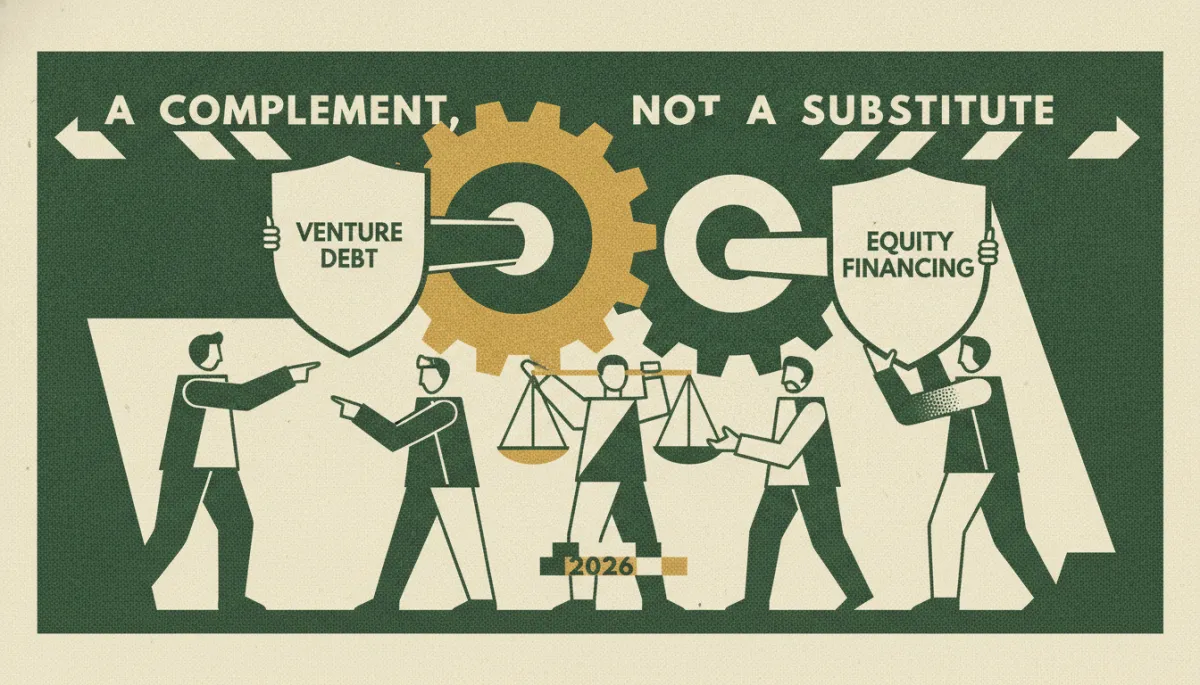
Venture Debt in 2026: A Complement, Not a Substitute
- Venture debt is a Capital Structure Optimization tool that complements equity rather than replacing it, extending runway with minimal dilution.
- It is typically a term loan for 20 to 35% of your most recent equity round, over a 2 to 4 year term, often with a 6 to 12 month interest-only period.
- The cost is interest of roughly 8 to 15%, upfront fees of 1 to 2%, and warrants adding 0.5 to 2% dilution, far less than the 15 to 30% an equity round would cost.
- Its best use is extending runway 6 to 12 months between equity rounds to hit a milestone that strengthens your next raise, without resetting your valuation.
- It is the wrong move when you need patient capital, when the business is not working, or when you cannot comfortably service the debt.
Venture debt occupies a useful but misunderstood place in a startup's financing toolkit. It is not a way to avoid raising equity, and it is not free money; it is a loan that, used at the right moment, extends your runway and minimizes dilution between equity rounds. Understanding it is part of sound Capital Structure Optimization, because the difference between using it well and using it badly can be the difference between reaching a value-creating milestone and taking on debt you cannot service. Here is how venture debt works, what it really costs, and when it belongs in your capital stack.

What Venture Debt Is and How It Works
Venture debt is a term loan designed for venture-backed startups, typically extended alongside or shortly after an equity round. Lenders generally provide 20 to 35% of a company's most recent equity round over a 2 to 4 year term, often including an initial interest-only period of 6 to 12 months before principal repayment begins, as Founderpath describes. So a company that just raised a $10 million round might access $2 to $3.5 million in venture debt on top of it.
The structure reflects its purpose. Venture debt is not standalone financing for an unproven company; it is available precisely because you have recently raised equity, which gives the lender confidence and a recent valuation to size against. The interest-only period is designed to give the company room to deploy the capital and reach a milestone before repayment weighs on cash. Understanding this structure is the starting point for Capital Structure Optimization with venture debt: it is a complement to a fresh equity round, sized as a fraction of it, with terms built to bridge you to your next inflection point rather than to fund the company indefinitely. It works with your equity, not instead of it.

The Real Cost: Interest, Fees, and Warrants
Venture debt is cheaper than equity but not cheap in absolute terms, and understanding its full cost is essential to using it well. The cost has three components. Interest typically runs 8 to 15% (often structured as a benchmark rate plus 6 to 9%), the primary financing cost. Upfront fees usually add 1 to 2% of the loan amount, which on a $3 million loan is $30,000 to $60,000. And warrants, the equity kicker, give the lender the right to buy a small slice of equity, typically 0.5 to 2%, compensating them for the risk, per Brex.
The warrant component is what makes venture debt minimally dilutive rather than non-dilutive, and the comparison is the whole point. A warrant creates some dilution, but at 0.5 to 2% it is far less than the 15 to 30% ownership you would give up raising the equivalent amount in an equity round, as re:cap notes. That is the core Capital Structure Optimization case for venture debt: you access capital while preserving the vast majority of the equity an equity raise would have cost. The interest and fees are real cash costs you must be able to service, but the dilution savings are substantial, which is exactly why venture debt is attractive when you need capital but want to protect ownership.

The Right Use: Extending Runway Between Rounds
Venture debt has one clearly right use, and it defines whether the financing makes sense: extending runway between equity rounds to reach a milestone that strengthens your next raise. Venture debt can add 6 to 12 months of runway beyond what your equity raise provides, letting you hit a revenue target, a product launch, or a key hire that improves your position for the next fundraise, as SVB describes. The point is to reach an inflection that raises your valuation before you raise equity again.
This use is powerful because of what it avoids: raising more equity now at your current valuation. If you can use venture debt to bridge to a milestone that materially increases what your company is worth, you raise your next equity round at a higher valuation, which more than offsets the cost of the debt. You convert a small amount of debt and warrant dilution into a meaningfully better equity round later, without resetting your valuation in the meantime. This is Capital Structure Optimization at its sharpest: using a modestly priced instrument to reach the milestone that makes your next, larger financing far more favorable. When venture debt is used to buy time to create value, the math usually works strongly in the founder's favor.

When Venture Debt Is the Wrong Move
Venture debt is dangerous when used outside its narrow right use, and three situations make it the wrong move. The first is using it to fund a company that is not working. Venture debt is a loan that must be repaid; if the business is not on a path to the milestone or the next raise, the debt simply accelerates the problem, because now you owe money on top of a struggling company. Debt amplifies outcomes in both directions, and on a failing trajectory it amplifies the failure.
The second wrong use is taking it when you cannot comfortably service the debt. The interest and eventual principal payments are real cash obligations, and a company already tight on cash can find that the debt service tips it over rather than extending its life. The third is using it as a substitute for equity you actually need, when the company requires patient, risk-bearing capital and a strategic investor rather than a loan with a repayment schedule. Venture debt does not provide guidance, a network, or the patience of equity; it provides money with strings. Recognizing these situations is essential Capital Structure Optimization, because the same instrument that extends a healthy company's runway can sink a fragile one. The test is simple: do you have a clear path to a value-creating milestone and the cash to service the debt along the way? If not, venture debt is the wrong tool.

Fitting It Into Your Capital Stack
Used well, venture debt is one layer in a deliberately constructed capital stack, each layer matched to its purpose. Equity funds the uncertain, long-horizon bets and brings strategic partnership; venture debt extends runway between equity rounds at low dilution; revenue-based financing or a line of credit handles other specific needs. The sophisticated founder does not choose one source but assembles the right combination, which is the essence of Capital Structure Optimization.
In practice, venture debt fits best layered on top of a fresh equity round, sized to bridge to the next milestone, with terms you can service from the runway it helps create. The decision should be made with a clear view of the whole stack: how much equity you raised, what milestone the combined capital must reach, and whether the debt service fits the cash flow plan. This is exactly where experienced financial leadership earns its place, modeling the venture debt against the company's runway and milestones, negotiating the warrant and interest terms, and ensuring the debt strengthens rather than strains the capital structure. A founder who treats venture debt as one carefully chosen layer in a thoughtful capital stack, rather than as easy money or a substitute for a needed equity raise, captures its real benefit: more runway, a stronger next round, and most of their equity preserved.

Frequently Asked Questions
What Is Venture Debt and How Does It Work?
Venture debt is a term loan for venture-backed startups, typically extended alongside or after an equity round. Lenders provide 20 to 35 percent of your most recent round over a 2 to 4 year term, often with a 6 to 12 month interest-only period before principal repayment. It is available because you recently raised equity, which gives the lender a recent valuation and confidence, and it is meant to complement equity rather than replace it.
How Much Does Venture Debt Cost?
Three components: interest of roughly 8 to 15 percent, upfront fees of 1 to 2 percent of the loan, and warrants giving the lender 0.5 to 2 percent of equity. The interest and fees are cash costs you must service. The warrant dilution makes it minimally dilutive, but at 0.5 to 2 percent it is far less than the 15 to 30 percent ownership an equivalent equity raise would cost, which is its main appeal.
When Should You Use Venture Debt?
To extend runway 6 to 12 months between equity rounds so you can reach a milestone, a revenue target, product launch, or key hire, that strengthens your next raise without resetting your valuation. If you can bridge to an inflection that raises your company's worth, you raise your next equity round at a higher valuation, which more than offsets the cost of the debt. That value-creating bridge is its right use.
When Is Venture Debt a Bad Idea?
When the business is not working, since debt amplifies a failing trajectory; when you cannot comfortably service the interest and principal from your runway; or when you actually need patient, risk-bearing equity and a strategic investor rather than a loan. Venture debt provides money with repayment strings but no guidance, network, or patience, so it suits a healthy company with a clear path to a milestone, not a fragile one.
References
