
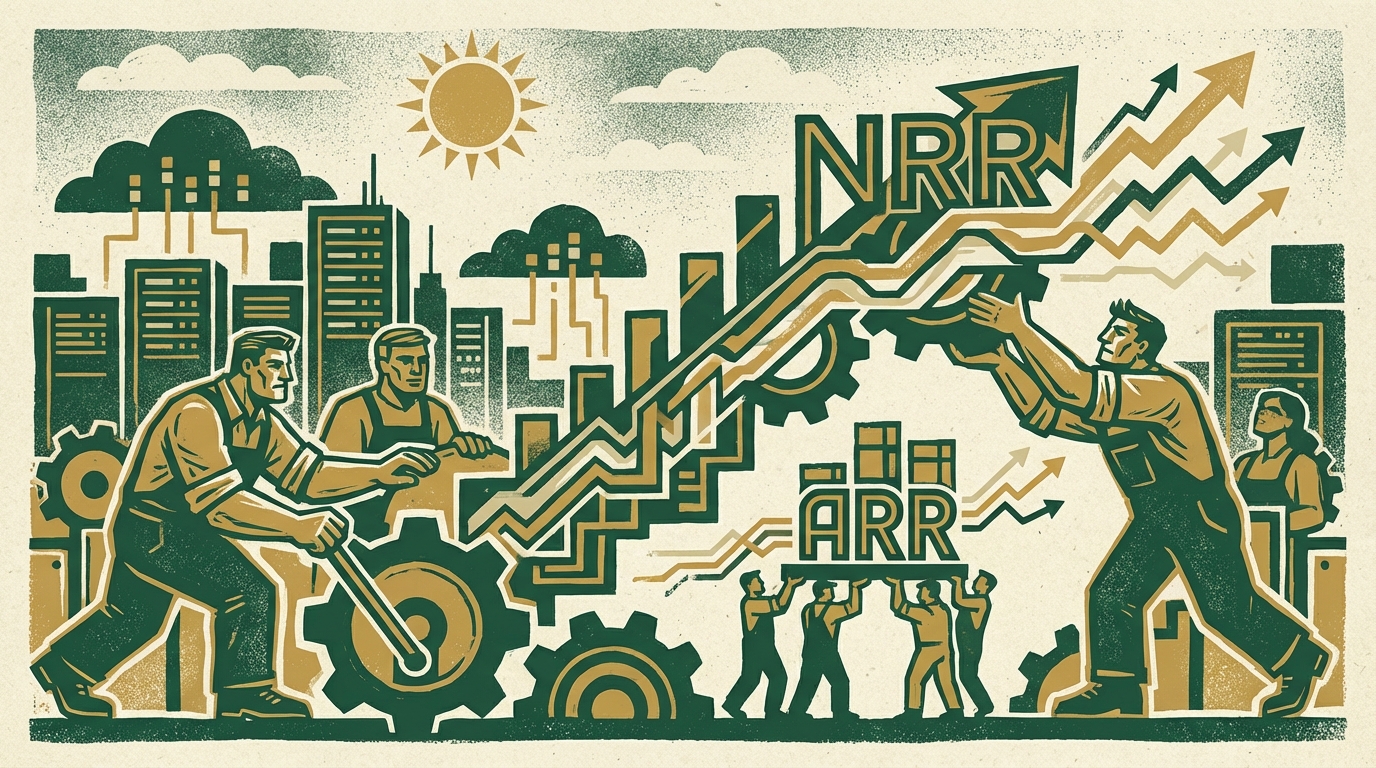
SaaS Metrics in 2026: Why NRR is the New ARR
Published: 2026-01-29 • Estimated reading time: 8 min
I sat in a boardroom last month, a beautiful glass-walled affair overlooking the city, and watched a founder get absolutely dismantled. He was brilliant, passionate, and his ARR growth chart was a perfect, hockey-stick-shaped monument to hustle. Five years ago, VCs would have been throwing money at him. But the lead investor, a woman with a reputation for quiet intensity, just tapped her pen on a single number on the slide. 101%.
His Net Revenue Retention.
“Your bucket is full,” she said, not unkindly, “but it’s rusting from the inside out.”
That meeting was a microcosm of a tectonic shift that’s happened in SaaS. The cheap-money party of the early 2020s is a distant, fuzzy memory. Today, the music is off, the lights are on, and investors are meticulously checking the plumbing. They’re no longer just asking “How fast are you growing?” They’re asking, “How durable is that growth?” And the single best answer to that question is your NRR.
As a Fractional CFO for SaaS companies, my team and I have moved Net Revenue Retention from a secondary slide in the appendix to the very first metric we scrutinize. It’s the new king. ARR tells you that you’re selling; NRR tells you that you’re keeping and growing the customers you’ve already won. One is vanity, the other is sanity.
The Valuation Shift: Efficiency Over Absolute Growth
Investors have shifted their focus from pure ARR growth to capital-efficient growth, making Net Revenue Retention (NRR) a primary driver of SaaS valuation multiples. In the bygone era of zero-interest-rate policy, growth was the only god. You could burn cash at an astonishing rate as long as the top-line ARR number went up and to the right. That game is over. Today’s market rewards sustainable, profitable growth, and NRR is the clearest indicator of a company's underlying health and efficiency.

Why the change? Because NRR is a proxy for so many other vital signs: customer satisfaction, product-market fit, and pricing power. A high NRR signifies a sticky product that becomes more valuable to customers over time. This creates a powerful, compounding growth engine that doesn't rely on a constantly churning, and expensive, sales and marketing machine. In fact, research from firms like SaaS Capital has shown a direct correlation between high NRR and top-quartile growth and valuation. It’s the ultimate measure of Recurring Revenue Quality—proof that your customers not only stay, but they also spend more.
Deconstructing NRR: Expansion vs. Retention
Net Revenue Retention is a composite metric that measures the total revenue from an existing customer cohort over time, balancing revenue lost to churn and downgrades against new revenue gained from expansion and upgrades. It answers a simple, brutal question: If you stopped all new sales and marketing today, would your company grow or shrink from your existing customer base? The formula looks something like this:
(Starting MRR + Expansion MRR - Downgrade MRR - Churned MRR) / Starting MRR
Think of it as the two sides of the same coin: retention is defense, expansion is offense. You need both to win.
The Power of Expansion Revenue
Expansion Revenue, the 'E' in NRR, is the most capital-efficient growth lever a SaaS company can pull. This is the revenue you generate when existing customers upgrade to a higher tier, add more users, or buy new product modules. It’s a beautiful thing because the cost to acquire this revenue is a fraction of what it costs to land a new logo. Your customer success team, not your expensive field sales reps, is often driving this growth.

Top-performing SaaS companies consistently post NRR rates over 120%, according to reporting from High Alpha. This means they are growing by at least 20% each year from their existing customers alone. That's a powerful flywheel that makes the business incredibly resilient and attractive to investors.
The Leaky Bucket: Identifying Churn Root Causes
A thorough customer churn analysis is essential for improving NRR, as it reveals the specific product gaps, onboarding failures, or support issues causing customers to leave. I always tell founders to stop obsessing over the water they’re pouring into the bucket (new logos) until they’ve plugged the holes in the bottom. That's churn. It’s the silent killer of SaaS companies, a constant drag on growth that makes every other part of the business harder.

Simply looking at a single churn number is useless. You have to dissect it. My team's approach is to perform a detailed cohort analysis to see when customers are leaving and a root cause analysis to understand why. Are they leaving in the first 90 days? That's an onboarding problem. Are power users suddenly dropping off? That's likely a product gap or a new competitor. While the median annual logo retention for private B2B SaaS companies is a respectable 90% (SaaS Capital), even a small improvement here can have a massive impact on your NRR and long-term viability.
Pricing Power: The CFO's Secret Weapon
A strategic approach to pricing and packaging, led by the CFO, is one of the most direct and powerful ways to increase Expansion Revenue and, consequently, NRR. For too long, pricing has been treated as a one-time marketing decision. This is a catastrophic mistake. Pricing is a dynamic, strategic function that should be at the core of your growth strategy. It's the ultimate lever for improving your SaaS Unit Economics.
This is where a strategic Fractional CFO for SaaS moves beyond the spreadsheet. We work with founders to build pricing models that align with customer value. Are you charging per seat when your value is really tied to API calls or data processed? Are you leaving money on the table by not having a premium tier with enterprise-grade features? A classic McKinsey study found that a 1% improvement in price can boost operating profits by 11.1%. Implementing small, annual price escalators and creating clear upgrade paths are tactical moves that can fundamentally transform your NRR.

Benchmarking Your SaaS Business for 2026
For a Series B SaaS company in 2026, a "good" Net Revenue Retention rate is considered to be above 115%, with top-quartile performers exceeding 130%. Of course, context matters. Companies serving small businesses will naturally have a lower NRR than those serving enterprise clients, who are less likely to go out of business and more likely to expand.
I've seen founders get distracted by irrelevant benchmarks. Don't compare your SMB-focused MarTech tool to an enterprise data platform like Snowflake. It's an exercise in frustration. You need to understand where you fit in the landscape. Here’s a simplified table my team uses as a starting point for assessing Investor Metrics based on 2025-2026 data from sources like Benchmarkit.ai and SaaS Capital.

If you're below the median for your category, it's a red flag. Not an unfixable one, but a clear signal that you need to shift focus internally from pure acquisition to customer health, expansion, and retention. Because in 2026, a great growth story with a leaky bucket won’t get you to the next round. A durable, efficient business with an NRR that prints its own growth will.
Frequently Asked Questions
Why has NRR overtaken ARR as the key SaaS metric?
NRR has overtaken ARR because it measures the efficiency and durability of revenue, not just its absolute volume. In a capital-constrained environment, investors prioritize companies that can grow by retaining and expanding their existing customer base, which is far cheaper than acquiring new logos. It's a direct indicator of product-market fit and customer satisfaction.
What is a 'good' NRR benchmark for Series B companies in 2026?
A good NRR for a Series B company typically falls between 110% and 120%. However, top-quartile performers, especially those focused on the enterprise market, are expected to exceed 125% or even 130%. Context is key, as benchmarks vary significantly based on the target customer segment (SMB vs. Enterprise).
How can a CFO drive NRR improvements?
A CFO can drive NRR by moving beyond traditional financial oversight and taking a strategic role in pricing and packaging. This includes implementing value-based pricing, creating clear upgrade paths, building annual price escalators into contracts, and using financial data to identify the most profitable customer cohorts to focus on for expansion.
What is the formula for Net Revenue Retention?
The standard formula is: (Revenue from Starting Cohort + Expansion Revenue - Downgrade Revenue - Churn Revenue) / Revenue from Starting Cohort. It calculates the percentage of revenue retained from the customers you had at the beginning of a period (e.g., one year ago).
Can NRR be over 100%?
Yes, and that's the goal. An NRR over 100% means that the revenue gained from existing customer upgrades and expansion is greater than the revenue lost from customers churning or downgrading. This is often referred to as "negative churn" and is a hallmark of a healthy, growing SaaS business.
Is ARR still an important metric for SaaS companies?
Absolutely. ARR (Annual Recurring Revenue) remains a critical metric for understanding the overall scale and top-line growth of a SaaS business. However, it is no longer the only primary metric. Investors now look at NRR alongside ARR to assess the quality and sustainability of that growth.
References
