

Quarterly Business Reviews That Actually Change Behavior
- A quarterly business review is meant to be the heartbeat of Strategic Financial Planning, the moment the leadership team steps back, assesses results, and decides what to do next, yet most QBRs change nothing.
- The failure mode is treating the QBR as a backward-looking status report. An effective QBR is a forward-looking decision forum that produces intentional choices for the next quarter.
- The mechanism that drives change is accountability: every QBR must end with a defined list of action items, each with a clear owner, a deadline, and tracking.
- The cadence matters: run it every 3 to 4 months, with serious preparation, often around 6 weeks ahead, so the meeting works from real analysis rather than last-minute slides.
- Tie every discussion to goals and close the loop by reviewing last quarter's commitments first, which is what turns the QBR into a rhythm that actually changes behavior.
Almost every company runs some version of a quarterly review, and almost all of them are a waste of time. The leadership team gathers, someone presents slides full of what happened last quarter, everyone nods, and nothing changes, until the next quarter, when they do it again. A quarterly business review should be the opposite: the forcing function that makes the business step back, confront its results honestly, and make deliberate decisions about the quarter ahead. Done well, it is the operating rhythm of Strategic Financial Planning. Done poorly, it is theater. The difference comes down to a few specific practices. Here is how to run a QBR that actually changes behavior.

Why Most QBRs Change Nothing
The reason most quarterly reviews fail to change anything is that they are structured as backward-looking reports rather than forward-looking decision sessions, so they inform without driving action. The typical QBR consists of presenting what happened last quarter, the results, the metrics, the narrative, and then adjourning, with the implicit assumption that reviewing the past is itself useful. But reviewing the past changes nothing unless it leads to decisions and commitments about the future, and most QBRs stop short of that, leaving the team informed but not redirected.
This backward-looking failure mode is so common precisely because it is comfortable. Presenting results is safe and requires no hard choices; making decisions about what to do differently, assigning who will do it, and holding people accountable next quarter is uncomfortable and demanding. So QBRs drift toward the comfortable version, becoming status updates that everyone sits through and no one acts on. The cost is significant: the quarterly cadence, which should be a powerful rhythm for steering the business, is wasted on a ritual that produces no change. For Strategic Financial Planning, this is a real loss, because the QBR is the natural moment to translate the company's plan and results into adjusted action for the coming quarter. Recognizing that a QBR which merely reports the past changes nothing, and that the entire value lies in what decisions and commitments it produces for the future, is the first step to fixing it. The goal is not a better presentation of last quarter; it is a forum that forces intentional decisions for next quarter.

The QBR as a Forward-Looking Decision Forum
The fundamental reframe that makes a QBR effective is to treat it as a forward-looking strategic decision forum rather than a backward-looking report, where reviewing results is merely the input to the real work of deciding what to do next. As Gainsight emphasizes, a truly effective QBR is not just a report of what happened; it is a forward-looking session that uncovers opportunities, confronts challenges, and produces actionable next steps. The past-quarter results are reviewed not for their own sake but to inform the decisions about the quarter ahead.
This reframe changes the entire character and agenda of the meeting. Instead of spending the bulk of the time presenting historical results, an effective QBR spends most of its time on the forward questions: given these results, what should we do differently, what should we double down on, what should we stop, and what are the most important things to accomplish next quarter. The review of results becomes a quick, focused input, and the decisions become the main event. A well-run QBR forces the business to step back, assess its results, and make intentional decisions for the next quarter, which is exactly the discipline that drives improvement. This forward orientation is what connects the QBR to Strategic Financial Planning, because the quarterly review is where the plan meets reality and gets adjusted, where the company decides how to deploy its resources and attention for the coming period based on what it has learned. Structuring the QBR as a decision forum, with the agenda weighted toward forward choices rather than backward reporting, is the single most important shift in making it valuable. The meeting should end with the team knowing what they have decided to do, not just what happened.

Action Items With Owners, Deadlines, and Tracking
The specific mechanism that converts a QBR's decisions into actual behavior change is rigorous accountability: every review must end with a defined list of action items, each with a clear owner, a deadline, and a way to track progress. As Gainsight and others stress, this is what ensures the discussions translate into tangible forward movement and reinforces accountability, rather than producing decisions that evaporate the moment the meeting ends. A decision with no owner and no deadline is not a decision; it is a wish.
This accountability structure is the difference between a QBR that changes behavior and one that does not. When the meeting concludes with each key decision assigned to a specific person, given a clear deadline, and entered into a tracking mechanism, the decisions become commitments that can be followed up on, and people know they will be held to them. Without this, even a QBR that makes good decisions fails, because nobody owns the follow-through and the decisions quietly disappear. The discipline is simple but often neglected: at the end of the review, capture the concrete action items, assign each to an owner, set a deadline, and establish how progress will be tracked, so that the next quarter's review can check whether each commitment was met. This turns the QBR from a discussion into a system of commitments, which is what actually moves the business. For Strategic Financial Planning, this accountability is essential, because the value of the quarterly decisions is realized only if they are executed, and clear ownership with tracking is what ensures execution. The action-item discipline is the engine that converts the QBR's forward-looking decisions into real change in how the business operates.

The Right Cadence and Preparation
Two practical factors significantly affect whether a QBR delivers value: the cadence at which it runs and the preparation that goes into it. On cadence, the QBR should run every 3 to 4 months, quarterly, which is frequent enough to steer the business responsively but spaced enough that meaningful results and changes accumulate between reviews, as the field standard holds. This quarterly rhythm is the natural beat for stepping back from execution to reassess and redirect, more often would be too disruptive and less often would let the business drift too long without correction.
Preparation is what separates a substantive QBR from a superficial one, and it requires real lead time. Serious preparation, often beginning around 6 weeks in advance, allows the team to review the data thoroughly, craft a coherent narrative, work through the issues, and arrive fully ready, as the guidance suggests. A QBR thrown together with last-minute slides produces a shallow discussion, because the real analysis, what the results mean and what to do about them, has not been done. Adequate preparation means the meeting itself can focus on decisions rather than on absorbing information for the first time, because the participants come having already digested the data and thought about the implications. This preparation also includes selecting the few vital metrics that will anchor the discussion, typically 5 to 7 key KPIs presented consistently, rather than drowning the review in data. For Strategic Financial Planning, the combination of a disciplined quarterly cadence and serious advance preparation is what makes the QBR a reliable, substantive rhythm rather than an occasional scramble. The cadence ensures the business reviews and redirects regularly, and the preparation ensures each review is deep enough to produce good decisions, together forming the operating rhythm that keeps the company's strategy and execution aligned quarter after quarter.
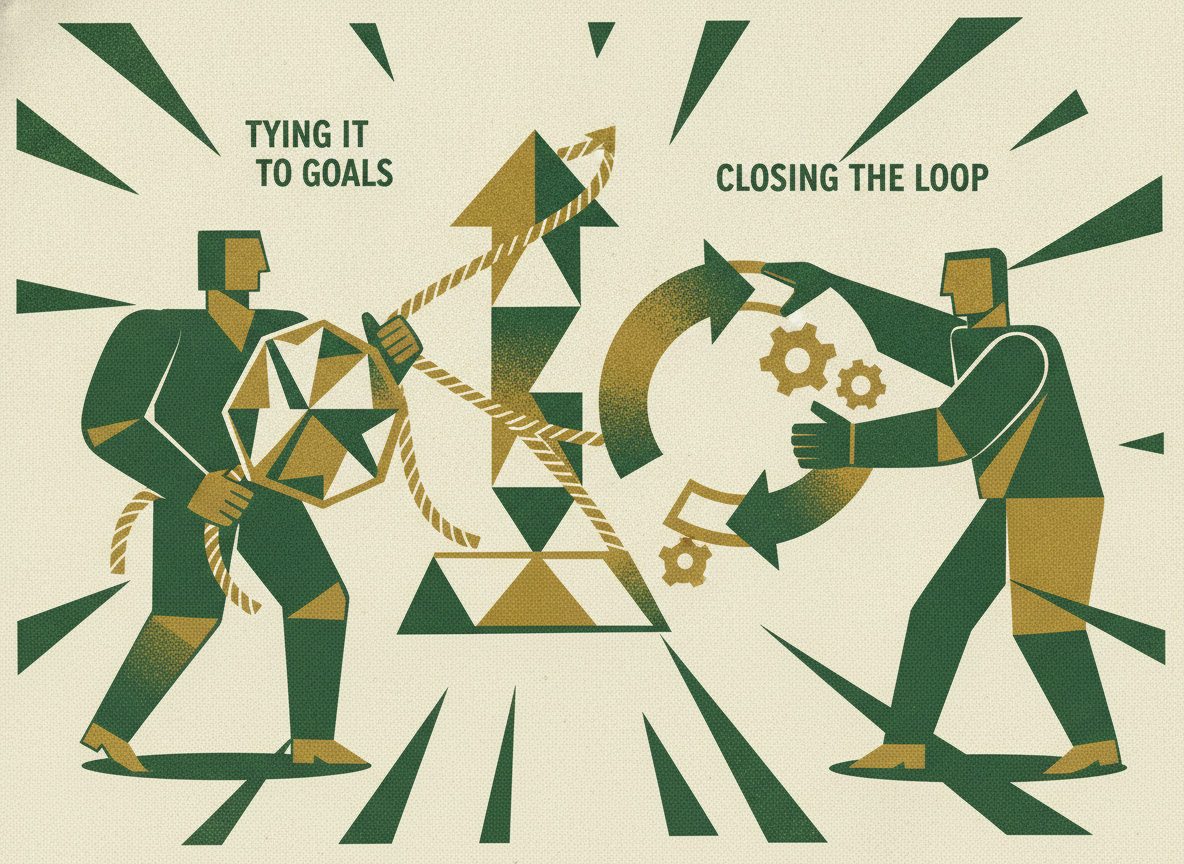
Tying It to Goals and Closing the Loop
The final practices that make a QBR genuinely change behavior are tying every discussion to the company's goals and closing the loop by reviewing the prior quarter's commitments at the start of each new review. On goals, the most effective QBRs, including those at companies like Google and LinkedIn, structure the discussion around a goals framework such as OKRs, tying every point back to predefined objectives and measurable key results, as Gainsight notes. This keeps the review focused on what matters, progress toward the company's actual goals, rather than drifting into disconnected updates, and it makes the forward decisions concrete by framing them as adjustments to how the company will pursue its objectives.
Closing the loop is the practice that creates real accountability over time: each QBR begins by reviewing the action items committed to in the previous QBR, checking what was accomplished and what was not. This is what gives the action-item discipline its teeth, because people know that next quarter's review will open with an honest accounting of whether they delivered on this quarter's commitments. Without this loop, commitments made in one QBR are forgotten by the next, and the accountability is hollow; with it, the quarterly reviews become a connected chain where each builds on the last and follow-through is consistently checked. Together, tying discussions to goals and closing the loop on commitments transform the QBR from an isolated event into a continuous rhythm of decision, commitment, execution, and review that genuinely drives the business forward. This is the heart of what makes a QBR change behavior rather than merely report it, and it is a core practice of Strategic Financial Planning in action, the disciplined quarterly cadence that connects the company's goals to deliberate decisions and accountable execution, quarter after quarter. A founder who runs QBRs this way has a powerful tool for steering the business; one who runs them as status reports has a recurring meeting that changes nothing.

Frequently Asked Questions
Why Do Most Quarterly Business Reviews Fail to Change Anything?
Because they are structured as backward-looking status reports rather than forward-looking decision sessions. The typical QBR presents what happened last quarter and then adjourns, leaving the team informed but not redirected. Reviewing the past changes nothing unless it leads to decisions and commitments about the future, and most QBRs stop short of that, wasting the powerful quarterly cadence on a ritual that produces no action.
What Makes a QBR Effective?
Treating it as a forward-looking decision forum. The past-quarter results are reviewed quickly as input, and most of the time goes to deciding what to do next: what to change, double down on, or stop, and the priorities for the coming quarter. The meeting should end with the team knowing what they have decided to do, not just what happened, which connects the review directly to steering the business.
How Do You Make QBR Decisions Actually Happen?
With rigorous accountability. Every QBR must end with a defined list of action items, each assigned to a clear owner, given a deadline, and entered into a tracking mechanism. A decision with no owner and no deadline is just a wish. This turns the review from a discussion into a system of commitments that can be followed up on, and it is reinforced by opening each new QBR with a review of whether the prior quarter's commitments were met.
How Often Should You Run a QBR and How Much Preparation Is Needed?
Run it quarterly, every 3 to 4 months, which is frequent enough to steer responsively but spaced enough for meaningful results to accumulate. Preparation should begin well ahead, often around 6 weeks, so the team can review data, craft a narrative, and arrive ready to decide rather than absorbing information for the first time. Anchor the discussion on 5 to 7 vital KPIs presented consistently, rather than drowning the review in data.
References
