
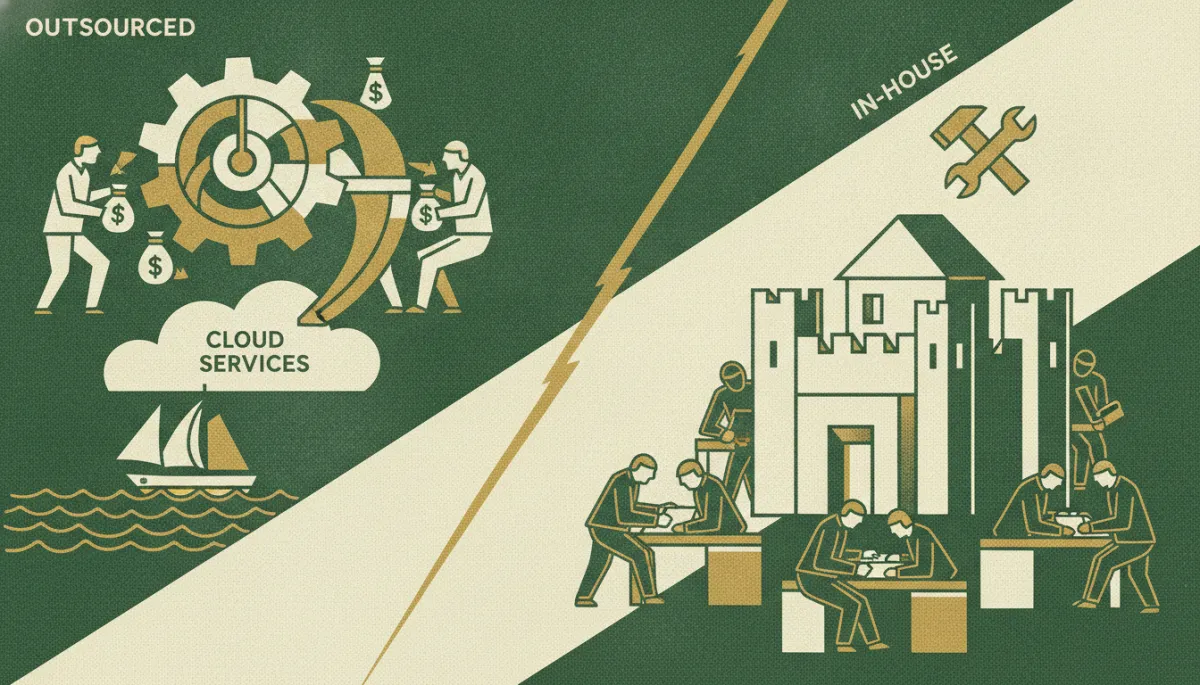
Outsourced vs In-House Bookkeeping: The Real Trade-off
- The bookkeeping decision, outsource or hire in-house, is often the first step toward a broader outsourced finance model that can extend up to an Outsourced CFO.
- The cost gap is large. Outsourced bookkeeping runs roughly $250 to $2,000 a month, while a fully loaded in-house bookkeeper costs $4,500 to $6,000 a month, or $55,000 to $85,000 a year.
- Outsourced is not just cheaper; it often delivers better results, with standardized processes reducing errors and closing the books faster than a single in-house person.
- In-house makes sense mainly for cash-heavy or paper-heavy operations that genuinely need daily on-site handling.
- For most companies under roughly $5 to $7 million in revenue, outsourced bookkeeping, paired with fractional finance leadership, is the more efficient choice.
Almost every growing company hits the same fork: the founder can no longer do the bookkeeping themselves, and they have to decide whether to hire someone in-house or outsource it. The instinct is often to hire, because having someone in the building feels like more control. But the math and the outcomes usually favor outsourcing, especially when it is part of a broader model that can scale up to an Outsourced CFO as the company grows. Here is the real trade-off between the two, and how to decide which fits your business.

The Real Cost Comparison
The most concrete difference between outsourced and in-house bookkeeping is cost, and the gap is wider than founders expect once all the numbers are counted. Outsourced bookkeeping for a small business runs roughly $250 to $2,000 a month depending on size and complexity, while an in-house bookkeeper costs approximately $4,500 to $6,000 a month fully loaded, or $55,000 to $85,000 a year once salary, benefits, taxes, and tools are included, per SystemSix. The fully-loaded comparison is the one that matters, because the salary alone understates the true cost of an employee.
The headline finding across the field is that outsourced bookkeeping typically delivers the same quality at 30 to 50% lower cost than hiring in-house. For a company that does not have enough ongoing bookkeeping work to fully occupy a full-time person, this gap is even larger in practice, because an in-house bookkeeper is a fixed cost whether or not there is a full day of work, while outsourced bookkeeping scales to what you actually use. This cost reality is the starting point for the decision and often the deciding factor, especially since outsourced bookkeeping is frequently the entry point to a fuller outsourced finance arrangement that can include an Outsourced CFO without the cost of any full-time finance staff.

Beyond Cost: Quality, Speed, and Scalability
Cost is the obvious advantage, but the less obvious one is that outsourced bookkeeping often produces better results than a single in-house hire, for structural reasons. An outsourced provider runs standardized processes with multiple review layers, which reduces errors substantially compared to a non-specialist in-house staffer, and closes the books faster: businesses using outsourced bookkeeping close their monthly books in about 10 days on average, versus 24 days for comparable businesses with in-house bookkeepers, according to SystemSix. Faster, cleaner books are not a minor benefit; they feed every downstream financial decision.
Scalability is the third structural advantage. An outsourced provider can scale capacity within a day during a growth spurt or seasonal surge, while changing in-house staffing takes weeks of hiring or risks idle cost in slow periods. An outsourced arrangement also does not carry the single-point-of-failure risk of one in-house bookkeeper who can quit, get sick, or go on vacation, leaving the books unattended. These structural benefits, fewer errors, faster closes, elastic capacity, and continuity, are why outsourcing frequently wins on more than price. For a founder, the combination of lower cost and better outcomes is compelling, and it is why outsourced finance, scaling from bookkeeping up to an Outsourced CFO, has become the default for so many growing companies.

When In-House Actually Makes Sense
Outsourcing is not always the answer, and there are real situations where in-house bookkeeping is the better fit. The clearest case is a cash-heavy or paper-heavy operation that genuinely needs daily, on-site handling, a restaurant with daily cash counts, a retail business with constant physical invoices and receipts, an operation where the bookkeeping work is physically tied to the location. In these businesses, the daily, hands-on nature of the work makes a remote outsourced arrangement awkward, and having someone in the building is genuinely valuable.
The other case for in-house is scale: a company large enough to fully occupy a full-time bookkeeper, or several, and complex enough to want that capability under direct management. At sufficient size, the cost advantage of outsourcing narrows, and the benefits of in-person control and integration with the team grow. There is also a preference factor: some founders simply value the control and in-person support of an in-house person, and that preference is legitimate even when the math slightly favors outsourcing. The honest assessment is that in-house makes sense for cash- and paper-heavy daily operations and for companies large enough to justify and manage full-time staff, while for most others, the outsourced model, often extending to an Outsourced CFO for the senior layer, is more efficient.

The Revenue Thresholds That Guide the Choice
Revenue scale offers a useful, if rough, guide to which model fits, because it correlates with the amount and complexity of bookkeeping work. The first major bookkeeping pain point typically arrives around $250,000 in annual revenue, when DIY bookkeeping in spreadsheets stops being adequate but a full-time hire is nowhere near justified, per industry analysis. This is the classic entry point for outsourced bookkeeping: enough complexity that you need real help, not enough volume to occupy an employee.
Outsourcing tends to remain the best fit up to roughly $5 to $7 million in revenue, the zone where there is genuine, ongoing bookkeeping work but still not quite enough to fully justify and efficiently use a full-time in-house team, especially when outsourced providers deliver it more cheaply and cleanly. Past that scale, the calculus can shift toward building an in-house function, though many companies continue to outsource well beyond it. These thresholds are guides, not rules, the right answer depends on your specific complexity and operations, but they help frame the decision. A company that switches from a struggling in-house setup to professional outsourced services typically recoups the transition cost within about three months through better cash flow management and tax planning, which underscores how often the outsourced model is the more efficient choice in this range.

The Outsourced Stack: Bookkeeping Plus Fractional Leadership
The most powerful version of the outsourced model is not just bookkeeping; it is a stack that scales from bookkeeping up through controller-level oversight to an Outsourced CFO, all without a single full-time finance hire. This is the real strategic advantage of outsourcing: it lets a growing company assemble exactly the finance capability it needs at each level, day-to-day bookkeeping, periodic controller review, and senior strategic leadership, sized and priced to the company's actual stage.
In practice, this means a company can have its books kept accurately and closed quickly by an outsourced bookkeeping service, its financial oversight and controls handled at a controller level, and its strategy, fundraising, and high-level financial decisions guided by an Outsourced CFO, for a fraction of what the equivalent full-time team would cost. As the company grows, the arrangement scales smoothly, adding hours and seniority as needed, and eventually converting to in-house roles when the scale justifies them. This is why the bookkeeping decision is rarely just about bookkeeping: choosing the outsourced path opens the door to a complete, scalable finance function delivered fractionally. For most companies under the $5 to $7 million range, this stack, outsourced bookkeeping plus fractional finance leadership up to an Outsourced CFO, delivers the most finance capability per dollar, which is exactly what a growing company needs.

Frequently Asked Questions
Is Outsourced or In-House Bookkeeping Cheaper?
Outsourced is substantially cheaper for most small businesses. Outsourced bookkeeping runs roughly $250 to $2,000 a month, while a fully loaded in-house bookkeeper costs $4,500 to $6,000 a month, or $55,000 to $85,000 a year once salary, benefits, taxes, and tools are counted. Across the field, outsourced typically delivers the same quality at 30 to 50 percent lower cost, and the gap is larger when there is not enough work to occupy a full-time person.
Does Outsourced Bookkeeping Produce Better Results?
Often, yes, for structural reasons. Outsourced providers run standardized processes with multiple review layers, which reduces errors, and they close the books faster, about 10 days on average versus 24 for in-house. They also scale capacity within a day and avoid the single-point-of-failure risk of one in-house person who can quit or go on leave. These benefits frequently make outsourcing win on more than just price.
When Does In-House Bookkeeping Make Sense?
Mainly for cash-heavy or paper-heavy operations that genuinely need daily on-site handling, like restaurants with daily cash counts or retail with constant physical invoices, and for companies large enough to fully occupy and manage a full-time bookkeeper. Some founders also simply prefer in-person control and support, which is a legitimate factor even when the math slightly favors outsourcing.
At What Revenue Should You Outsource Bookkeeping?
The first major pain point usually arrives around $250,000 in revenue, when DIY spreadsheets become inadequate but a full-time hire is not justified, which is the classic entry point for outsourcing. Outsourcing tends to remain the best fit up to roughly $5 to $7 million in revenue, where there is real ongoing work but not quite enough to efficiently justify a full-time in-house team, especially given the cost and quality advantages.
References
