

How Much to Raise: Sizing the Round to the Milestone
- The right Fundraising Strategy sizes the round to the next fundable milestone, not to a round number or a calendar year. You raise the amount that gets you to the bar your next round requires.
- The runway standard has shifted. Because seed-to-Series A now takes 18 to 24 months, you should raise enough to reach the next stage, not just survive twelve months.
- Work backward: define your next milestone, calculate the burn to get there, add roughly a 30% buffer, and that is your target raise.
- The numbers anchor the math. Median 2026 seed rounds run about $3M to $3.5M at a $12 to $15M post-money, costing 15 to 25% dilution.
- Raise too little and you run out before the milestone; raise too much and you over-dilute. The milestone-based amount threads that needle.
How much should you raise is the question founders most often get wrong, usually by anchoring on a round number that sounds right or on surviving the next year. Both are the wrong frame. The right amount is determined by one thing: the capital it takes to reach your next fundable milestone with a buffer. Raise to that, and you give yourself the best shot at a strong next round; raise to anything else, and you risk either running out short of the milestone or selling more of your company than you needed to. Here is the milestone-based Fundraising Strategy for sizing a round in 2026.

Raise to the Milestone, Not the Calendar
The core principle of sizing a round is to raise to your next fundable milestone, not to a fixed time period or a number that sounds good. The right amount is the amount that gets you to the point where your next round becomes raisable, the metrics, the traction, the proof that unlocks the following stage of capital, as Value Add VC frames it. The question is not "how much can I raise" or "how much do I need for a year," but "what does it cost to reach the milestone that makes me fundable again."
This milestone framing changes everything about the calculation. It forces you to first define what your next round requires, then work out the capital to get there, rather than picking an amount and hoping it is enough. For a seed-stage company, the cleanest milestones are revenue-driven: reaching roughly $1M to $3M in ARR with strong retention, or three consecutive quarters of meaningful growth, the kind of proof a Series A investor wants to see. The round you raise should be sized to reach that proof. This is the foundation of a sound Fundraising Strategy, because it ties the amount of capital directly to its purpose, getting you to the next stage, rather than to an arbitrary target.

The 18-24 Month Runway Standard
A critical shift that founders raising in 2026 must internalize is that the time between rounds has lengthened, which changes how much runway a round needs to provide. The median time from seed to Series A is now 18 to 24 months, up from shorter periods in easier years, per Value Add VC. The practical implication is direct: you must raise enough runway to reach the next stage's bar, not just enough to survive twelve months, because twelve months is no longer enough time to get there.
This is where founders who raised in faster markets get caught out. A round sized for a year of runway, on the old assumption that the next round comes quickly, leaves the company out of cash six months before it has hit the milestone the next round requires. With the seed-to-A timeline at 18 to 24 months, the round needs to fund that full stretch plus a buffer. In practice, this means seed-stage companies burning $150K to $400K a month typically need raises of $3M to $7M to fund an 18-to-24-month runway, depending on team size. Sizing a round to the current, longer between-rounds reality, rather than to outdated assumptions, is an essential part of Fundraising Strategy in 2026. Underestimating the runway you need is one of the most common and most dangerous fundraising mistakes.

Working Backward From Your Next Milestone
The actual calculation for sizing a round works backward from the milestone, and it is straightforward enough that any founder can do it. First, define your next fundable milestone concretely, the ARR, the growth, the proof your next round will require. Second, estimate the monthly burn it will take to reach that milestone, accounting for the hires and spending the plan demands. Third, multiply the burn by the time to reach the milestone, and fourth, add a buffer of roughly 30% for the things that take longer or cost more than planned. The result is your target raise, as Capwave describes.
The buffer is not optional padding; it is realism. Plans slip, milestones take longer than expected, and the fundraising process itself consumes time and runway. A round sized to exactly the planned burn with no margin leaves you raising your next round from a position of weakness the moment anything goes slightly wrong, which something always does. The 30% buffer gives you the room to absorb the normal slippage and still reach the milestone with enough runway to raise the next round deliberately rather than desperately. This backward calculation, milestone, burn, time, buffer, turns round sizing from a guess into a defensible number, which is exactly what a disciplined Fundraising Strategy should produce. It also gives you a clear story for investors about why you are raising the specific amount you are asking for.

Balancing Runway Against Dilution
The milestone-based amount has to be weighed against dilution, because every dollar you raise costs equity, and the goal is enough runway without giving away more of the company than necessary. The benchmarks anchor the trade-off: median 2026 seed rounds run about $3M to $3.5M at a $12 to $15M post-money valuation, which costs founders roughly 15 to 25% dilution, per Pitchwise. Knowing these benchmarks tells you whether your target raise implies reasonable or excessive dilution at a realistic valuation.
The balance is genuine, and erring in either direction is costly. Raise more than you need, and you take on extra dilution for runway you will not use, or worse, you spend the excess less carefully because it is there. Raise less than the milestone requires, and you risk running out before reaching the proof your next round needs, which forces a weak bridge or a down round, far more dilutive than raising the right amount upfront. The milestone-based calculation gives you the runway side of the equation; checking it against valuation benchmarks gives you the dilution side. The right raise is the one that funds the milestone with a buffer at a dilution your cap table can bear. Threading that needle, enough but not too much, is one of the central judgments of Fundraising Strategy, and getting it right protects both your runway and your ownership.
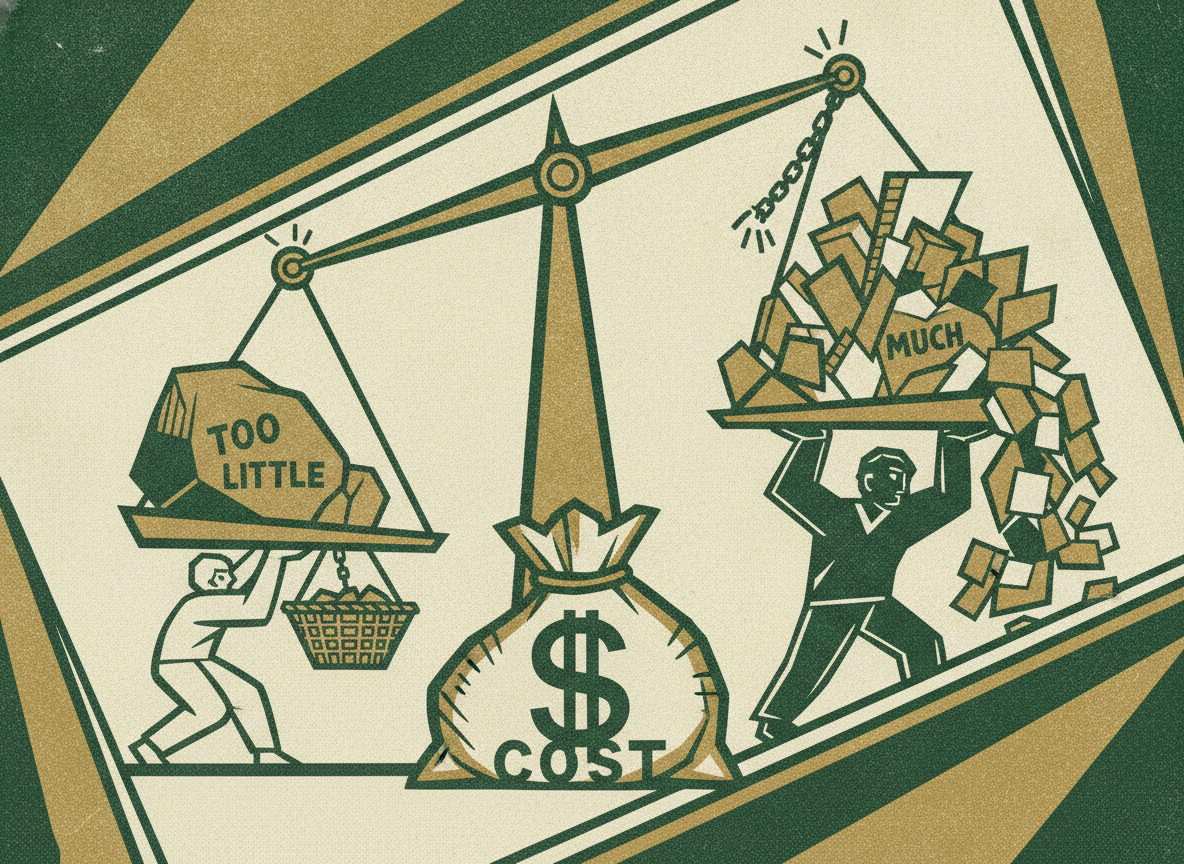
The Cost of Raising Too Little or Too Much
Both errors in sizing a round are expensive, which is why the milestone-based amount matters so much. Raising too little is the more dangerous mistake, because it can be fatal. If you run out of cash before reaching the milestone your next round requires, you are forced to raise from weakness, a bridge round on poor terms, a down round, or a fire-sale, each of which costs far more dilution and credibility than raising the right amount would have. Underfunding the milestone is how good companies end up in bad financing situations.
Raising too much is a gentler error but still real. Excess capital dilutes you more than necessary, and it can also breed undisciplined spending, since abundant cash reduces the pressure to be efficient that often makes early companies sharp. There is also a valuation risk: raising a large round at a high valuation sets a bar your next round must clear, and if the business does not grow into it, you face a down round anyway. The milestone-based approach avoids both errors by sizing the raise to its actual purpose plus a sensible buffer, no more and no less. This is the heart of a disciplined Fundraising Strategy: not maximizing the amount raised or minimizing dilution in isolation, but raising precisely what it takes to reach the next fundable milestone with room to spare, so the next round is raised from strength. Done right, the amount you raise becomes a deliberate, defensible decision rather than a guess, which is exactly what it should be.

Frequently Asked Questions
How Much Should a Startup Raise?
The amount that gets you to your next fundable milestone with a buffer, not a round number or twelve months of survival. Define the milestone your next round will require, estimate the burn to reach it, multiply by the time needed, and add roughly a 30 percent buffer. That milestone-based figure is your target raise, and it ties the capital directly to its purpose: reaching the proof that unlocks the next stage.
How Much Runway Should a Round Provide in 2026?
Enough to reach the next stage, which now means 18 to 24 months, since that is the current median time from seed to Series A. Raising for only twelve months, on the old assumption that the next round comes quickly, leaves you out of cash before hitting the milestone the next round requires. Seed companies burning $150K to $400K a month typically need $3M to $7M to fund that runway.
How Do You Calculate the Right Raise Amount?
Work backward from the milestone. Define your next fundable milestone concretely, estimate the monthly burn to reach it, multiply burn by the time needed, and add about a 30 percent buffer for slippage. The buffer is realism, not padding, since plans slip and fundraising itself consumes runway. The result is a defensible target raise and a clear story for investors about why you are asking for that specific amount.
What Happens If You Raise Too Little or Too Much?
Raising too little is the more dangerous error: running out before your milestone forces a weak bridge or down round, costing far more dilution than raising the right amount upfront. Raising too much over-dilutes you, can breed undisciplined spending, and sets a valuation bar your next round must clear. The milestone-based amount avoids both by funding the milestone with a sensible buffer, no more and no less.
References
