

Driver-Based Forecasting for Non-Finance Founders
- Driver-based forecasting is the most practical upgrade most founders can make to their Strategic Financial Planning: build the forecast from the operational levers that actually move the business, not from last year plus a percentage.
- The accuracy gain is real. Companies using driver-based planning report forecasting accuracy improvements often exceeding 25% over static methods.
- A driver is a measurable activity that produces financial results, leads times average deal size, or visitors times conversion times price. Forecast the drivers and the dollars follow.
- It reduces emotional forecasting, because revenue and cost become outputs of real activities rather than negotiated guesses.
- You do not need a finance degree to do it. Identifying the three or four levers that drive your business and modeling those is something any founder can learn.
Most founders forecast the same way: take last year's revenue, add a percentage that feels right, and call it a plan. The problem is that the percentage is a guess disconnected from how the business actually generates money, so the forecast is wrong from the start and tells you nothing about what to change. Driver-based forecasting fixes this by building the projection from the operational levers that drive results. It is more accurate, more useful, and entirely learnable, which makes it one of the highest-return improvements to a founder's Strategic Financial Planning. Here is how it works and how to build one without a finance background.
The Problem With Percentage-Based Budgets
The traditional budget is built backwards: it starts with last year's numbers and applies a blanket percentage increase, which disconnects the forecast from how the business actually works. A 20% growth assumption is a wish, not a plan, because it does not say what would have to happen, how many more customers, at what conversion, at what price, to produce that growth. When the number is just a percentage, you cannot manage to it, because it does not point at anything you can change.
This approach fails precisely when it matters most. As Corporate Finance Institute notes, traditional budgeting built on historical data and static assumptions often fails to capture the real drivers of performance, producing inaccurate forecasts and rigid budgets. In a changing market, a forecast anchored to last year's results with an arbitrary uplift is stale before the year begins. The deeper problem is that it provides no operational guidance: if you are tracking behind, the percentage budget cannot tell you which lever to pull. Driver-based forecasting solves this by making the forecast a function of the things you can actually influence, which is the foundation of Strategic Financial Planning that informs decisions rather than just setting a target.
What Driver-Based Forecasting Actually Means
Driver-based forecasting builds the financial projection from the operational drivers that produce the results, rather than from the results themselves. A driver is a measurable activity that flows into a financial outcome. Revenue for a sales-led business might be driven by number of leads times conversion rate times average deal size; for an e-commerce business, by visitors times conversion times average order value. You forecast the drivers, and the financial numbers fall out of them, as Farseer describes.
The power of this approach is that it connects the forecast to reality and to action. Because revenue and cost are linked to operational drivers, the forecast updates instantly when a driver shifts, and the model dynamically reflects what is actually happening. It also makes the forecast a planning tool: if you want to grow revenue, the model shows exactly which drivers must move and by how much, so growth becomes a set of operational targets rather than a hopeful percentage. This is the essence of modern Strategic Financial Planning, the forecast is a model of how the business works, not a guess about where it will end up. Once a founder sees their forecast as drivers rather than dollars, the whole exercise becomes more concrete and more useful.
Finding Your Business's Real Drivers
The heart of driver-based forecasting is identifying the few drivers that actually move your business, and this is more about clarity than complexity. Every business has a small number of levers that determine most of its financial results, and the work is to find them. For most companies, revenue comes down to some combination of volume, conversion, and price, while costs come down to a few categories that scale with activity. The goal is to identify the three or four drivers that, if you understood and could influence them, would let you predict and steer the business.
This identification is itself valuable, because it forces clarity about how the business actually makes money. A founder who can name their key drivers, and how they connect to revenue and cost, understands their business model at a level many never reach. The drivers are business-specific: a SaaS company's might be new customers, churn, and expansion; a services firm's might be billable hours, rate, and utilization; a manufacturer's might be units, price, and input cost. As Lumel emphasizes, focusing on the true operational drivers is what links the forecast to real business activities. Getting this right, naming the handful of levers that drive your specific business, is the most important step in building a driver-based forecast and a real exercise in Strategic Financial Planning.

Why It Is More Accurate and Less Emotional
Driver-based forecasting is more accurate than percentage budgeting because it is grounded in measurable activity rather than wishful assumption, and the improvement is substantial. Companies using driver-based planning report accuracy gains often exceeding 25% over static methods, per industry data, because the model adjusts instantly when a driver shifts rather than holding a stale annual assumption. When your forecast is built from how the business actually generates money, it tracks reality far more closely than a number pulled from last year plus a guess.
Just as important, it reduces emotional forecasting. Because revenue and cost are tied to operational drivers, profitability becomes a real-time output of measurable activities, not a negotiated guess, as the field describes. This changes the conversation: instead of arguing about whether growth should be 15% or 25%, the team discusses whether the conversion rate can realistically improve and by how much, which is a concrete, evidence-based question. The forecast stops being a target someone wants to hit and becomes a model of what the business can actually do. This anchoring of expectations in measurable activity is one of the most underrated benefits of driver-based Strategic Financial Planning, because it replaces the politics and optimism of percentage budgeting with a grounded, operational discussion.
Building a Driver-Based Forecast Without a Finance Degree
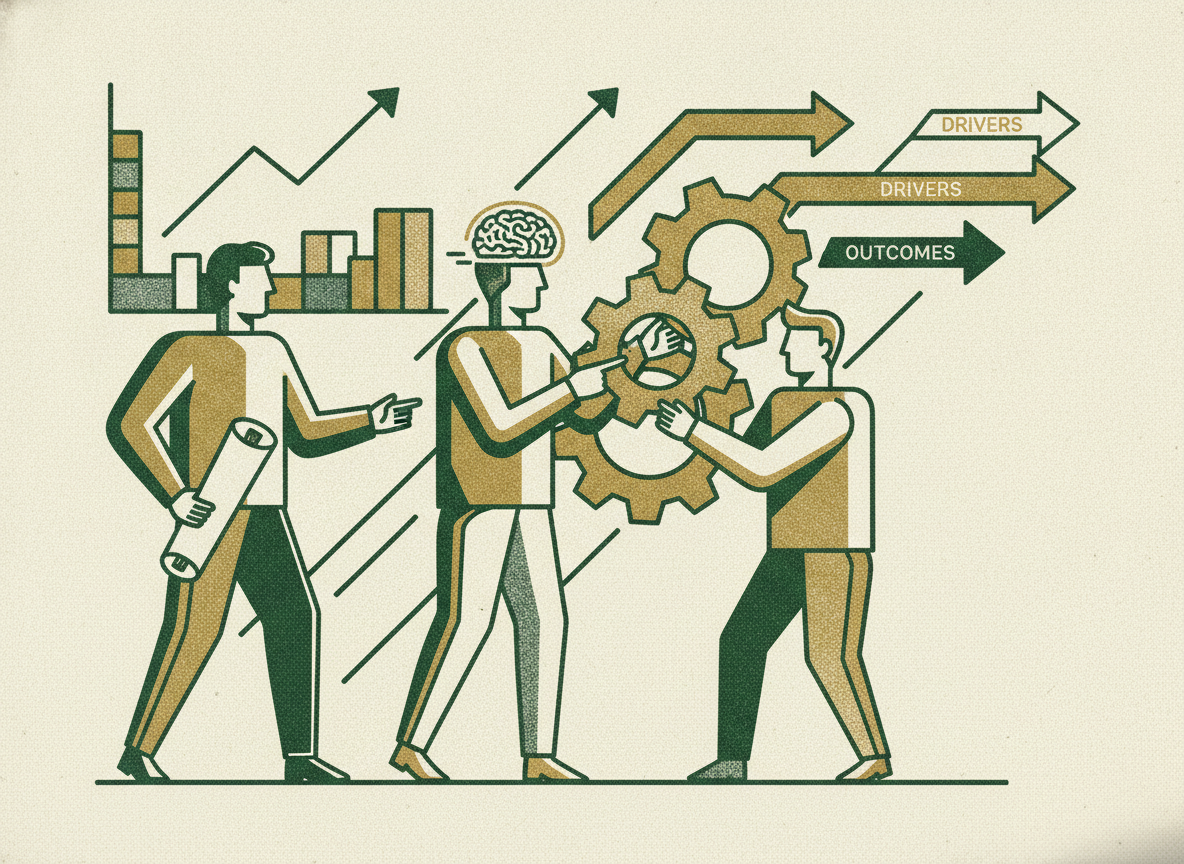
The encouraging truth is that driver-based forecasting does not require a finance background; it requires clear thinking about your own business, which founders are well-equipped to do. Start by writing down how your revenue is actually generated as a formula of drivers, leads times conversion times deal size, or whatever fits your model. Do the same for your major costs, identifying which scale with activity and which are fixed. You now have the skeleton of a driver-based model, expressed in terms you understand because they describe your own business.
From there, the model is built by projecting each driver and letting the math flow to the financial outcomes. You can build a basic version in a spreadsheet, and many planning tools make it easier, but the logic is the same regardless of the tool. The hard part was never the math; it was the clarity about what drives the business, and that is something a founder understands better than anyone. This is also exactly where a fractional CFO adds value, helping a founder identify their true drivers and structure the model, then handing them a forecast they actually understand because it is built from their own business logic. A founder who can think in drivers has the foundation for genuinely useful Strategic Financial Planning, no finance degree required, just a clear understanding of how their own company makes money, expressed as the levers they can pull.

Frequently Asked Questions
What Is Driver-Based Forecasting?
It is building a financial forecast from the operational drivers that produce results, rather than from last year's numbers plus a percentage. A driver is a measurable activity that flows into a financial outcome, like leads times conversion times deal size for revenue. You forecast the drivers, and the financial numbers fall out of them, so the forecast reflects how the business actually generates money and updates instantly when a driver shifts.
Why Is Driver-Based Forecasting More Accurate?
Because it is grounded in measurable activity rather than wishful assumption. The model adjusts instantly when a driver changes, instead of holding a stale annual percentage, and companies using it report accuracy gains often exceeding 25 percent over static methods. It also reduces emotional forecasting, since revenue and cost become outputs of real activities rather than a negotiated guess about growth.
How Do You Identify Your Business's Drivers?
Find the three or four levers that determine most of your financial results. For most companies, revenue reduces to some combination of volume, conversion, and price, and costs to a few categories that scale with activity. The drivers are business-specific: new customers, churn, and expansion for SaaS; billable hours, rate, and utilization for services. Naming them forces clarity about how your business actually makes money.
Do You Need a Finance Background to Build a Driver-Based Forecast?
No. It requires clear thinking about your own business, which founders are well-equipped to do. Write down how your revenue is generated as a formula of drivers and identify which costs scale with activity. The hard part is the clarity about what drives the business, not the math, and that is something a founder understands well. A fractional CFO can help structure the model from your own business logic.
References
