
The Cost of Capital, Explained for Founders
- Cost of capital is the foundation of Capital Structure Optimization: every dollar of funding has a price, and knowing it tells you which investments are worth making.
- Equity is more expensive than debt, even though it requires no interest payment, because you give up shares and future profits, and debt enjoys a tax shield on interest.
- Your weighted average cost of capital (WACC) blends the cost of your debt and equity by their proportions, giving you a single number for what your funding costs.
- WACC is your hurdle rate: an investment that returns more than your WACC creates value, while one that returns less destroys it.
- Startups have a high cost of capital because investors demand returns for the risk, and lowering it, with cheaper financing where appropriate, is a real lever on value.
Founders intuitively know that equity is precious and debt must be repaid, but few can put a number on what their capital actually costs, which means they make financing and investment decisions without the one figure that should anchor them. The cost of capital is that figure. It tells you the minimum return any investment must clear to be worth making, and it reveals which financing choices are cheap and which are expensive. Understanding it is essential to Capital Structure Optimization, because you cannot optimize a structure whose cost you cannot measure. Here is the cost of capital explained plainly, and why it should guide your decisions.
Every Dollar of Funding Has a Cost
The starting insight is that every source of funding has a cost, including the ones that do not feel like they do. Debt has an obvious cost, the interest you pay. Equity feels free because there is no payment, but it is actually the most expensive capital, because you give up a share of the company and all its future profits to the investors who provided it. As re:cap explains, debt carries explicit, predictable costs while equity carries implicit costs, the ownership and future returns you surrender, and both are real.
Recognizing that all capital has a cost changes how a founder thinks about financing. The question is never just "can I get this money" but "what does this money cost me, and is what I will do with it worth that cost." A dollar of equity that funds a low-return project is expensive money badly spent; a dollar of debt at a reasonable rate funding a high-return investment is cheap money well used. Capital Structure Optimization is fundamentally about understanding and managing these costs, choosing the right mix of funding sources and deploying the capital where its return exceeds its cost. It all begins with the recognition that every dollar of funding, equity included, has a price that must be measured and respected.
Why Equity Is More Expensive Than Debt
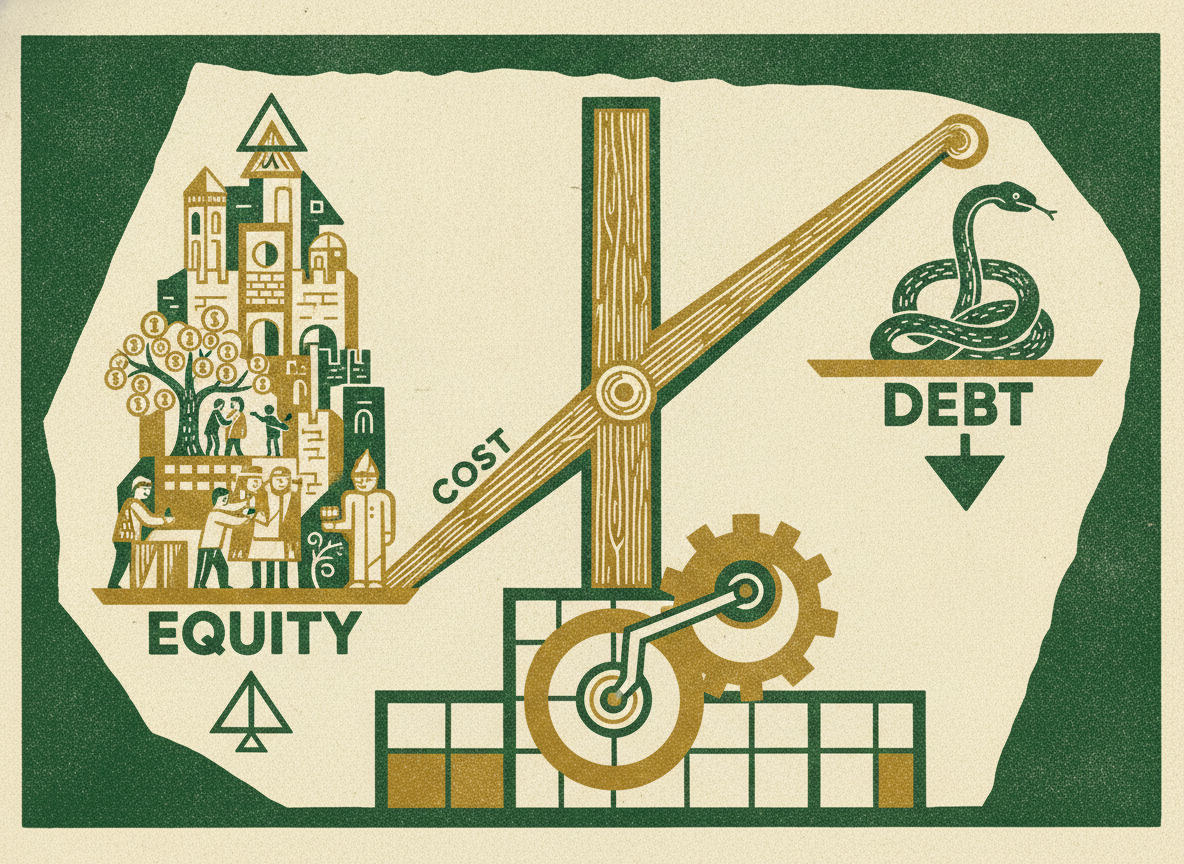
A counterintuitive but crucial point is that equity, despite requiring no interest payment, is more expensive than debt, and understanding why is central to Capital Structure Optimization. The cost of equity is the return investors expect for the risk of backing your company, and because equity is riskier for the investor than debt, they demand a higher return, which they receive through their ownership stake and the future profits and upside it represents. You pay for equity not in cash interest but in a permanent share of everything the company becomes, which is typically far more expensive than the interest on debt.
Debt is cheaper for two reasons. First, lenders take less risk than equity investors, because debt is repaid before equity in any liquidation and carries a contractual claim, so they accept a lower return. Second, interest on debt is tax-deductible, creating a tax shield that reduces the effective cost, as Financial Modeling Prep notes. The combination of lower risk and the tax shield makes debt meaningfully cheaper than equity for the same amount of capital. This is the foundational insight of Capital Structure Optimization and the reason instruments like venture debt and revenue-based financing exist: where a company can responsibly use debt instead of equity, it accesses capital at a lower cost and preserves the ownership that equity would consume. Equity's apparent costlessness, no payments due, masks its true expense, the company itself.
WACC: Your Blended Cost of Capital
Because most companies use a mix of debt and equity, the practical measure of cost of capital is the weighted average cost of capital, or WACC, which blends the two into a single number. WACC combines the cost of your debt and the cost of your equity, weighted by their proportions in your capital structure, to give the average rate of return the company must generate to satisfy all its funders, as Tide describes. If a company is funded heavily by expensive equity, its WACC is high; if it uses more low-cost debt, its WACC is lower.
WACC is valuable because it reduces the complexity of multiple funding sources to one figure that represents what the company's capital costs overall. This single number is what you compare investment returns against, and it is what changes as you alter your capital structure, which is precisely why Capital Structure Optimization aims to minimize it. A company's WACC reflects the choices it has made about how to fund itself, and lowering it, by using cheaper capital where appropriate, makes every future investment easier to justify and raises the company's value. Startups typically have a high WACC because they rely heavily on equity and investors demand large returns for the risk, which is one reason capital efficiency matters so much for early companies. Understanding your WACC, even approximately, gives you the anchor number for the most important financial decisions you make.
The Hurdle Rate: Using WACC to Make Decisions
The most practical use of cost of capital is as a hurdle rate, the minimum return any investment must clear to be worth making. Your WACC defines this threshold: an investment, project, or acquisition that is expected to return more than your cost of capital creates value, while one expected to return less destroys it, as re:cap puts it. This single test, does the expected return exceed our cost of capital, should anchor major capital allocation decisions.
This reframes how a founder evaluates opportunities. Without a cost-of-capital hurdle, investment decisions are made on gut feel about whether something seems worthwhile. With it, they are made against a clear standard: this expansion is projected to return 30% and our cost of capital is 18%, so it creates value; that project returns 12% against the same 18% cost, so it destroys value and should be reconsidered. The hurdle rate turns the abstract idea of a good investment into a concrete comparison. It also explains why a company with a high cost of capital must be more selective, because more of its potential investments fail to clear the higher bar. Using WACC as a hurdle rate is one of the most powerful applications of Capital Structure Optimization, because it connects the cost of how you fund the company directly to the discipline of how you deploy that funding. Every major investment should be tested against the cost of the capital that would fund it.

Lowering Your Cost of Capital
Because cost of capital determines which investments create value and influences company valuation, lowering it is a genuine strategic lever, and that is the active goal of Capital Structure Optimization. A lower WACC means cheaper capital, a lower hurdle rate that more investments can clear, and a higher company valuation, since a lower cost of capital increases the present value of the company's future cash flows. For founders and investors alike, a lower cost of capital is unambiguously better.
The levers to lower it follow from understanding what drives it. Using appropriate debt in place of some equity reduces WACC, because debt is cheaper and carries a tax shield, though this must be balanced against the risk that too much debt brings. Reducing the risk the company presents to funders, by demonstrating stable cash flows, strong unit economics, and reliable execution, lowers the return both lenders and equity investors demand, which lowers the cost of both. And as a company matures and de-risks, its cost of capital naturally falls, which is part of why later-stage capital is cheaper than early-stage capital. The work of Capital Structure Optimization is to manage these levers deliberately: choosing the right mix of debt and equity, using cheaper financing instruments where the company can support them, and building the kind of stable, well-run business that funders perceive as lower risk. A founder who actively manages their cost of capital, rather than treating it as a given, finds that more investments become worthwhile and the company itself becomes more valuable, which is the ultimate payoff of understanding what capital truly costs.

Frequently Asked Questions
What Is the Cost of Capital?
It is the cost of the funding a company uses, blending the cost of debt and the cost of equity. Debt costs the interest you pay, while equity costs the ownership and future profits you give up to investors. Every dollar of funding has a price, including equity, which feels free because it requires no payment but is actually the most expensive capital because you surrender a permanent share of the company.
Why Is Equity More Expensive Than Debt?
Because equity investors take more risk than lenders, they demand a higher return, which they receive through their ownership stake and the future upside it represents, far more than the interest on debt. Debt is also cheaper because interest is tax-deductible, creating a tax shield, and because lenders are repaid before equity in a liquidation. Equity's lack of payments masks its true expense: a permanent claim on the company.
What Is WACC?
The weighted average cost of capital blends the cost of your debt and equity by their proportions in your capital structure, giving a single number for what your funding costs overall. A company funded heavily by expensive equity has a high WACC; one using more low-cost debt has a lower WACC. It is the figure you compare investment returns against, and minimizing it is the goal of capital structure optimization.
How Do You Use Cost of Capital to Make Decisions?
As a hurdle rate. Your WACC is the minimum return any investment must clear to create value: an investment expected to return more than your cost of capital creates value, while one returning less destroys it. This turns gut-feel decisions into a clear test, an expansion returning 30 percent against an 18 percent cost of capital creates value, while a 12 percent project against the same cost destroys it.
References
